Duke-NUS Medical School, National University of Singapore, Singapore, Singapore.
Health Services Research Centre, Singapore Health Services, Singapore, Singapore.
BMC Med Res Methodol. 2020 Jul 2;20(1):177. doi: 10.1186/s12874-020-01059-y.
Since the beginning of the COVID-19 outbreak in December 2019, a substantial body of COVID-19 medical literature has been generated. As of June 2020, gaps and longitudinal trends in the COVID-19 medical literature remain unidentified, despite potential benefits for research prioritisation and policy setting in both the COVID-19 pandemic and future large-scale public health crises.
In this paper, we searched PubMed and Embase for medical literature on COVID-19 between 1 January and 24 March 2020. We characterised the growth of the early COVID-19 medical literature using evidence maps and bibliometric analyses to elicit cross-sectional and longitudinal trends and systematically identify gaps.
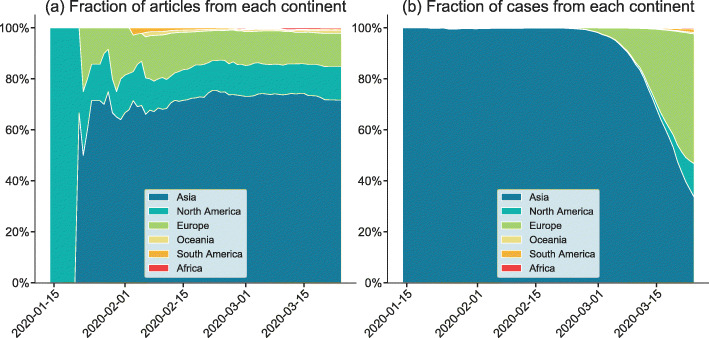
The early COVID-19 medical literature originated primarily from Asia and focused mainly on clinical features and diagnosis of the disease. Many areas of potential research remain underexplored, such as mental health, the use of novel technologies and artificial intelligence, pathophysiology of COVID-19 within different body systems, and indirect effects of COVID-19 on the care of non-COVID-19 patients. Few articles involved research collaboration at the international level (24.7%). The median submission-to-publication duration was 8 days (interquartile range: 4-16).
Although in its early phase, COVID-19 research has generated a large volume of publications. However, there are still knowledge gaps yet to be filled and areas for improvement for the global research community. Our analysis of early COVID-19 research may be valuable in informing research prioritisation and policy planning both in the current COVID-19 pandemic and similar global health crises.
自 2019 年 12 月 COVID-19 疫情爆发以来,已经产生了大量 COVID-19 医学文献。截至 2020 年 6 月,尽管 COVID-19 大流行和未来大规模公共卫生危机中的研究重点和政策制定都可能受益,但 COVID-19 医学文献中的空白和纵向趋势仍未得到确定。
在本文中,我们在 2020 年 1 月 1 日至 3 月 24 日期间在 PubMed 和 Embase 上搜索了 COVID-19 医学文献。我们使用证据图谱和文献计量学分析来描述早期 COVID-19 医学文献的增长,以引出横断面和纵向趋势,并系统地确定空白。
早期 COVID-19 医学文献主要来自亚洲,主要集中在疾病的临床特征和诊断上。许多潜在的研究领域仍未得到充分探索,例如心理健康、新技术和人工智能的使用、COVID-19 在不同身体系统中的病理生理学以及 COVID-19 对非 COVID-19 患者护理的间接影响。很少有文章涉及国际层面的研究合作(24.7%)。提交到出版的中位时间为 8 天(四分位距:4-16)。
尽管处于早期阶段,但 COVID-19 研究已经产生了大量出版物。然而,仍有知识空白需要填补,全球研究界也有改进的空间。我们对早期 COVID-19 研究的分析可能有助于为当前 COVID-19 大流行和类似的全球卫生危机中的研究重点和政策规划提供信息。