Paulus Judith K, Kourelis Jiorgos, Ramasubramanian Selva, Homma Felix, Godson Alice, Hörger Anja C, Hong Tram Ngoc, Krahn Daniel, Ossorio Carballo Laura, Wang Shuaishuai, Win Joe, Smoker Matthew, Kamoun Sophien, Dong Suomeng, van der Hoorn Renier A L
The Plant Chemetics Laboratory, Department of Plant Sciences, University of Oxford, Oxford OX1 2JD, United Kingdom.
The Plant Chemetics Laboratory, Max Planck Institute for Plant Breeding Research, 50829 Cologne, Germany.
Proc Natl Acad Sci U S A. 2020 Jul 21;117(29):17409-17417. doi: 10.1073/pnas.1921101117. Epub 2020 Jul 2.
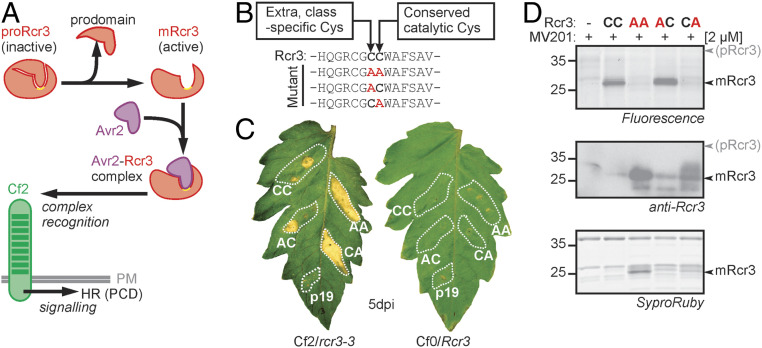
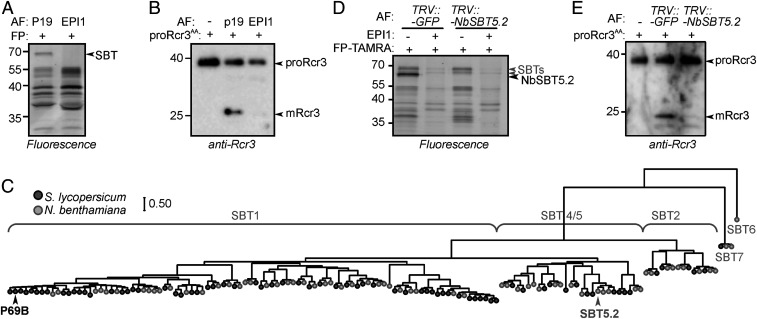
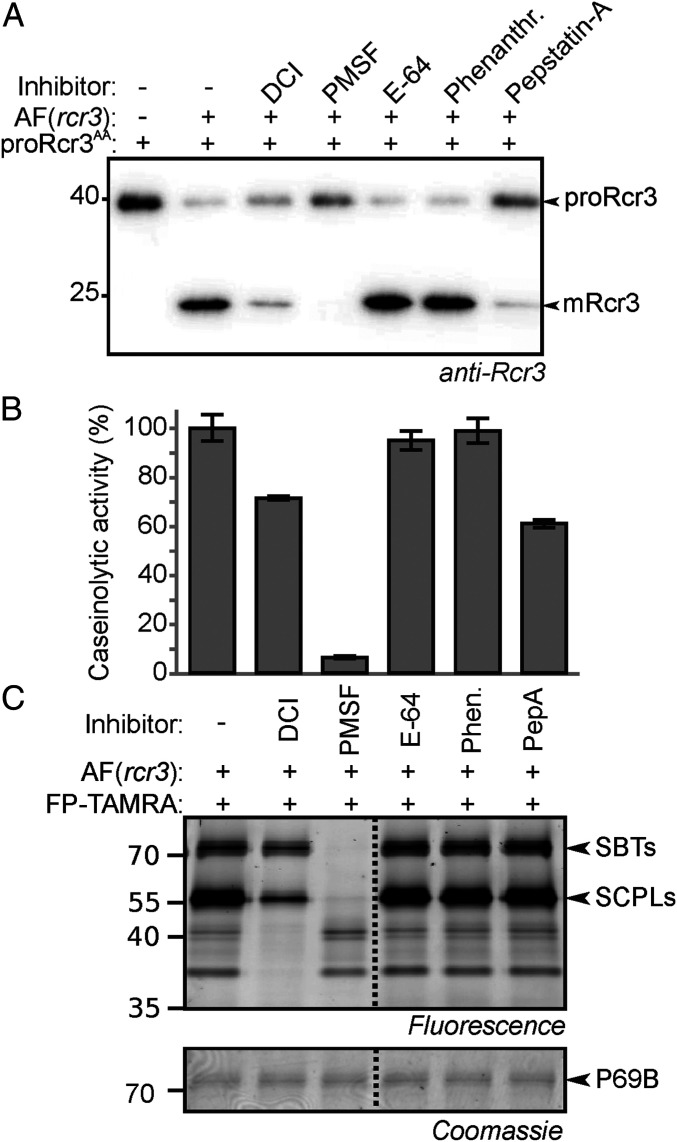
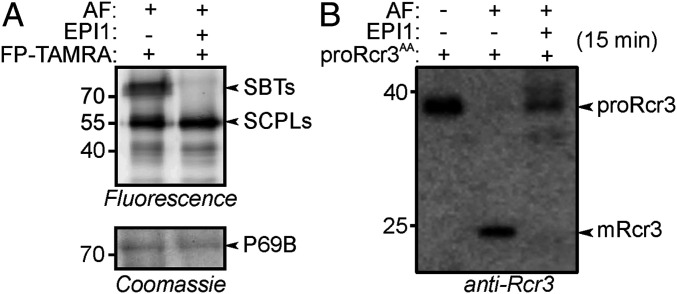
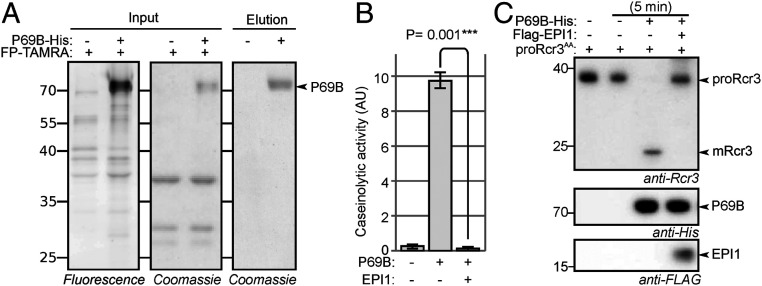
Proteolytic cascades regulate immunity and development in animals, but these cascades in plants have not yet been reported. Here we report that the extracellular immune protease Rcr3 of tomato is activated by P69B and other subtilases (SBTs), revealing a proteolytic cascade regulating extracellular immunity in solanaceous plants. Rcr3 is a secreted papain-like Cys protease (PLCP) of tomato that acts both in basal resistance against late blight disease () and in gene-for-gene resistance against the fungal pathogen syn. Despite the prevalent model that Rcr3-like proteases can activate themselves at low pH, we found that catalytically inactive proRcr3 mutant precursors are still processed into mature mRcr3 isoforms. ProRcr3 is processed by secreted P69B and other Asp-selective SBTs in solanaceous plants, providing robust immunity through SBT redundancy. The apoplastic effector EPI1 of can block Rcr3 activation by inhibiting SBTs, suggesting that this effector promotes virulence indirectly by preventing the activation of Rcr3(-like) immune proteases. Rcr3 activation in requires a SBT from a different subfamily, indicating that extracellular proteolytic cascades have evolved convergently in solanaceous plants or are very ancient in the plant kingdom. The frequent incidence of Asp residues in the cleavage region of Rcr3-like proteases in solanaceous plants indicates that activation of immune proteases by SBTs is a general mechanism, illuminating a proteolytic cascade that provides robust apoplastic immunity.
蛋白水解级联反应调控动物的免疫和发育,但植物中的这些级联反应尚未见报道。在此,我们报告番茄的细胞外免疫蛋白酶Rcr3被P69B和其他枯草杆菌蛋白酶(SBTs)激活,揭示了一种调控茄科植物细胞外免疫的蛋白水解级联反应。Rcr3是番茄分泌的一种木瓜蛋白酶样半胱氨酸蛋白酶(PLCP),在对晚疫病的基础抗性以及对真菌病原体丁香假单胞菌的基因对基因抗性中均发挥作用。尽管普遍认为Rcr3样蛋白酶可在低pH下自我激活,但我们发现催化无活性的proRcr3突变体前体仍能加工成成熟的mRcr3异构体。在茄科植物中,proRcr3由分泌的P69B和其他天冬氨酸选择性SBTs加工,通过SBT冗余提供强大的免疫力。丁香假单胞菌的质外体效应子EPI1可通过抑制SBTs来阻断Rcr3的激活,这表明该效应子通过阻止Rcr3(样)免疫蛋白酶的激活间接促进毒力。番茄中Rcr3的激活需要来自不同亚家族的SBT,这表明细胞外蛋白水解级联反应在茄科植物中是趋同进化的,或者在植物界中非常古老。茄科植物中Rcr3样蛋白酶切割区域中天冬氨酸残基的频繁出现表明,SBTs激活免疫蛋白酶是一种普遍机制,阐明了一种提供强大质外体免疫的蛋白水解级联反应。