Chandan Saurabh, Mohan Babu P, Khan Shahab R, Bhogal Neil, Canakis Andrew, Bilal Mohammad, Dhaliwal Amaninder S, Aziz Muhammad, Mashiana Harmeet S, Singh Shailender, Lee-Smith Wade, Ponnada Suresh, Bhat Ishfaq, Pleskow Douglas
Gastroenterology and Hepatology, University of Nebraska Medical Center, Omaha, Nebraska, United States.
Internal Medicine, University of Arizona, Banner University Medical Center, Tucson, Arizona, United States.
Endosc Int Open. 2020 Jul;8(7):E944-E952. doi: 10.1055/a-1164-6398. Epub 2020 Jun 16.
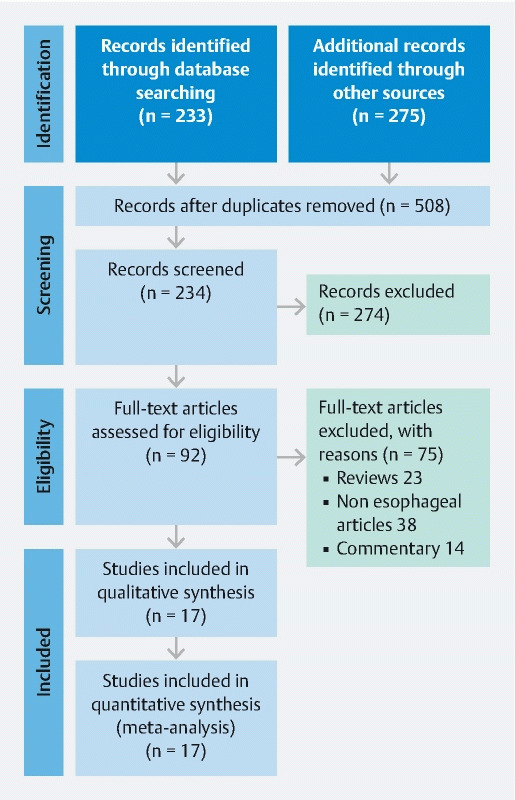
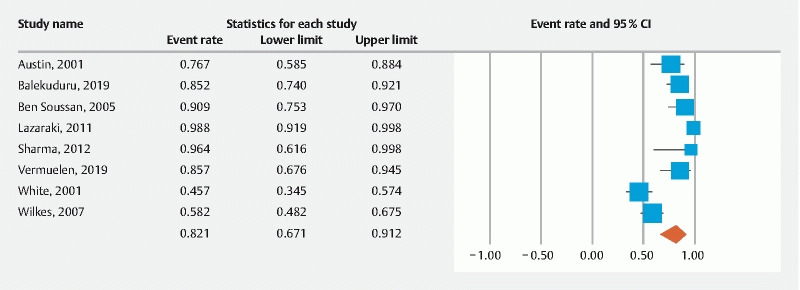
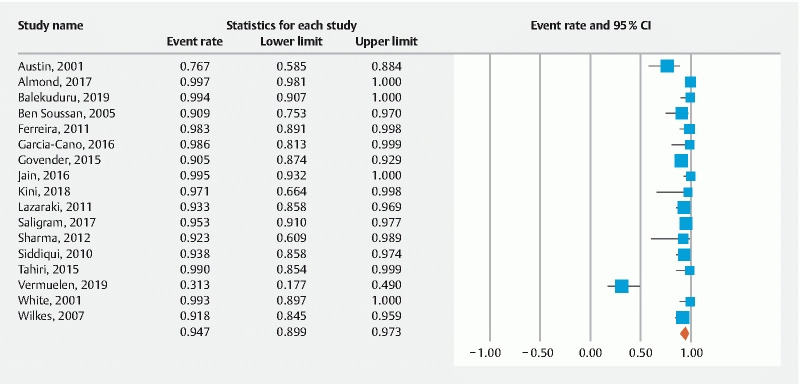
Despite advances in curative treatments for esophageal cancer, many patients often present with advanced disease. Dysphagia resulting in significant weight loss and malnutrition leads to poor quality of life. Palliative esophageal stenting with self-expanding metal stents (SEMS) helps alleviate symptoms and prolongs survival. However, access to fluoroscopy may be limited at certain centers causing delay in patient care. We searched multiple databases from inception to November 2019 to identify studies evaluating the efficacy and safety of endoscopic palliative esophageal stenting and selected only those studies where fluoroscopic guidance was not used. Our primary aim was to calculate the overall technical as well as clinical success. Using meta-regression analysis, we also evaluated the effect of tumor location and obstruction length on overall technical and clinical success. A total of 1778 patients from 17 studies were analyzed. A total of 2036 stents were placed without the aid of fluoroscopy. The pooled rate of technical success was 94.7 % (CI 89.9-97.3, PI 55-99; I = 85) and clinical success was 82.1 % (CI 67.1-91.2, PI 24-99; I = 87). Based on meta-regression analysis both the length of obstruction and tumor location did not have any statistically significant effect on technical and clinical success. The pooled rate of adverse events was 4.1 % (CI 2.4-7.2; I = 72) for stent migration, 8.1 % (CI 4.1-15.4; I = 89) for tumor overgrowth and 1.2 % (CI 0.7-2; I = 0) for perforation. The most frequent clinical adverse event was retro-sternal chest pain. Palliative esophageal stenting without fluoroscopy using SEMS is both safe and effective in patients with advanced esophageal cancer.
尽管食管癌的根治性治疗取得了进展,但许多患者就诊时往往已处于疾病晚期。吞咽困难导致显著体重减轻和营养不良,进而导致生活质量低下。使用自膨式金属支架(SEMS)进行姑息性食管支架置入有助于缓解症状并延长生存期。然而,某些中心的荧光镜检查设备可能有限,导致患者治疗延迟。我们检索了多个数据库,涵盖从创建到2019年11月的内容,以确定评估内镜下姑息性食管支架置入疗效和安全性的研究,并仅选择那些未使用荧光镜引导的研究。我们的主要目的是计算总体技术成功率以及临床成功率。通过meta回归分析,我们还评估了肿瘤位置和梗阻长度对总体技术和临床成功率的影响。共分析了来自17项研究的1778例患者。在无荧光镜辅助的情况下共置入了2036个支架。技术成功率的合并率为94.7%(可信区间89.9 - 97.3,预测区间55 - 99;I² = 85),临床成功率为82.1%(可信区间67.1 - 91.2,预测区间24 - 99;I² = 87)。基于meta回归分析,梗阻长度和肿瘤位置对技术和临床成功率均无统计学显著影响。支架移位的不良事件合并率为4.1%(可信区间2.4 - 7.2;I² = 72),肿瘤过度生长的为8.1%(可信区间4.1 - 15.4;I² = 89),穿孔的为1.2%(可信区间0.7 - 2;I² = 0)。最常见的临床不良事件是胸骨后胸痛。对于晚期食管癌患者,不使用荧光镜进行姑息性食管支架置入使用SEMS是安全有效的。