Rehabilitation Center, Shinshu University Hospital, Asahi 3-1-1, Matsumoto, Nagano, 390-8621, Japan.
Department of Orthopaedic Surgery, Shinshu University School of Medicine, Asahi 3-1-1, Matsumoto, Nagano, 390-8621, Japan.
BMC Musculoskelet Disord. 2020 Jul 3;21(1):431. doi: 10.1186/s12891-020-03469-x.
Locomotive syndrome (LoS) is defined as the loss of mobility due to age-related impairment of motor organs. The purpose of this study was to evaluate the prevalence and severity of LoS, muscular strength and balancing ability, and prevalence of sarcopenia in relation to the presence of LoS according to sex and age groups ranging between 50 and 89 years.
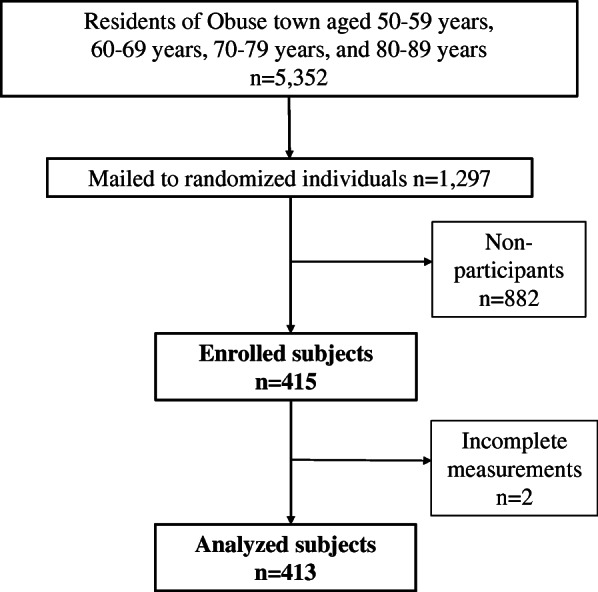
Male and female participants between the ages of 50-89 were randomly selected in the resident registry of a cooperating town. Calls for participation continued until approximately 50 consenting participants were successfully recruited for each age group and sex. A total of 413 participants (203 male and 210 female) were enrolled for undergoing a LoS risk test and measuring their physical function. Physical function was compared to participants with or without LoS.
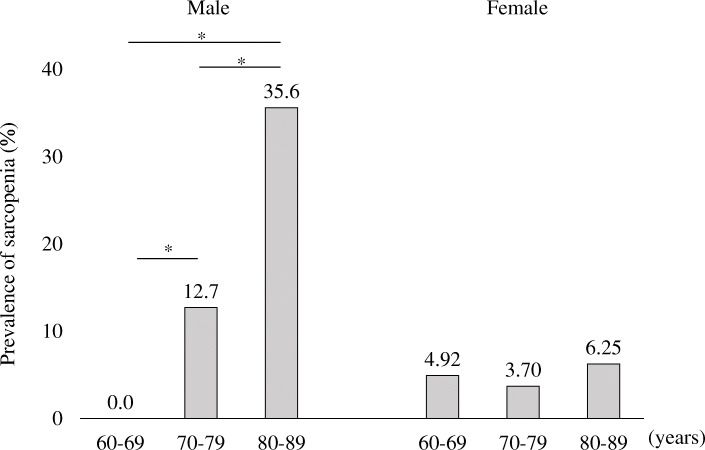
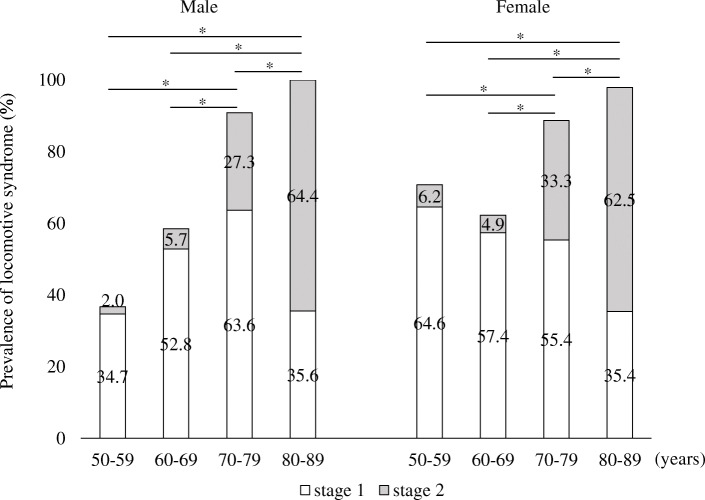
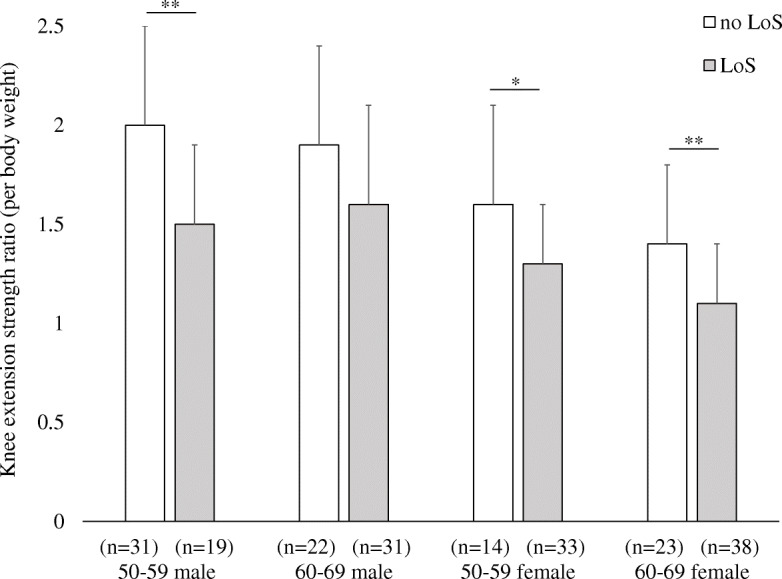
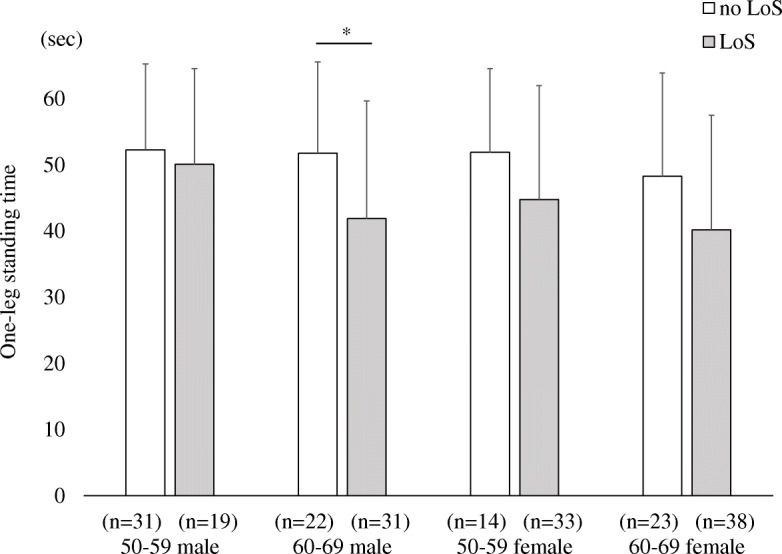
A total of 312 patients (75.5%) were diagnosed as LoS, of which 144 (46.2%) were male and 168 (53.8%) were female. The severity of LoS for the 312 patients were 210 (67.3%) for stage 1 and 102 (32.7%) for stage 2. The prevalence of LoS in males were 37, 59, 91, and 100% in the 50s, 60s, 70s, and 80s age strata, respectively. The prevalence of LoS in females were 71, 62, 89, and 98% in the 50s, 60s, 70s, and 80s age strata, respectively. The prevalence of sarcopenia was significantly higher as the age strata in males grew higher. Knee extension strength was significantly lower for participants in their 50s and females in addition to females in their 60s with LoS. The 31 patients diagnosed as sarcopenia included 29 (93.5%) with LoS, 11 (35.4%) classified as LoS stage 1, and 18 (58.1%) classified as stage 2.
The prevalence of LoS was high in participants over 70 years of age. In males, the prevalence of sarcopenia was higher as the age strata grew higher. Patients with LoS exhibited lower knee extension strength. We believe that some measures to prevent or improve LoS may require exercise to increase the muscle strength of the lower limbs.
运动综合征(LoS)是指由于与年龄相关的运动器官损伤而导致的活动能力丧失。本研究的目的是评估 50 至 89 岁人群中与 LoS 相关的 LoS 的患病率和严重程度、肌肉力量和平衡能力以及肌少症的患病率,并按性别和年龄组进行分析。
在合作城镇的居民登记处随机选择 50-89 岁的男性和女性参与者。招募参与者的呼吁一直持续到每个年龄组和性别成功招募到大约 50 名同意参与者为止。共有 413 名参与者(203 名男性和 210 名女性)接受了 LoS 风险测试和身体功能测量。将身体功能与患有或不患有 LoS 的参与者进行比较。
共有 312 名患者(75.5%)被诊断为 LoS,其中 144 名(46.2%)为男性,168 名(53.8%)为女性。312 名患者的 LoS 严重程度为 210 名(67.3%)为 1 期,102 名(32.7%)为 2 期。男性在 50 多岁、60 多岁、70 多岁和 80 多岁的年龄段中,LoS 的患病率分别为 37%、59%、91%和 100%。女性在 50 多岁、60 多岁、70 多岁和 80 多岁的年龄段中,LoS 的患病率分别为 71%、62%、89%和 98%。随着男性年龄组的增长,肌少症的患病率显著升高。除了 60 多岁的女性外,50 多岁的参与者和女性的膝关节伸展力量显著降低。被诊断为肌少症的 31 名患者中,29 名(93.5%)患有 LoS,11 名(35.4%)为 LoS 1 期,18 名(58.1%)为 LoS 2 期。
70 岁以上参与者的 LoS 患病率较高。在男性中,随着年龄组的增加,肌少症的患病率也随之升高。患有 LoS 的患者膝关节伸展力量较低。我们认为,可能需要一些预防或改善 LoS 的措施,以增加下肢肌肉力量。