State Key Laboratory for Managing Biotic and Chemical Threats to the Quality and Safety of Agro-products, Ningbo University, Ningbo, 315211, China.
School of Marine Sciences, Ningbo University, Ningbo, 315211, China.
Microbiome. 2020 Jul 3;8(1):106. doi: 10.1186/s40168-020-00879-w.
Microbiome assembly in early life may have a long-term impact on host health. Larval nursery is a crucial period that determines the success in culture of Litopenaeus vannamei, the most productive shrimp species in world aquaculture industry. However, the succession patterns and assembly mechanisms of larval shrimp bacterial community still lack characterization at a fine temporal scale. Here, using a high-frequency sampling strategy and 16S rRNA gene amplicon sequencing, we investigated dynamics of larval shrimp bacterial community and its relationship with bacterioplankton in the rearing water across the whole developmental cycle in a realistic aquaculture practice.
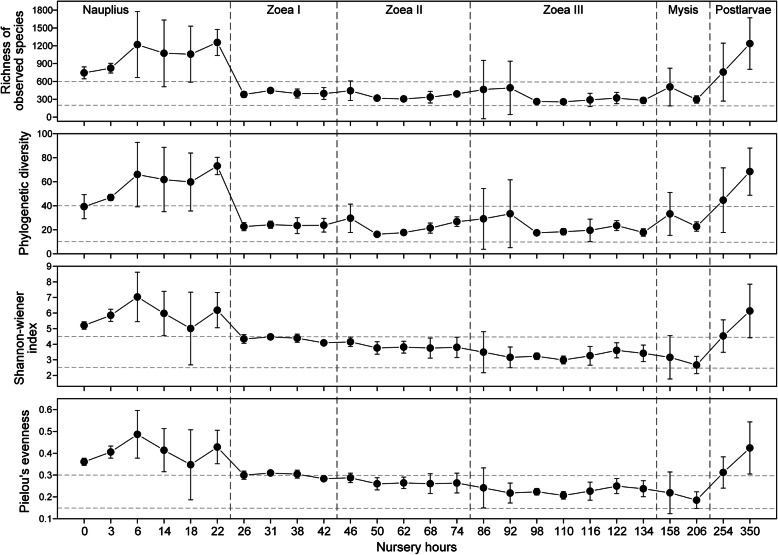
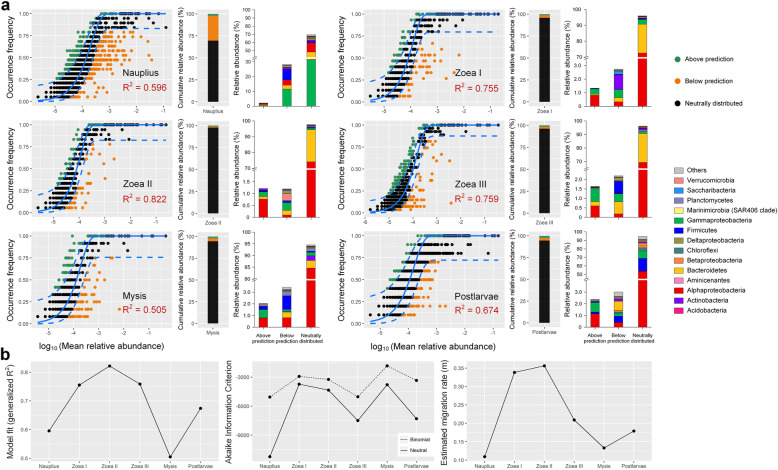
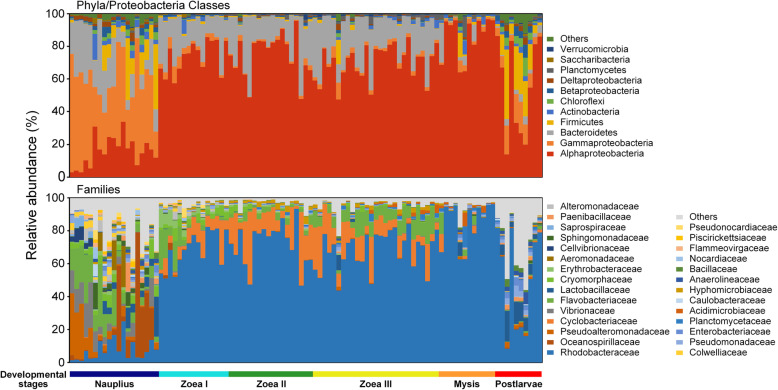
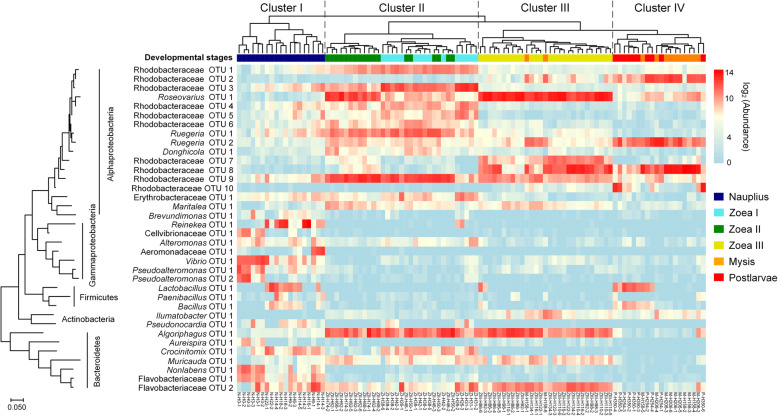
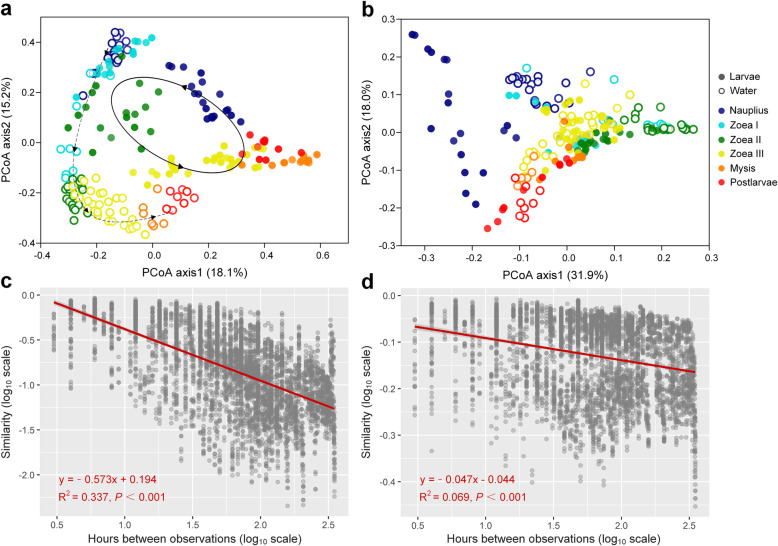
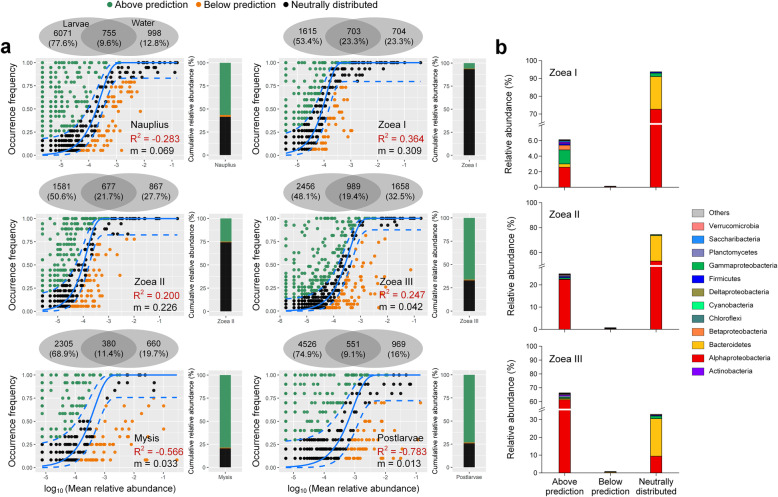
Alpha-diversity of larval shrimp bacteria showed a U-shaped pattern across the developmental cycle with the stages zoea and mysis as the valley. Correspondingly, the compositions of dominant bacterial taxa at the stages nauplius and early postlarvae were more complex than other stages. Remarkably, Rhodobacteraceae maintained the overwhelming dominance after the mouth opening of larvae (zoea I~early postlarvae). The taxonomic and phylogenetic compositions of larval bacterial community both showed stage-dependent patterns with higher rate of taxonomic turnover, suggesting that taxonomic turnover was mainly driven by temporal switching among closely related taxa (such as Rhodobacteraceae taxa). The assembly of larval bacteria was overall governed by neutral processes (dispersal among individuals and ecological drift) at all the stages, but bacterioplankton also had certain contribution during three sub-stages of zoea, when larval and water bacterial communities were most associated. Furthermore, the positive host selection for Rhodobacteraceae taxa from the rearing water during the zoea stage and its persistent dominance and large predicted contribution to metabolic potentials of organic matters at post-mouth opening stages suggest a crucial role of this family in larval microbiome and thus a potential source of probiotic candidates for shrimp larval nursery.
Our results reveal pronounced succession patterns and dynamic assembly processes of larval shrimp bacterial communities during the developmental cycle, highlighting the importance of the mouth opening stage from the perspective of microbial ecology. We also suggest the possibility and potential timing in microbial management of the rearing water for achieving the beneficial larval microbiota in the nursery practice. Video Abstract.
生命早期的微生物组组装可能对宿主健康产生长期影响。幼虫保育期是决定凡纳滨对虾养殖成功的关键时期,凡纳滨对虾是世界水产养殖业中最具生产力的虾类。然而,幼虫虾细菌群落的演替模式和组装机制在精细的时间尺度上仍缺乏特征描述。在这里,我们使用高频采样策略和 16S rRNA 基因扩增子测序,在现实水产养殖实践中,调查了整个发育周期内养殖水中幼虫虾细菌群落的动态及其与浮游细菌的关系。
幼虫虾细菌的 α 多样性在整个发育周期内呈 U 型模式,幼体和糠虾阶段为低谷。相应地,无节幼体和早期幼体阶段的优势细菌类群组成比其他阶段更复杂。值得注意的是,红杆菌科在幼虫开口后(幼体 I早期幼体)保持绝对优势。幼虫细菌群落的分类和系统发育组成均表现出阶段依赖性模式,分类周转率较高,表明分类周转率主要由密切相关类群(如红杆菌科类群)之间的时间转换驱动。幼虫细菌的组装总体上由个体间的扩散和生态漂移等中性过程控制,但在幼体的三个亚阶段(即幼体 13 期),当幼虫和水细菌群落最相关时,浮游细菌也有一定的贡献。此外,在幼体阶段,宿主对养殖水中红杆菌科类群的阳性选择,以及其在开口后阶段的持续优势和对有机物质代谢潜力的大量预测贡献,表明该科在幼虫微生物组中起着至关重要的作用,因此可能是虾类幼虫保育中益生菌候选物的潜在来源。
我们的研究结果揭示了幼虫虾细菌群落在发育周期中的明显演替模式和动态组装过程,从微生物生态学的角度强调了开口阶段的重要性。我们还提出了在养殖水的微生物管理方面的可能性和潜在时机,以实现保育实践中有益的幼虫微生物组。