Microarray Research Team, National Center for Genetic Engineering and Biotechnology, 113 Thailand Science Park, Phahonyothin Road, Khlong Luang, Pathum Thani, 12120, Thailand.
Shrimp Genetic Improvement Center (SGIC), National Center for Genetic Engineering and Biotechnology, Surat Thani, 84110, Thailand.
Sci Rep. 2020 Mar 17;10(1):4896. doi: 10.1038/s41598-020-61559-1.
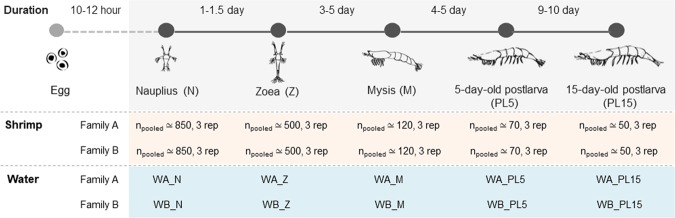
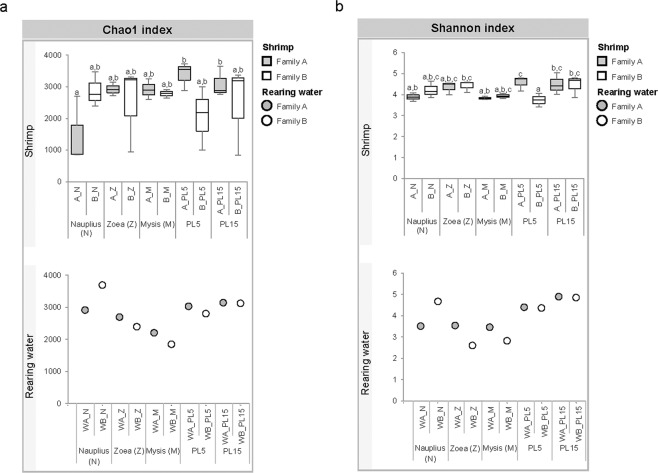
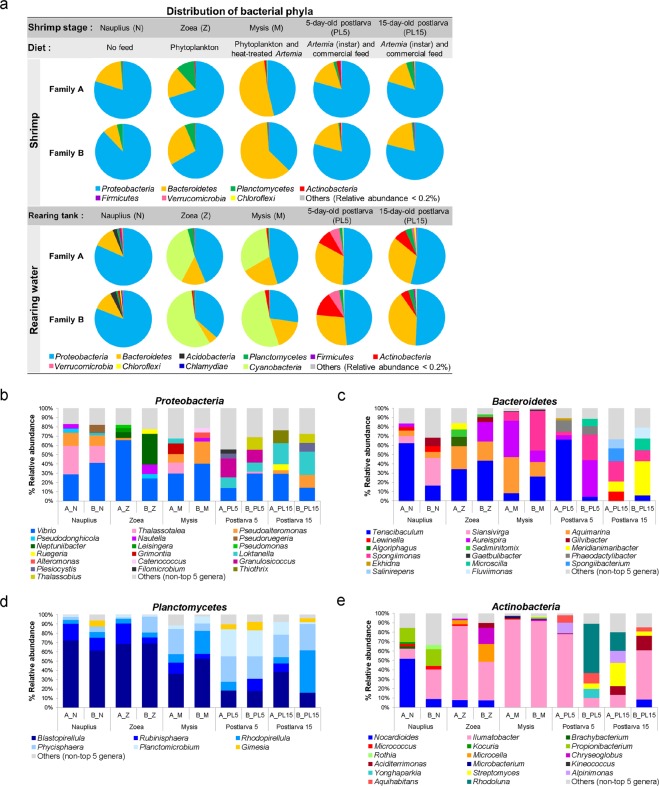
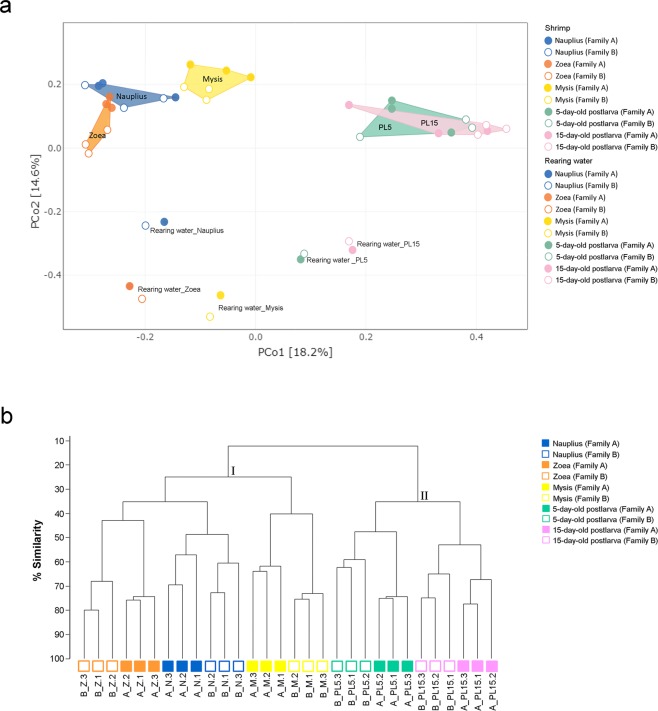
Microbial colonization is an essential process in the early life of animal hosts-a crucial phase that could help influence and determine their health status at the later stages. The establishment of bacterial community in a host has been comprehensively studied in many animal models; however, knowledge on bacterial community associated with the early life stages of Penaeus monodon (the black tiger shrimp) is still limited. Here, we examined the bacterial community structures in four life stages (nauplius, zoea, mysis and postlarva) of two black tiger shrimp families using 16S rRNA amplicon sequencing by a next-generation sequencing. Although the bacterial profiles exhibited different patterns in each developmental stage, Bacteroidetes, Proteobacteria, Actinobacteria and Planctomycetes were identified as common bacterial phyla associated with shrimp. Interestingly, the bacterial diversity became relatively stable once shrimp developed to postlarvae (5-day-old and 15-day-old postlarval stages), suggesting an establishment of the bacterial community in matured shrimp. To our knowledge, this is the first report on bacteria establishment and assembly in early developmental stages of P. monodon. Our findings showed that the bacterial compositions could be shaped by different host developmental stages where the interplay of various host-associated factors, such as physiology, immune status and required diets, could have a strong influence.
微生物定殖是动物宿主早期生命的一个重要过程——这是一个关键阶段,它可以帮助影响和决定宿主在后期的健康状况。在许多动物模型中,宿主中细菌群落的建立已经得到了全面研究;然而,与斑节对虾(黑虎虾)早期生活阶段相关的细菌群落的知识仍然有限。在这里,我们使用下一代测序的 16S rRNA 扩增子测序,检查了两个黑虎虾家族的四个生命阶段(无节幼体、幼体、糠虾和幼虾)中的细菌群落结构。尽管细菌图谱在每个发育阶段呈现出不同的模式,但厚壁菌门、变形菌门、放线菌门和浮霉菌门被鉴定为与虾相关的常见细菌门。有趣的是,一旦虾发育到幼虾(5 天龄和 15 天龄幼虾阶段),细菌多样性变得相对稳定,这表明成熟虾中细菌群落的建立。据我们所知,这是首次报道斑节对虾早期发育阶段的细菌定植和组装。我们的研究结果表明,细菌组成可能受到不同宿主发育阶段的影响,其中各种宿主相关因素(如生理、免疫状态和所需的饮食)的相互作用可能会产生强烈影响。