Department of Pediatric Intensive Care, Amsterdam University Medical Centre, Amsterdam, Netherlands.
Department of Radiology and Nuclear Medicine, Amsterdam University Medical Centre, Amsterdam, Netherlands.
Eur J Pediatr. 2020 Dec;179(12):1969-1977. doi: 10.1007/s00431-020-03723-3. Epub 2020 Jul 3.
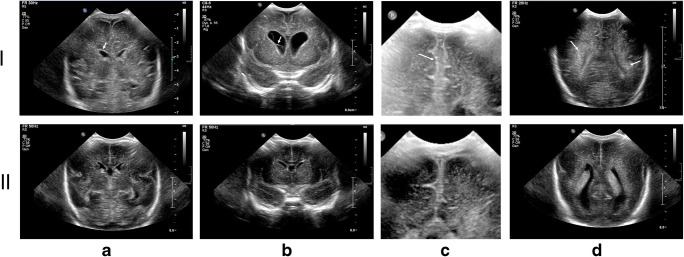
Central nervous system (CNS) infections are potentially life threatening in neonates and can lead to the ill-defined diagnosis of ventriculitis. With this study we aimed to explore and describe ventriculitis regarding clinical, microbiological and ultrasonographic characteristics. We performed a retrospective cohort study including all neonates with a culture-proven CNS infection admitted to our tertiary NICU over a 12-year period (2004-2016). For each case clinical data was gathered, and three timed cranial ultrasounds were anonymized and retrospectively reviewed and assessed for signs of ventriculitis. Forty-five patients were included with 9 (20%) diagnosed with ventriculitis. Mortality in both ventriculitis and non-ventriculitis cases was one-third. Patients with pre-existing conditions as post-haemorrhagic hydrocephalus are at risk of developing ventriculitis. Most common pathogens were gram negative bacteria (68.9%). Ultrasonographic signs of ventriculitis developed over time, and interrater agreement was substantial.Conclusion: Neonatal ventriculitis is a serious entity in the continuum of meningitis. Early and correct diagnoses of ventriculitis are both important because of possible persisting or newly developing hydrocephalus or seizures. Sequential imaging should be performed. What is Known: • CNS infections in neonates lead to high mortality and morbidity. • Ventriculitis is a severe complication of meningitis. What is New: • High morbidity; the majority of ventriculitis patients have pre-existing PHVD and develop seizures and hydrocephalus. • Interrater agreement is good; bedside CUS is a useful tool for reaching a sustainable diagnosis of ventriculitis.
中枢神经系统(CNS)感染在新生儿中可能具有生命威胁,并可能导致诊断不明确的脑室炎。本研究旨在探索和描述脑室炎的临床、微生物学和超声特征。我们进行了一项回顾性队列研究,纳入了在 12 年期间(2004-2016 年)我院三级新生儿重症监护病房(NICU)中经培养证实为 CNS 感染的所有新生儿。对于每个病例,我们收集了临床数据,并对 3 次定时头颅超声进行了匿名化处理,并进行了回顾性评估,以评估是否存在脑室炎的征象。共纳入 45 例患儿,其中 9 例(20%)诊断为脑室炎。脑室炎和非脑室炎病例的死亡率均为三分之一。存在如出血后脑积水等基础疾病的患儿有发生脑室炎的风险。最常见的病原体是革兰氏阴性菌(68.9%)。脑室炎的超声征象随时间而发展,且观察者间的一致性较高。结论:新生儿脑室炎是脑膜炎连续体中的严重疾病实体。早期和正确诊断脑室炎都很重要,因为可能会持续或新出现脑积水或癫痫发作。应进行连续影像学检查。已知情况: • 新生儿中枢神经系统感染会导致高死亡率和高发病率。 • 脑室炎是脑膜炎的严重并发症。新发现: • 发病率高;大多数脑室炎患儿存在先前存在的 PHVD,并出现癫痫发作和脑积水。 • 观察者间的一致性良好;床边 CUS 是一种有助于确诊脑室炎的有用工具。