Tokyo Metropolitan Institute of Medical Science, Setagaya-ku, Tokyo, Japan.
PCND Neuroscience Research Institute, Poway, CA, USA.
J Alzheimers Dis. 2020;76(4):1249-1253. doi: 10.3233/JAD-200416.
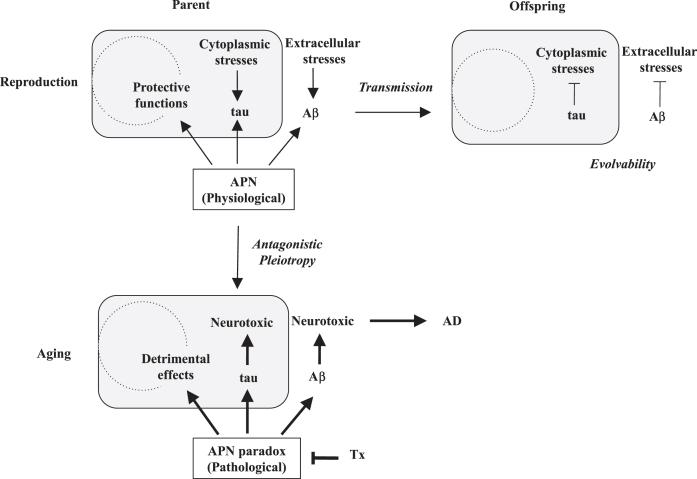
Despite the apparent neurotoxicity of amyloid-β (Aβ), recent clinical trials of Aβ immunotherapy have not shown any clinical benefit in Alzheimer's disease (AD). Given this, clarification of the next generation therapeutic strategy in AD is warranted. Hypothetically, adiponectin might be involved in promoting amyloidogenic evolvability in reproduction, which may result in the adiponectin paradox through antagonistic pleiotropy mechanism in aging, leading to AD. Accordingly, preventing the adiponectin paradox by suppressing adiponectin signaling might prove therapeutic in AD.
尽管淀粉样蛋白-β(Aβ)具有明显的神经毒性,但最近的 Aβ 免疫疗法临床试验并未显示出对阿尔茨海默病(AD)的任何临床益处。有鉴于此,AD 的下一代治疗策略需要进一步明确。从理论上讲,脂联素可能参与促进生殖过程中的淀粉样蛋白生成进化,这可能通过衰老过程中的拮抗多效性机制导致脂联素悖论,从而导致 AD。因此,通过抑制脂联素信号来预防脂联素悖论可能对 AD 具有治疗作用。