Waragai Masaaki, Ho Gilbert, Takamatsu Yoshiki, Wada Ryoko, Sugama Shuei, Takenouchi Takato, Masliah Eliezer, Hashimoto Makoto
Laboratory for Parkinson's Disease, Tokyo Metropolitan Institute of Medical Science, Tokyo, Japan.
Department of Neurodegenerative Diseases, PCND Neuroscience Research Institute, Poway, CA, United States.
Front Endocrinol (Lausanne). 2020 Mar 4;11:108. doi: 10.3389/fendo.2020.00108. eCollection 2020.
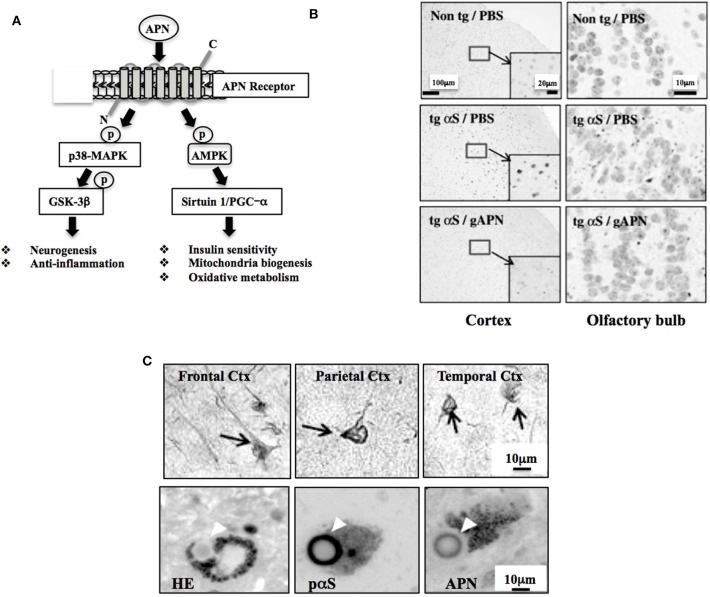
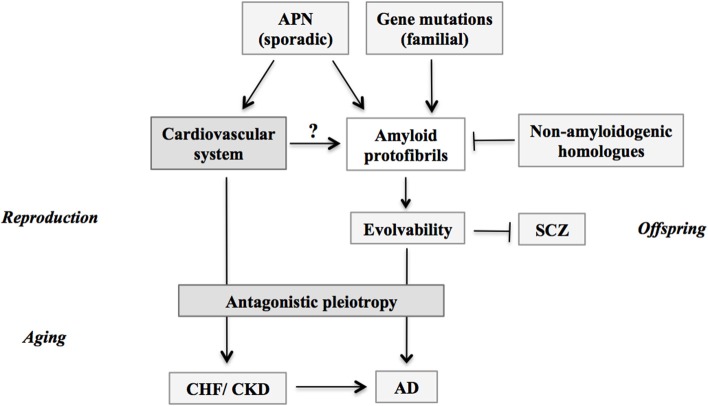
Adiponectin (APN) is a multi-functional adipokine which sensitizes the insulin signals, stimulates mitochondria biogenesis, and suppresses inflammation. By virtue of these beneficial properties, APN may protect against metabolic syndrome, including obesity and type II diabetes mellitus. Since these diseases are associated with hypoadiponectinemia, it is suggested that loss of function of APN might be involved. In contrast, despite beneficial properties for cardiovascular cells, APN is detrimental in circulatory diseases, including chronic heart failure (CHF) and chronic kidney disease (CKD). Notably, such an APN paradox might also be applicable to neurodegeneration. Although APN is neuroprotective in various experimental systems, APN was shown to be associated with the severity of amyloid accumulation and cognitive decline in a recent prospective cohort study in elderly. Furthermore, Alzheimer's disease (AD) was associated with hyperadiponectinemia in many studies. Moreover, APN was sequestered by phospho-tau into the neurofibrillary tangle in the postmortem AD brains. These results collectively indicate that APN might increase the risk of AD. In this context, the objective of the present study is to elucidate the mechanism of the APN paradox in AD. Hypothetically, APN might be involved in the stimulation of the amyloidogenic evolvability in reproductive stage, which may later manifest as AD by the antagonistic pleiotropy mechanism during aging. Given the accumulating evidence that AD and CHF are mechanistically overlapped, it is further proposed that the APN paradox of AD might be converged with those of other diseases, such as CHF and CKD.
脂联素(APN)是一种多功能脂肪因子,它能增强胰岛素信号、刺激线粒体生物合成并抑制炎症。凭借这些有益特性,APN可能预防包括肥胖症和II型糖尿病在内的代谢综合征。由于这些疾病与低脂联素血症相关,提示可能涉及APN功能丧失。相反,尽管APN对心血管细胞有有益特性,但在包括慢性心力衰竭(CHF)和慢性肾脏病(CKD)在内的循环系统疾病中却是有害的。值得注意的是,这种APN矛盾现象可能也适用于神经退行性变。尽管在各种实验系统中APN具有神经保护作用,但在最近一项针对老年人的前瞻性队列研究中,APN被证明与淀粉样蛋白积累的严重程度和认知能力下降有关。此外,在许多研究中,阿尔茨海默病(AD)与高脂联素血症相关。而且,在AD患者死后的大脑中,磷酸化tau蛋白将APN隔离到神经原纤维缠结中。这些结果共同表明APN可能增加AD的风险。在此背景下,本研究的目的是阐明AD中APN矛盾现象的机制。假设APN可能在生殖阶段刺激淀粉样蛋白生成的可进化性,这可能在衰老过程中通过拮抗性多效性机制随后表现为AD。鉴于越来越多的证据表明AD和CHF在机制上有重叠,进一步提出AD的APN矛盾现象可能与CHF和CKD等其他疾病的APN矛盾现象趋同。