Arcella Davide, Cascio Claudia, Mackay Karen
EFSA J. 2020 Jan 7;18(1):e05953. doi: 10.2903/j.efsa.2020.5953. eCollection 2020 Jan.
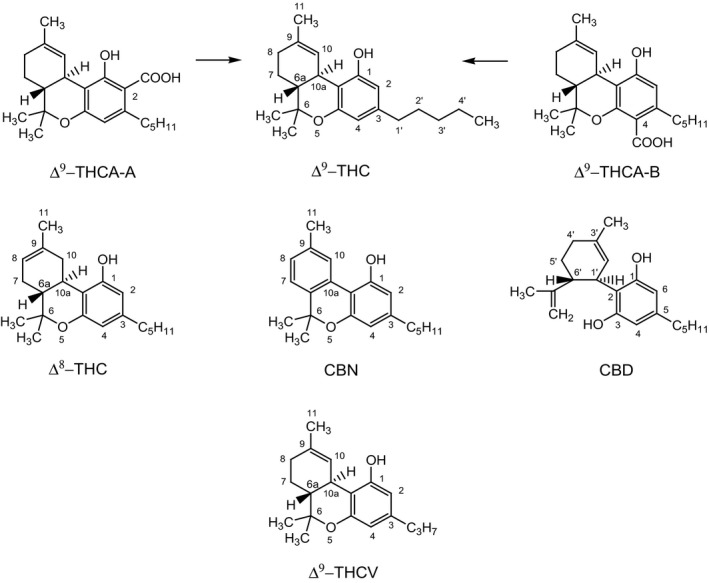
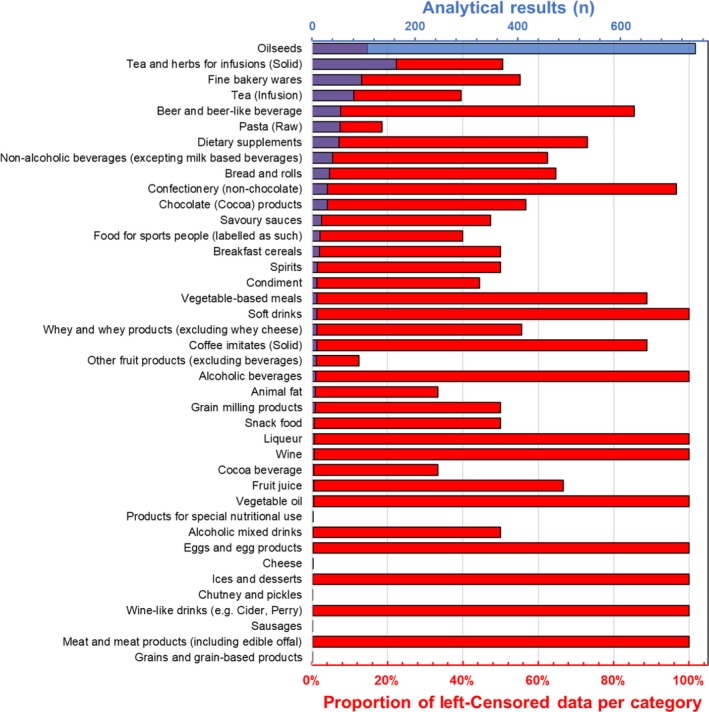
Delta-9-tetrahydrocannabinol (Δ-THC) is a naturally occurring psychoactive compound derived from the hemp plant . In 2015, EFSA established an acute reference dose (ARfD) of 1 μg/kg body weight (bw) for Δ-THC and assessed acute dietary exposure from milk and dairy products. This resulted at the most 3% and 13% of the ARfD for adults and toddlers, respectively. Following the European Commission Recommendation 2016/2115 on the monitoring of the presence of Δ-THC in food and the issuing of a new mandate, EFSA assessed the acute human exposure to Δ-THC. 'Standard' food categories were used as proxies for consumption of hemp and hemp-based products. Twelve independent scenarios based on single food categories were considered and acute exposure was assessed for consumption days only for all age groups excluding infants. Occurrence data for Total-Δ-THC (588 samples in total) were used for this assessment up to the highest reliable percentile for each food category. The EFSA ARfD of 1 μg/kg bw was exceeded in the adult high consumers of most considered hemp and hemp-containing products, under the lower-bound (LB) and upper-bound (UB) scenario. At the UB, acute exposure in adult high consumers was estimated based on the highest reliable percentile of occurrence, for Hemp seeds (P95, up to 9 μg/kg bw), Hemp oil (P95, up to 21 μg/kg bw), Tea (Infusion) (P95, up to 208 μg/kg bw), Breakfast cereals (P50, up to 1.3 μg/kg bw), Pasta (Raw) (P75, up to 6.4 μg/kg bw), Bread and rolls (P75, up to 1.3 μg/kg bw), Bread and rolls from hemp flour (P90, up to 4.1 μg/kg bw), Cereal bars (P50, up to 0.3 μg/kg bw), Fine bakery wares (P75, up to 5.1 μg/kg bw), Chocolate (Cocoa) products (P75, up to 1.1 μg/kg bw), Energy drinks (P75, up to 0.2 μg/kg bw), Dietary supplements (P75, up to 9.9 μg/kg bw), Beer and beer-like beverages (P90, up to 41 μg/kg bw). The use of proxies for the consumption of hemp and hemp-containing products, the limited number of occurrence data and the analytical limitations in the quantification of Δ-THC represent the most important sources of uncertainty. Overall, exposure estimates presented in this report are expected to represent an overestimation of acute exposure to Δ-THC in the EU.
Δ-9-四氢大麻酚(Δ-THC)是一种源自大麻植物的天然存在的精神活性化合物。2015年,欧洲食品安全局(EFSA)确定了Δ-THC的急性参考剂量(ARfD)为1微克/千克体重(bw),并评估了牛奶和乳制品中的急性膳食暴露情况。这分别导致成人和幼儿的ARfD最高占比为3%和13%。根据欧盟委员会关于监测食品中Δ-THC存在情况的第2016/2115号建议并发布新任务后,EFSA评估了人类对Δ-THC的急性暴露情况。“标准”食品类别被用作大麻及大麻基产品消费的替代指标。考虑了基于单一食品类别的12个独立情景,并仅针对除婴儿外的所有年龄组的消费日评估急性暴露情况。使用了总Δ-THC的出现数据(总共588个样本)进行此评估,直至每个食品类别的最高可靠百分位数。在大多数考虑的大麻及含大麻产品的成年高消费者中,在下限(LB)和上限(UB)情景下,超过了EFSA的1微克/千克bw的ARfD。在UB情景下,根据出现的最高可靠百分位数估算成年高消费者的急性暴露情况,对于大麻籽(P95,高达9微克/千克bw)、大麻油(P95,高达21微克/千克bw)、茶(冲泡)(P95,高达208微克/千克bw)、早餐谷物(P50,高达1.3微克/千克bw)、生面食(P75,高达6.4微克/千克bw)、面包和卷(P75,高达1.3微克/千克bw)、大麻面粉制成的面包和卷(P90,高达4.1微克/千克bw)、谷物棒(P50,高达0.3微克/千克bw)、精细烘焙食品(P75,高达5.1微克/千克bw)、巧克力(可可)产品(P75,高达1.1微克/千克bw)、能量饮料(P75,高达0.2微克/千克bw)、膳食补充剂(P75,高达9.9微克/千克bw)、啤酒和类似啤酒的饮料(P90,高达41微克/千克bw)。使用大麻及含大麻产品消费的替代指标、出现数据数量有限以及Δ-THC定量分析的局限性是最重要不确定性来源。总体而言,本报告中呈现的暴露估计值预计高估了欧盟对Δ-THC的急性暴露情况。