Yin Hongyu, Tang Yemei, Guo Yujia, Wen Shuxin
Shanxi Key Laboratory of Otorhinolaryngology Head and Neck Cancer, Shanxi Medical University, Taiyuan 030001, Shanxi, P.R. China.
Department of Otolaryngology Head & Neck Surgery, The First Hospital of Shanxi Medical University, Taiyuan 030001, Shanxi, P.R. China.
J Cancer. 2020 Jun 8;11(16):4884-4896. doi: 10.7150/jca.44506. eCollection 2020.
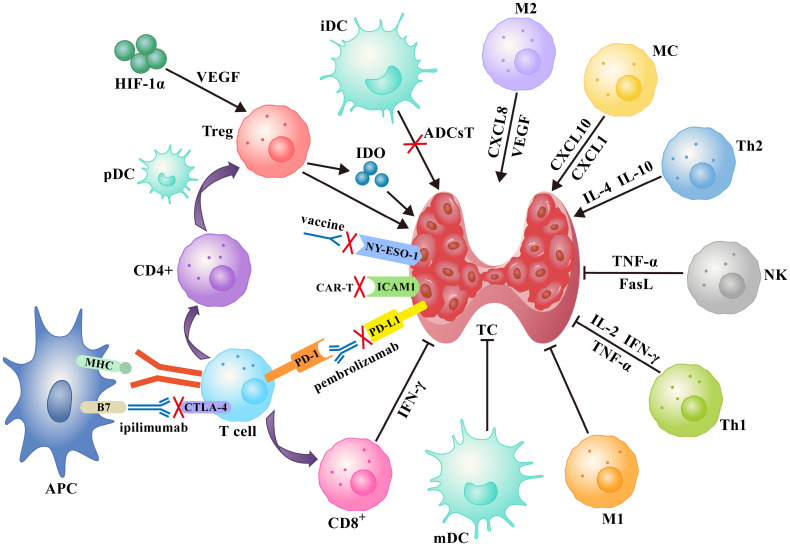
Thyroid cancer (TC) is a highly heterogeneous endocrine malignancy with an increased incidence in women than in men. Previous studies regarding the pathogenesis of TC focused on the pathological changes of the tumor cells while ignoring the importance of the mesenchymal cells in tumor microenvironment. However, more recently, the stable environment provided by the interaction of thyroid cancer cells with the peri-tumoral stroma has been widely studied. Studies have shown that components of an individual's immune system are closely related to the occurrence, invasion, and metastasis of TC, which may affect response to treatment and prognosis of the patients. This article presents a comprehensive review of the immune cells, secreted soluble mediators and immune checkpoints in the immune microenvironment, mechanisms that promoting TC cells immune evasion and existing immunotherapy strategies. Besides it provides new strategies for TC prognosis prediction and immunotherapy.
甲状腺癌(TC)是一种高度异质性的内分泌恶性肿瘤,女性发病率高于男性。以往关于TC发病机制的研究主要集中在肿瘤细胞的病理变化上,而忽视了肿瘤微环境中间质细胞的重要性。然而,最近,甲状腺癌细胞与肿瘤周围基质相互作用所提供的稳定环境受到了广泛研究。研究表明,个体免疫系统的组成部分与TC的发生、侵袭和转移密切相关,这可能会影响患者的治疗反应和预后。本文全面综述了免疫微环境中的免疫细胞、分泌的可溶性介质和免疫检查点,促进TC细胞免疫逃逸的机制以及现有的免疫治疗策略。此外,它还为TC的预后预测和免疫治疗提供了新的策略。