Division of Clinical Geriatrics, Center for Alzheimer Research, Department of Neurobiology Care Sciences and Society, Karolinska Institutet, Stockholm, Sweden.
Institute of Public Health and Clinical Nutrition, University of Eastern Finland, Kuopio, Finland.
Alzheimers Dement. 2020 Jul;16(7):1078-1094. doi: 10.1002/alz.12123. Epub 2020 Jul 5.
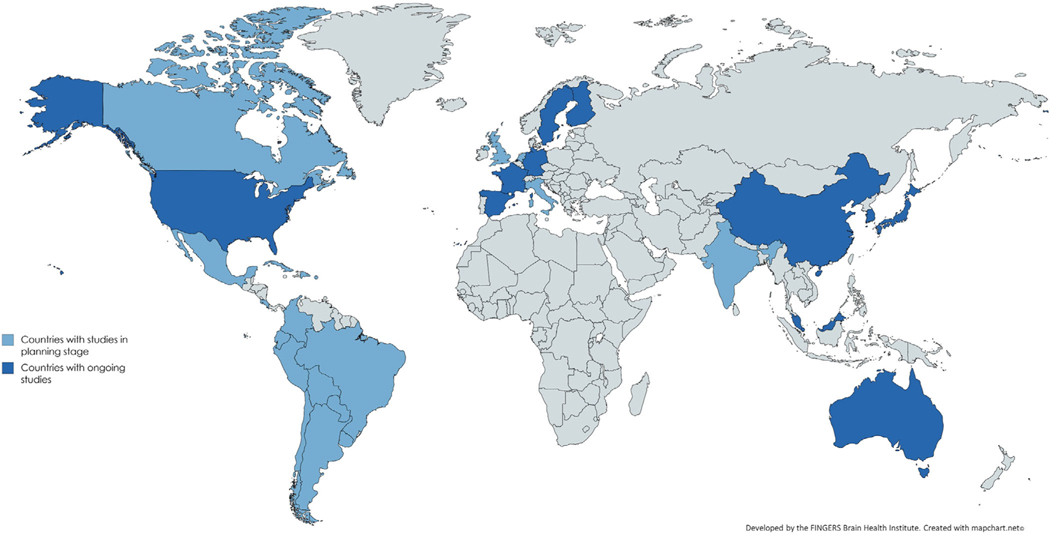
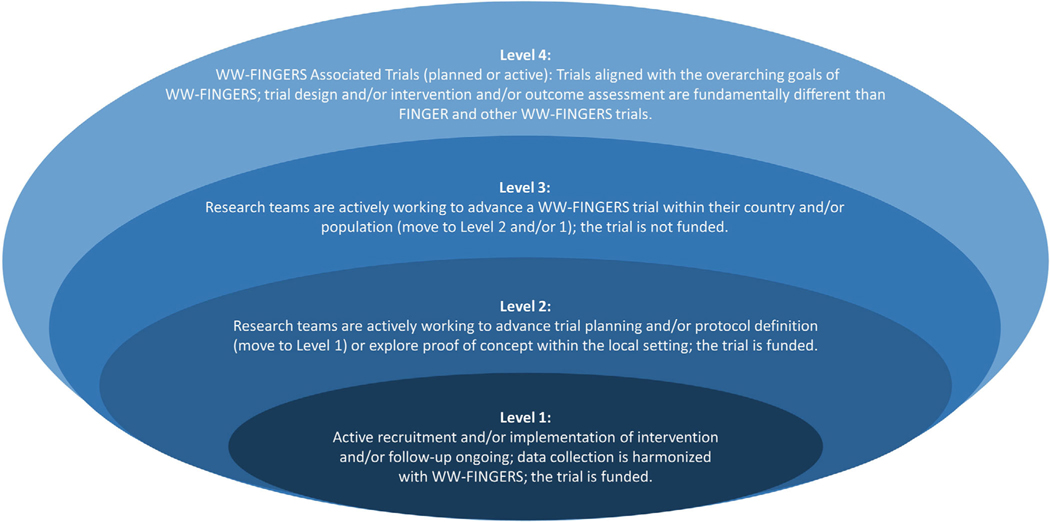
Reducing the risk of dementia can halt the worldwide increase of affected people. The multifactorial and heterogeneous nature of late-onset dementia, including Alzheimer's disease (AD), indicates a potential impact of multidomain lifestyle interventions on risk reduction. The positive results of the landmark multidomain Finnish Geriatric Intervention Study to Prevent Cognitive Impairment and Disability (FINGER) support such an approach. The World-Wide FINGERS (WW-FINGERS), launched in 2017 and including over 25 countries, is the first global network of multidomain lifestyle intervention trials for dementia risk reduction and prevention. WW-FINGERS aims to adapt, test, and optimize the FINGER model to reduce risk across the spectrum of cognitive decline-from at-risk asymptomatic states to early symptomatic stages-in different geographical, cultural, and economic settings. WW-FINGERS aims to harmonize and adapt multidomain interventions across various countries and settings, to facilitate data sharing and analysis across studies, and to promote international joint initiatives to identify globally implementable and effective preventive strategies.
降低痴呆风险可以阻止全球受影响人数的增加。包括阿尔茨海默病(AD)在内的迟发性痴呆的多因素和异质性特征表明,多领域生活方式干预对降低风险可能有一定影响。具有里程碑意义的芬兰老年医学干预研究预防认知障碍和残疾(FINGER)的积极结果支持这种方法。2017 年启动的全球 FINGER(WW-FINGERS)项目包括 25 个以上的国家,是首个针对痴呆风险降低和预防的多领域生活方式干预试验的全球网络。WW-FINGERS 的目标是调整、测试和优化 FINGER 模式,以在不同的地理、文化和经济环境中降低认知能力下降谱(从有风险的无症状状态到早期有症状阶段)的风险。WW-FINGERS 的目标是协调和调整不同国家和环境中的多领域干预措施,促进研究间的数据共享和分析,并促进国际联合举措,以确定可在全球实施和有效的预防策略。