Department of Neurology, Institute of Clinical Medicine, University of Eastern Finland, Yliopistonranta 1C, 70211, Kuopio, Finland.
The Ageing Epidemiology Research Unit, School of Public Health, Imperial College London, Charing Cross Hospital, St Dunstan's Road, LondonLondon, W6 8RP, UK.
Alzheimers Res Ther. 2024 Jan 31;16(1):23. doi: 10.1186/s13195-023-01355-x.
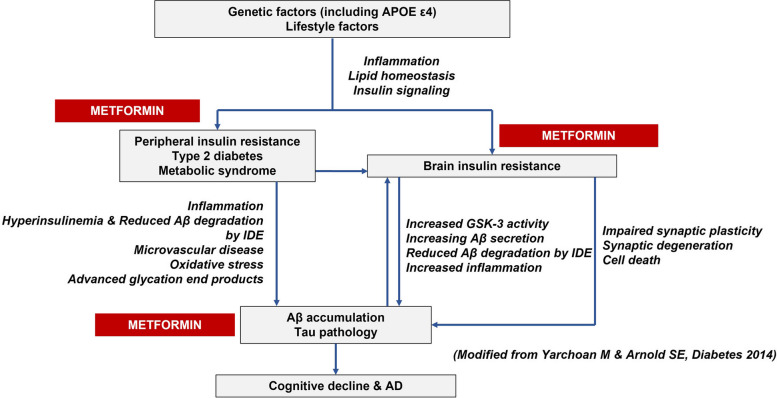
Combining multimodal lifestyle interventions and disease-modifying drugs (novel or repurposed) could provide novel precision approaches to prevent cognitive impairment. Metformin is a promising candidate in view of the well-established link between type 2 diabetes (T2D) and Alzheimer's Disease and emerging evidence of its potential neuro-protective effects (e.g. vascular, metabolic, anti-senescence). MET-FINGER aims to test a FINGER 2.0 multimodal intervention, combining an updated FINGER multidomain lifestyle intervention with metformin, where appropriate, in an APOE ε4-enriched population of older adults (60-79 years) at increased risk of dementia.
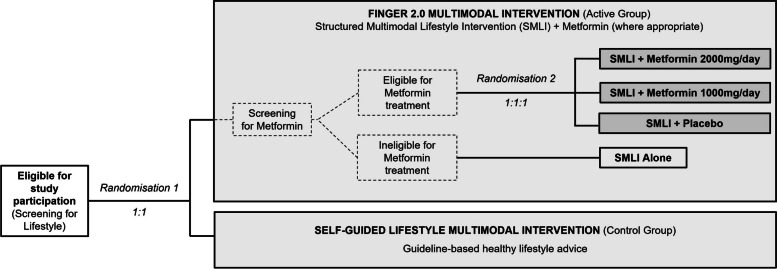
MET-FINGER is an international randomised, controlled, parallel-group, phase-IIb proof-of-concept clinical trial, where metformin is included through a trial-within-trial design. 600 participants will be recruited at three sites (UK, Finland, Sweden). Participants at increased risk of dementia based on vascular risk factors and cognitive screening, will be first randomised to the FINGER 2.0 intervention (lifestyle + metformin if eligible; active arm) or to receive regular health advice (control arm). Participants allocated to the FINGER 2.0 intervention group at risk indicators of T2D will be additionally randomised to receive metformin (2000 mg/day or 1000 mg/day) or placebo. The study duration is 2 years. The changes in global cognition (primary outcome, using a Neuropsychological Test Battery), memory, executive function, and processing speed cognitive domains; functional status; lifestyle, vascular, metabolic, and other dementia-related risk factors (secondary outcomes), will be compared between the FINGER 2.0 intervention and the control arm. The feasibility, potential interaction (between-groups differences in healthy lifestyle changes), and disease-modifying effects of the lifestyle-metformin combination will be exploratory outcomes. The lifestyle intervention is adapted from the original FINGER trial (diet, physical activity, cognitive training, monitoring of cardiovascular/metabolic risk factors, social interaction) to be consistently delivered in three countries. Metformin is administered as Glucophage®XR/SR 500, (500 mg oral tablets). The metformin/placebo treatment will be double blinded.
MET-FINGER is the first trial combining a multimodal lifestyle intervention with a putative repurposed disease-modifying drug for cognitive impairment prevention. Although preliminary, its findings will provide crucial information for innovative precision prevention strategies and form the basis for a larger phase-III trial design and future research in this field.
ClinicalTrials.gov (NCT05109169).
将多模式生活方式干预和疾病修饰药物(新型或重新定位)相结合,可能为预防认知障碍提供新的精准方法。二甲双胍是一种很有前途的候选药物,因为 2 型糖尿病(T2D)与阿尔茨海默病之间存在明确的联系,并且有越来越多的证据表明其具有潜在的神经保护作用(例如血管、代谢、抗衰老)。MET-FINGER 旨在测试一种 FINGER 2.0 多模式干预措施,该措施将更新的 FINGER 多领域生活方式干预与二甲双胍相结合,适当时,在 APOE ε4 丰富的老年人群(60-79 岁)中,该人群处于痴呆症的高风险中。
MET-FINGER 是一项国际性的随机、对照、平行组、IIb 期概念验证临床试验,其中二甲双胍通过试验内设计纳入。将在三个地点(英国、芬兰、瑞典)招募 600 名参与者。基于血管危险因素和认知筛查,处于痴呆风险较高的参与者将首先随机分配到 FINGER 2.0 干预组(生活方式+如果符合条件则使用二甲双胍;活跃组)或接受常规健康建议(对照组)。被分配到 FINGER 2.0 干预组的参与者,如果有 2 型糖尿病的风险指标,将被额外随机分配接受二甲双胍(2000mg/天或 1000mg/天)或安慰剂。研究持续 2 年。使用神经心理学测试电池(主要结果)评估全球认知(记忆力、执行功能和处理速度认知域)、功能状态的变化;生活方式、血管、代谢和其他与痴呆相关的风险因素(次要结果)将在 FINGER 2.0 干预组和对照组之间进行比较。生活方式-二甲双胍联合治疗的可行性、潜在相互作用(健康生活方式改变方面的组间差异)和疾病修饰作用将作为探索性结果。生活方式干预改编自原始 FINGER 试验(饮食、体育活动、认知训练、心血管/代谢危险因素监测、社会互动),在三个国家一致实施。二甲双胍作为 Glucophage®XR/SR 500 给药(500mg 口服片剂)。二甲双胍/安慰剂治疗将采用双盲法。
MET-FINGER 是第一项将多模式生活方式干预与潜在的重新定位疾病修饰药物相结合,用于预防认知障碍的试验。尽管初步,但它的发现将为创新的精准预防策略提供重要信息,并为更大规模的 III 期试验设计和该领域的未来研究奠定基础。
ClinicalTrials.gov(NCT05109169)。