UN World Food Programme, Kathmandu, Nepal.
Institute for Global Health, University College London, London, WC1N 1EH, UK.
Public Health Nutr. 2020 Oct;23(15):2824-2839. doi: 10.1017/S1368980020001020. Epub 2020 Jul 6.
To model the potential impact and equity impact of fortifying rice on nutritional adequacy of different subpopulations in Nepal.
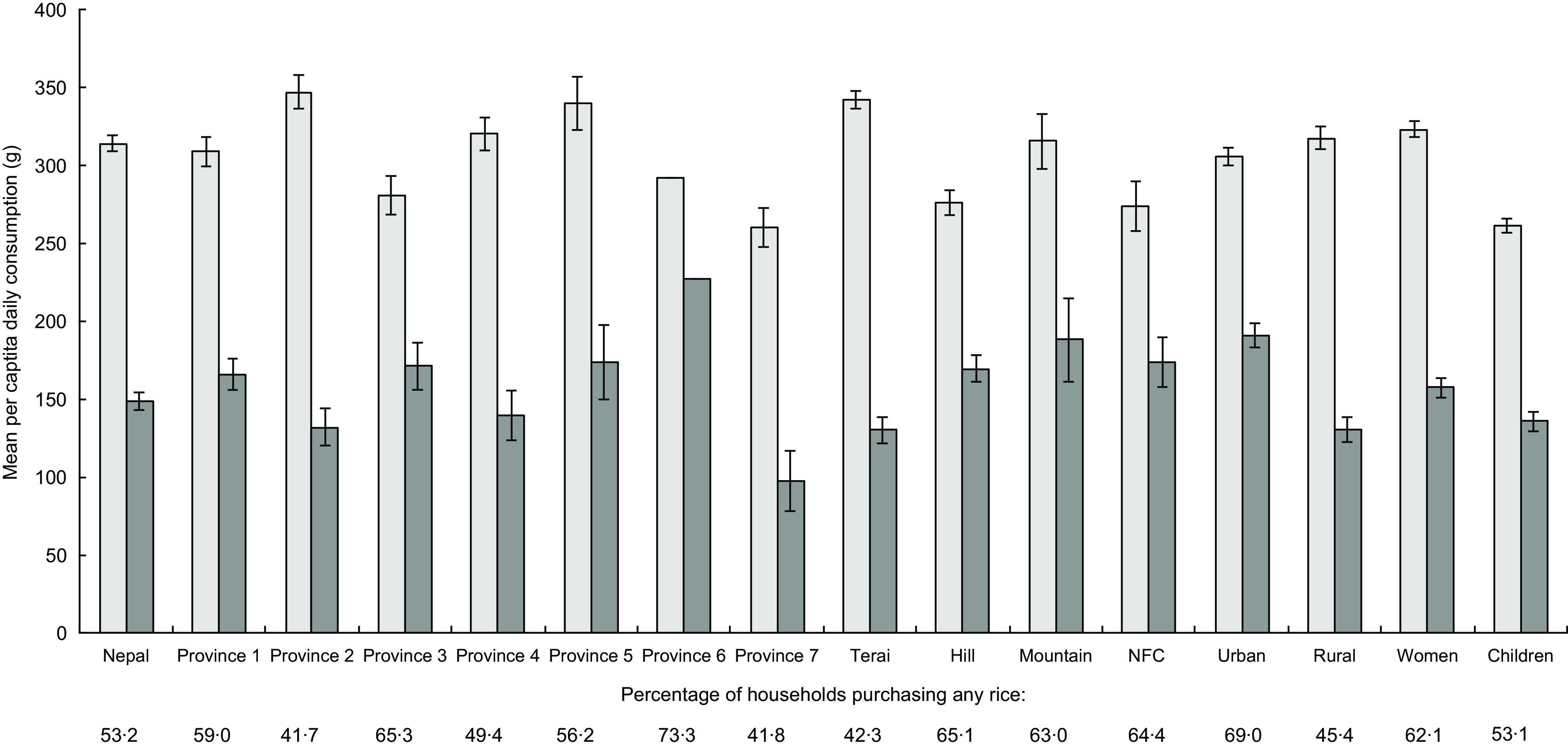
Using 24-h dietary recall data and a household consumption survey, we estimated: rice intakes; probability of adequacy (PA) of eight micronutrients commonly fortified in rice (vitamin A, niacin (B3), pyridoxine (B6), cobalamin (B12), thiamin (B1), folate (B9), Fe and Zn) plus riboflavin (B2), vitamin C and Ca and mean probability of adequacy (MPA) of these micronutrients. We modelled: no fortification; fortification of purchased rice, averaged across all households and in rice-buying households only. We compared adequacy increases between population subgroups.
(i) Dhanusha and Mahottari districts of Nepal (24-h recall) and (ii) all agro-ecological zones of Nepal (consumption data).
(i) Pregnant women (n 128), mothers-in-law and male household heads; (ii) households (n 4360).
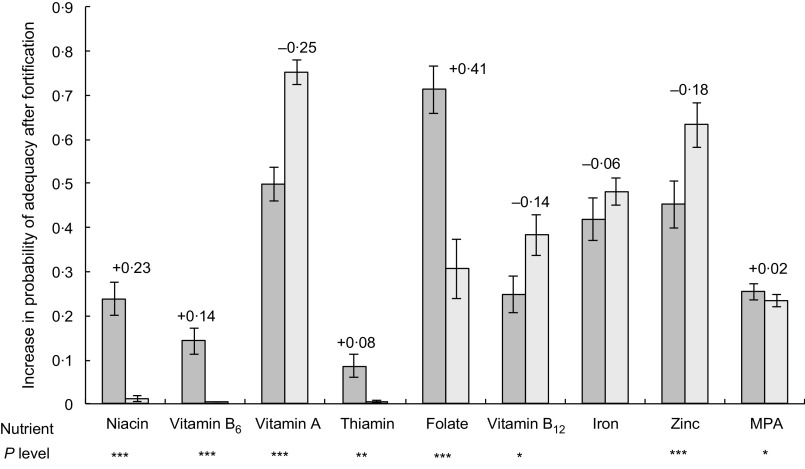
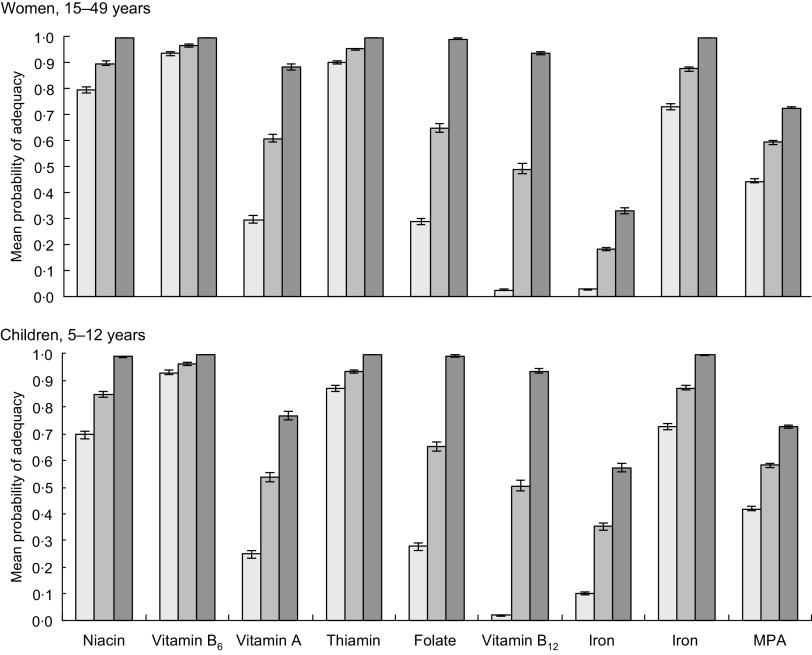
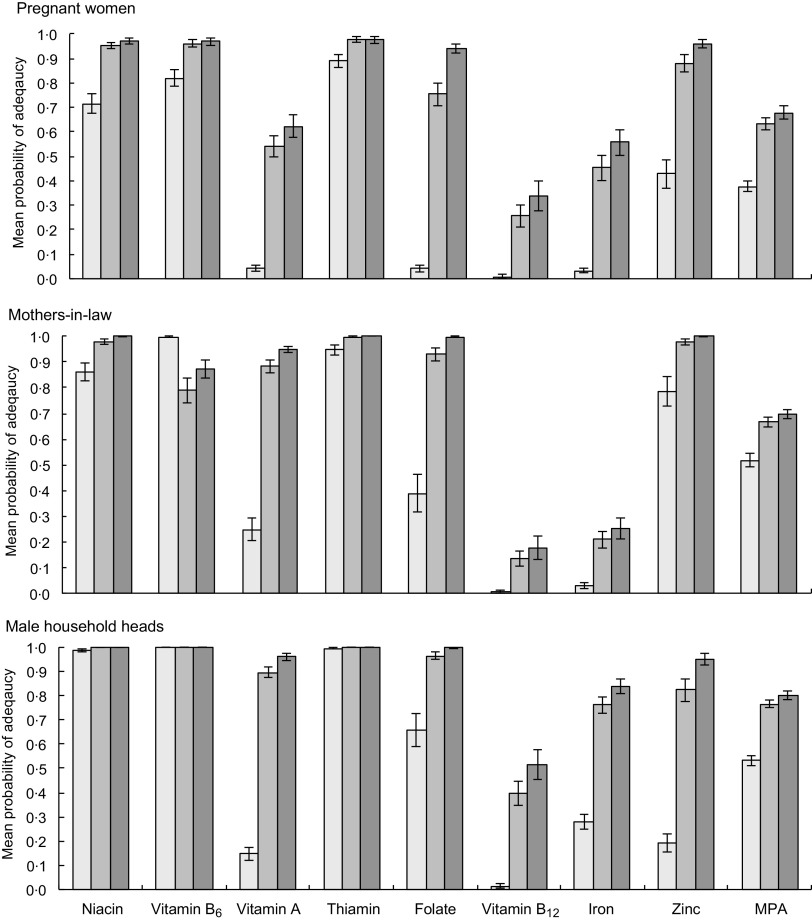
Unfortified diets were especially inadequate in vitamins B12, A, B9, Zn and Fe. Fortification of purchased rice in rice-purchasing households increased PA > 0·9 for thiamin, niacin, B6, folate and Zn, but B12 and Fe remained inadequate even after fortification (PA range 0·3-0·9). Pregnant women's increases exceeded men's for thiamin, niacin, B6, folate and MPA; men had larger gains in vitamin A, B12 and Zn. Adequacy improved more in the hills (coefficient 0·08 (95 % CI 0·05, 0·10)) and mountains (coefficient 0·07 (95 % CI 0·01, 0·14)) but less in rural areas (coefficient -0·05 (95 % CI -0·09, -0·01)).
Consumption of purchased fortified rice improves adequacy and gender equity of nutrient intake, especially in non-rice-growing areas.
建立模型以评估在尼泊尔强化大米对不同亚人群营养充足性的潜在影响和公平性影响。
我们利用 24 小时膳食回顾数据和家庭消费调查来估计:大米摄入量;八种常见于大米强化的微量营养素(维生素 A、烟酸(B3)、吡哆醇(B6)、钴胺素(B12)、硫胺素(B1)、叶酸(B9)、铁和锌)以及核黄素(B2)、维生素 C 和钙的充足概率(PA)和这些微量营养素的平均充足概率(MPA)。我们构建了以下模型:不进行强化、对所有家庭购买的大米进行平均强化以及仅对购买大米的家庭进行强化。我们比较了不同人群亚组的充足度增加情况。
(i)尼泊尔的丹库沙和马哈特哈里区(24 小时回顾)和(ii)尼泊尔所有农业生态区(消费数据)。
(i)孕妇(n=128)、婆婆和男户主;(ii)家庭(n=4360)。
未强化的饮食中维生素 B12、A、B9、Zn 和 Fe 尤其不足。在购买大米的家庭中对购买的大米进行强化,可使硫胺素、烟酸、B6、叶酸和 Zn 的 PA 大于 0.9,但即使在强化后 B12 和 Fe 仍不足(PA 范围 0.3-0.9)。对于 thiamin、niacin、B6、folate 和 MPA,孕妇的增加超过男性;男性的维生素 A、B12 和 Zn 增加更多。在丘陵(系数 0.08(95 % CI 0.05,0.10))和山区(系数 0.07(95 % CI 0.01,0.14))中,充足性的改善更大,但在农村地区(系数-0.05(95 % CI-0.09,-0.01))改善较少。
食用购买的强化大米可改善营养摄入的充足性和性别公平性,特别是在非水稻种植地区。