Department of Vascular Surgery, Shanghai Ninth People's Hospital, Shanghai JiaoTong University School of Medicine, Shanghai, People's Republic of China.
Shanghai Key Laboratory of Tissue Engineering, Shanghai Ninth People's Hospital, Shanghai JiaoTong University School of Medicine, Shanghai, People's Republic of China.
Stem Cells. 2020 Oct 1;38(10):1307-1320. doi: 10.1002/stem.3250. Epub 2020 Aug 4.
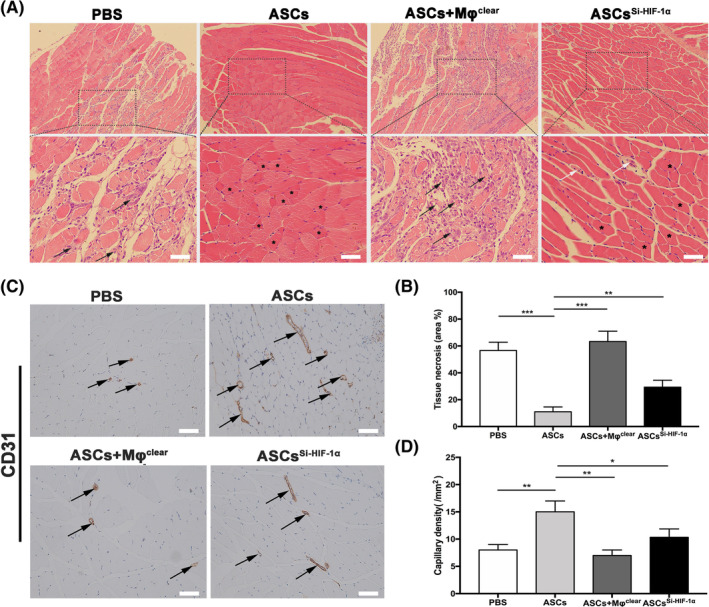
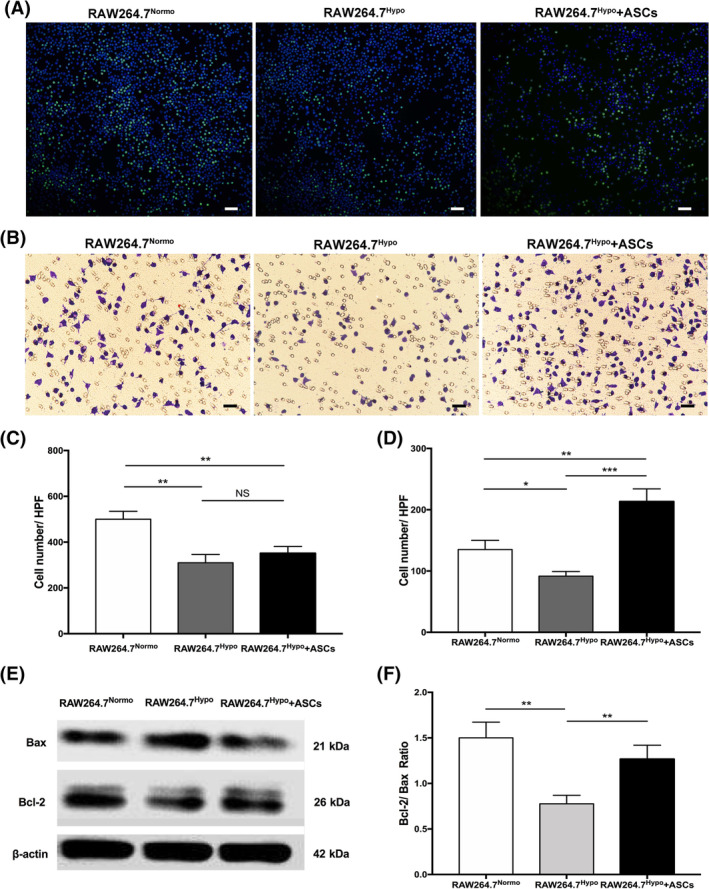
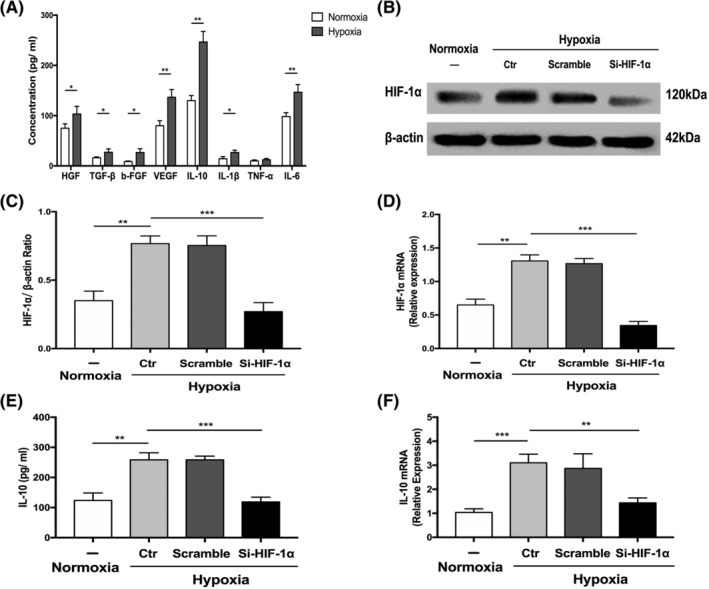
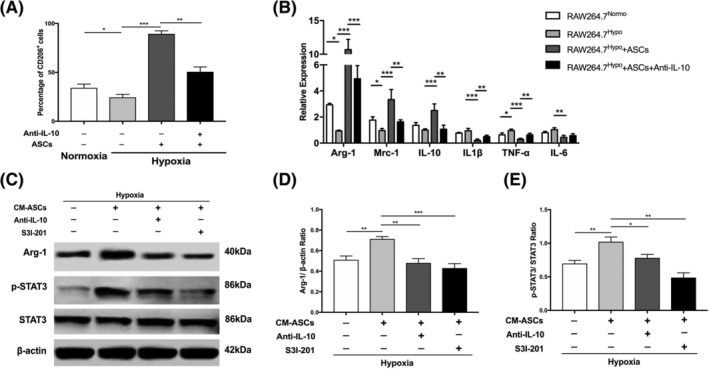
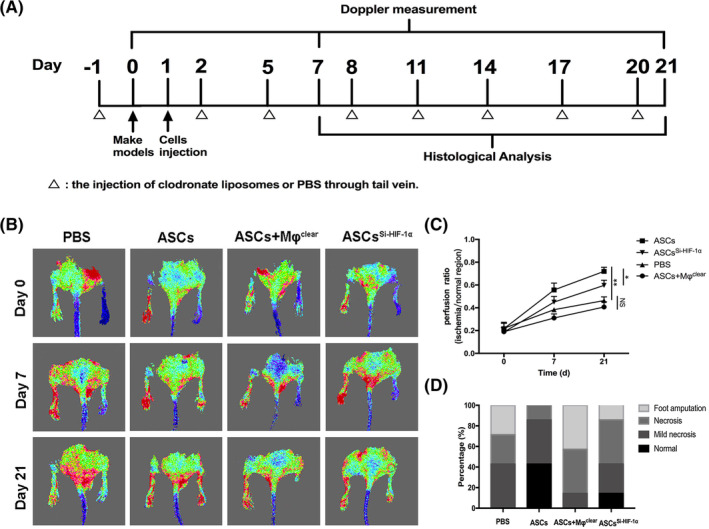
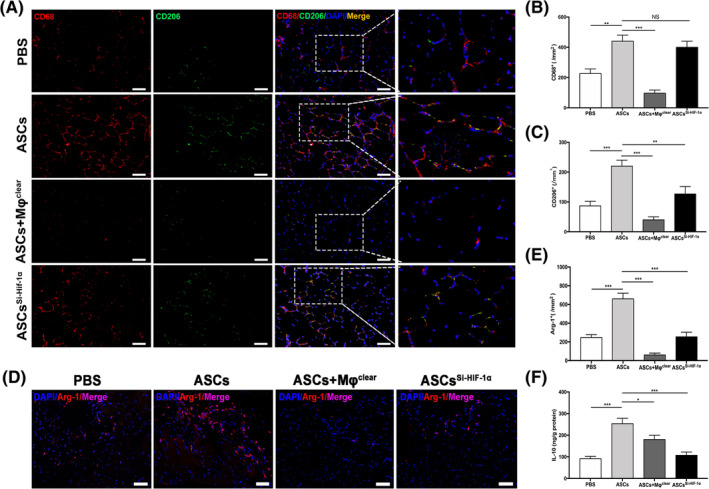
Adipose-derived mesenchymal stem cells (ASCs) are multipotent stromal cells that possess considerable therapeutic potential for tissue remodeling. However, their protective mechanism in critical limb ischemia has not been fully defined. After the occlusion of blood vessels, hypoxia becomes a prominent feature of the ischemic limb. This study investigated the immunomodulatory effect of ASCs on ischemic muscle repair and explored the specific mechanism. We found that the ability of RAW264.7 cells to migrate was impaired in hypoxia, whereas coculturing with ASCs could enhance the migration capacity. In addition, under hypoxic conditions, the paracrine effect of ASCs was enhanced and ASCs could induce RAW264.7 macrophages toward the anti-inflammatory M2 phenotype. We further demonstrated that ASCs-derived interleukin 10 (IL-10), mediated by hypoxia inducible factor-1α (HIF-1α), played a crucial role in the induction of M2 macrophages by activating the signal transducer and activator of transcription 3 (STAT3)/Arginase (Arg-1) pathway. Our in vivo experiments revealed that transplanted ASCs exhibited an immunomodulatory effect by recruiting macrophages to ischemic muscle and increasing the density of M2 macrophages. The transplantation of ASCs into ischemic limbs induced increased blood flow reperfusion and limb salvage rate, whereas the depletion of tissue macrophages or transplanting HIF-1α-silenced ASCs inhibited the therapeutic effect. These findings elucidated the critical role of macrophages in ASCs-mediated ischemic muscle repair and proved that allogeneic ASCs could exert the protective effect by enhancing the recruitment of macrophages and inducing macrophages toward M2 phenotype through HIF-1α/IL-10 pathway.
脂肪间充质干细胞(ASCs)是多能基质细胞,具有组织重塑的巨大治疗潜力。然而,其在严重肢体缺血中的保护机制尚未完全确定。血管闭塞后,缺氧成为缺血肢体的突出特征。本研究探讨了 ASCs 对缺血性肌肉修复的免疫调节作用,并探索了具体的机制。我们发现,RAW264.7 细胞在缺氧条件下迁移能力受损,而与 ASCs 共培养则可以增强其迁移能力。此外,在缺氧条件下,ASCs 的旁分泌作用增强,ASCs 可以诱导 RAW264.7 巨噬细胞向抗炎 M2 表型分化。我们进一步证明,ASCs 衍生的白细胞介素 10(IL-10)通过缺氧诱导因子 1α(HIF-1α)介导,在激活信号转导子和转录激活子 3(STAT3)/精氨酸酶(Arg-1)通路诱导 M2 巨噬细胞中发挥关键作用。我们的体内实验表明,移植的 ASCs 通过募集巨噬细胞到缺血肌肉并增加 M2 巨噬细胞的密度,发挥免疫调节作用。将 ASCs 移植到缺血肢体中可诱导增加血流再灌注和肢体存活率,而组织巨噬细胞耗竭或移植 HIF-1α 沉默的 ASCs 则抑制了治疗效果。这些发现阐明了巨噬细胞在 ASCs 介导的缺血性肌肉修复中的关键作用,并证明同种异体 ASCs 可以通过增强巨噬细胞的募集并通过 HIF-1α/IL-10 通路诱导巨噬细胞向 M2 表型来发挥保护作用。