Tuti Timothy, Winters Niall, Edgcombe Hilary, Muinga Naomi, Wanyama Conrad, English Mike, Paton Chris
Kellogg College, University of Oxford, Oxford, United Kingdom.
KEMRI-Wellcome Trust Research Programme, Nairobi, Kenya.
J Med Internet Res. 2020 Jul 6;22(7):e17100. doi: 10.2196/17100.
Although smartphone-based emergency care training is more affordable than traditional avenues of training, it is still in its infancy, remains poorly implemented, and its current implementation modes tend to be invariant to the evolving learning needs of the intended users. In resource-limited settings, the use of such platforms coupled with gamified approaches remains largely unexplored, despite the lack of traditional training opportunities, and high mortality rates in these settings.
The primary aim of this randomized experiment is to determine the effectiveness of offering adaptive versus standard feedback, on the learning gains of clinicians, through the use of a smartphone-based game that assessed their management of a simulated medical emergency. A secondary aim is to examine the effects of learner characteristics and learning spacing with repeated use of the game on the secondary outcome of individualized normalized learning gain.
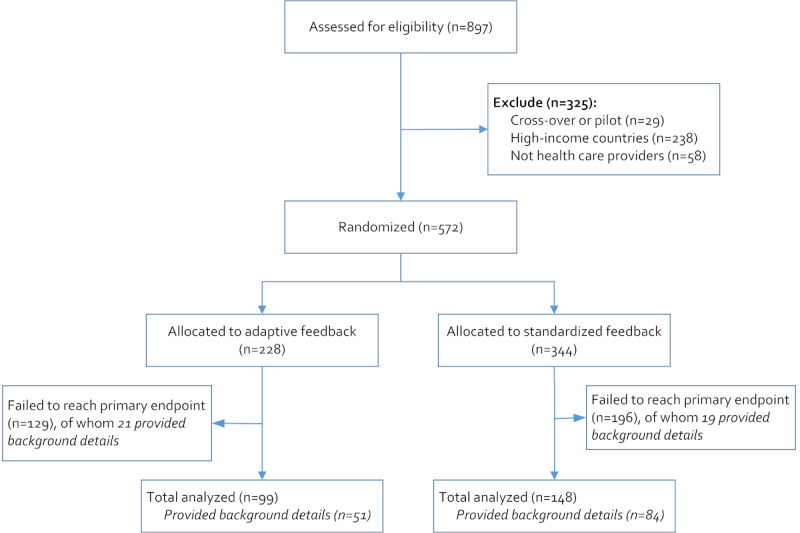
The experiment is aimed at clinicians who provide bedside neonatal care in low-income settings. Data were captured through an Android app installed on the study participants' personal phones. The intervention, which was based on successful attempts at a learning task, included adaptive feedback provided within the app to the experimental arm, whereas the control arm received standardized feedback. The primary end point was completion of the second learning session. Of the 572 participants enrolled between February 2019 and July 2019, 247 (43.2%) reached the primary end point. The primary outcome was standardized relative change in learning gains between the study arms as measured by the Morris G effect size. The secondary outcomes were the participants individualized normalized learning gains.
The effect of adaptive feedback on care providers' learning gain was found to be g=0.09 (95% CI -0.31 to 0.46; P=.47). In exploratory analysis, using normalized learning gains, when subject-treatment interaction and differential time effect was controlled for, this effect increased significantly to 0.644 (95% CI 0.35 to 0.94; P<.001) with immediate repetition, which is a moderate learning effect, but reduced significantly by 0.28 after a week. The overall learning change from the app use in both arms was large and may have obscured a direct effect of feedback.
There is a considerable learning gain between the first two rounds of learning with both forms of feedback and a small added benefit of adaptive feedback after controlling for learner differences. We suggest that linking the adaptive feedback provided to care providers to how they space their repeat learning session(s) may yield higher learning gains. Future work might explore in more depth the feedback content, in particular whether or not explanatory feedback (why answers were wrong) enhances learning more than reflective feedback (information about what the right answers are).
Pan African Clinical Trial Registry (PACTR) 201901783811130; https://pactr.samrc.ac.za/TrialDisplay.aspx?TrialID=5836.
INTERNATIONAL REGISTERED REPORT IDENTIFIER (IRRID): RR2-10.2196/13034.
尽管基于智能手机的急救培训比传统培训途径更经济实惠,但仍处于起步阶段,实施效果不佳,且当前的实施模式往往无法满足目标用户不断变化的学习需求。在资源有限的环境中,尽管缺乏传统培训机会且这些环境中的死亡率很高,但将此类平台与游戏化方法相结合的应用在很大程度上仍未得到探索。
本随机试验的主要目的是通过使用一款基于智能手机的游戏来评估临床医生对模拟医疗紧急情况的处理能力,从而确定提供适应性反馈与标准反馈对临床医生学习效果的有效性。次要目的是研究学习者特征和重复使用游戏时的学习间隔对个性化标准化学习效果这一次要结果的影响。
该试验针对在低收入环境中提供床边新生儿护理的临床医生。数据通过安装在研究参与者个人手机上的安卓应用程序获取。干预措施基于学习任务的成功尝试,包括在应用程序中为实验组提供适应性反馈,而对照组则接收标准化反馈。主要终点是完成第二次学习课程。在2019年2月至2019年7月招募的572名参与者中,247名(43.2%)达到了主要终点。主要结果是通过莫里斯G效应量衡量的研究组之间学习效果的标准化相对变化。次要结果是参与者的个性化标准化学习效果。
发现适应性反馈对护理人员学习效果的影响为g = 0.09(95%CI -0.31至0.46;P = 0.47)。在探索性分析中,使用标准化学习效果,在控制了受试者 - 治疗交互作用和差异时间效应后,立即重复时该效应显著增加至0.644(95%CI 0.35至0.94;P < 0.001),这是一个中等程度的学习效应,但一周后显著降低了0.28。两组使用应用程序后的总体学习变化都很大,这可能掩盖了反馈的直接效果。
在控制学习者差异后,两种反馈形式在前两轮学习之间都有显著的学习效果提升,适应性反馈有较小的额外益处。我们建议将提供给护理人员的适应性反馈与他们安排重复学习课程的方式联系起来,可能会产生更高的学习效果。未来的工作可能会更深入地探索反馈内容,特别是解释性反馈(答案错误的原因)是否比反思性反馈(正确答案的信息)更能促进学习。
泛非临床试验注册中心(PACTR)201901783811130;https://pactr.samrc.ac.za/TrialDisplay.aspx?TrialID=5836。
国际注册报告识别号(IRRID):RR2 - 10.2196/13034。
