Şenkal Naci, Meral Rasimcan, Medetalibeyoğlu Alpay, Konyaoğlu Hilal, Kose Murat, Tukek Tufan
Department of Internal Medicine, İstanbul Faculty of Medicine, İstanbul University; İstanbul-Turkey.
Department of General Surgery, and Medical Biology, İstanbul Faculty of Medicine, İstanbul University; İstanbul-Turkey.
Anatol J Cardiol. 2020 Jul;24(1):21-29. doi: 10.14744/AnatolJCardiol.2020.57431.
Coronavirus disease 2019 (COVID-19) is caused by the severe acute respiratory syndrome coronavirus 2 (SARS-CoV-2). Renin-angiotensin-aldosterone-system (RAAS) inhibitors may increase the expression of angiotensin-converting enzyme 2, which is the receptor for SARSCoV-2 Spike protein. The consequences of using angiotensin-converting enzyme inhibitors (ACEi) and angiotensin receptor blockers (ARB) during the COVID-19 pandemic are unknown.
A retrospective cohort study aiming to identify the odds of severe disease (defined as either hospitalization of ≥14 days, admission to the intensive care unit, or death) associated with exposure to ACEi or ARB was conducted. Adult patients (age ≥18 years) with COVID-19 admitted to the İstanbul Faculty of Medicine Corona Center between March 9 and May 11, 2020, were included. Chronic users of ACEi, ARB, or other antihypertensive drugs were matched according to age, sex, sick days before hospitalization, comorbidities, smoking, number of antihypertensive regimens, doxazosin use, furosemide use, and serum creatinine level. Odds ratios (OR) of having severe disease were calculated.
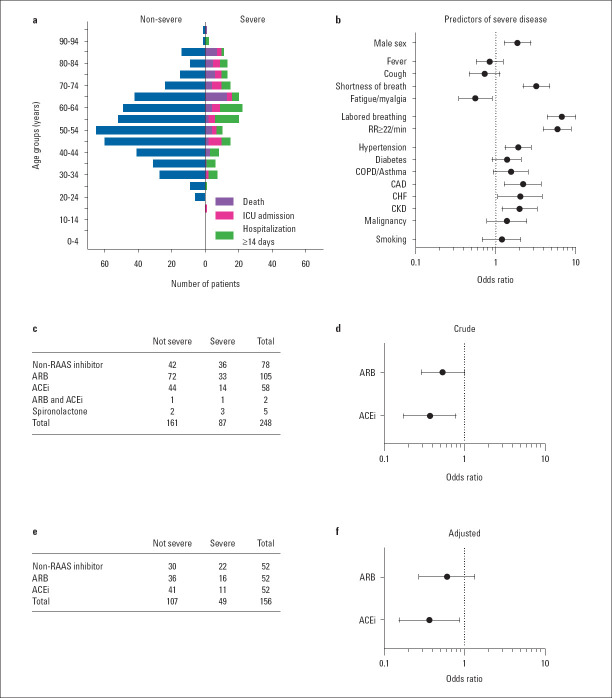
In total, 611 patients were admitted with COVID-19, confirmed by either reverse-transcriptase polymerase chain reaction or computed tomography (CT). There were 363 males, and the age ranged from 18 to 98 years, with an average age of 57±15 years. Of these, 165 participants had severe disease (53 deaths, case fatality rate: 8.7%). Among those with hypertension (n=249), ARB exposure was compatible with decreased odds (OR=0.60, 95% CI: 0.27-1.36, p=0.31) of severe disease though not statistically significant, while ACEi exposure significantly reduced the risk of severe disease (OR=0.37, 95% CI: 0.15-0.87, p=0.03). ACEi exposure was associated with milder infiltrations seen on baseline CT, lower C-reactive protein and ferritin, higher monocytes, shorter hospitalization, and less requirement for specific empirical treatments (favipiravir and meropenem).
Our data suggest that exposure to ACEi drugs may have favorable effects in the context of COVID-19 pneumonia.
2019冠状病毒病(COVID-19)由严重急性呼吸综合征冠状病毒2(SARS-CoV-2)引起。肾素-血管紧张素-醛固酮系统(RAAS)抑制剂可能会增加血管紧张素转换酶2的表达,而血管紧张素转换酶2是SARS-CoV-2刺突蛋白的受体。在COVID-19大流行期间使用血管紧张素转换酶抑制剂(ACEi)和血管紧张素受体阻滞剂(ARB)的后果尚不清楚。
开展一项回顾性队列研究,旨在确定与接触ACEi或ARB相关的重症疾病(定义为住院≥14天、入住重症监护病房或死亡)的几率。纳入2020年3月9日至5月11日期间入住伊斯坦布尔医学院新冠中心的成年COVID-19患者(年龄≥18岁)。根据年龄、性别、住院前患病天数、合并症、吸烟情况、抗高血压治疗方案数量、是否使用多沙唑嗪、是否使用呋塞米以及血清肌酐水平,对ACEi、ARB或其他抗高血压药物的长期使用者进行匹配。计算发生重症疾病的比值比(OR)。
共有611例经逆转录聚合酶链反应或计算机断层扫描(CT)确诊为COVID-19的患者入院。其中男性363例,年龄在18至98岁之间,平均年龄为57±15岁。其中,165例患者患有重症疾病(53例死亡,病死率:8.7%)。在高血压患者(n=249)中,接触ARB与重症疾病几率降低(OR=0.60,95%置信区间:0.27-1.36,p=0.31)相关,尽管无统计学意义,而接触ACEi显著降低了重症疾病风险(OR=0.37,95%置信区间:0.15-0.87,p=0.03)。接触ACEi与基线CT上较轻的浸润、较低的C反应蛋白和铁蛋白、较高的单核细胞、较短的住院时间以及较少的特定经验性治疗(法匹拉韦和美罗培南)需求相关。
我们的数据表明,在COVID-19肺炎的情况下,接触ACEi药物可能具有有益作用。