Abel Yvonne, Vlassiouk Ivan, Lork Enno, Smirnov Sergei, Talipov Marat R, Montforts Franz-Peter
Institut für Organische und Analytische Chemie, FB2, Universität Bremen, Leobener Straße NW2/C, 28359, Bremen, Germany.
Oak Ridge National Laboratory, Oak Ridge, Tennesee, 37831, USA.
Chemistry. 2020 Dec 18;26(71):17120-17127. doi: 10.1002/chem.202002736. Epub 2020 Nov 19.
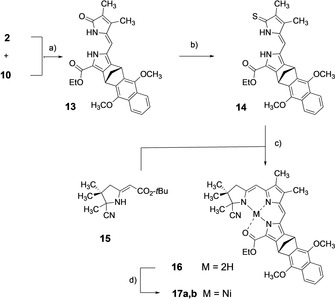
In donor-acceptor dyads undergoing photoinduced electron transfer (PET), a direction or pathway for electron movement is usually dictated by the redox properties and the separation distance between the donor and acceptor subunits, while the effect of symmetry is less recognized. We have designed and synthesized two isomeric donor-acceptor assemblies in which electronic coupling between donor and acceptor is altered by the orbital symmetry control with the reorganization energy and charge transfer exothermicity being kept unchanged. Analysis of the optical absorption and luminescence spectra, supported by the DFT and TD-DFT calculations, showed that PET in these assemblies corresponds to the Marcus inverted region (MIR) and has larger rate for isomer with weaker electronic coupling. This surprising observation provides the first experimental evidence for theoretically predicted adiabatic suppression of PET in MIR, which unambiguously controlled solely by symmetry.
在经历光致电子转移(PET)的供体-受体二元体系中,电子移动的方向或途径通常由供体和受体亚基之间的氧化还原性质及分离距离决定,而对称性的影响则较少被认识到。我们设计并合成了两种异构体供体-受体组装体,其中供体和受体之间的电子耦合通过轨道对称性控制而改变,同时重组能和电荷转移放热保持不变。由密度泛函理论(DFT)和含时密度泛函理论(TD-DFT)计算支持的光吸收和发光光谱分析表明,这些组装体中的PET对应于马库斯反转区域(MIR),并且对于电子耦合较弱的异构体具有更大的速率。这一惊人的观察结果为理论预测的MIR中PET的绝热抑制提供了首个实验证据,该绝热抑制仅由对称性明确控制。