Division of Hematologic Malignancies and Cellular Therapy, Duke University Medical Center, Durham, NC, USA.
Department of Pathology, Duke University Medical Center, Durham, NC, USA.
Cancer Med. 2020 Aug;9(16):5869-5880. doi: 10.1002/cam4.3265. Epub 2020 Jul 6.
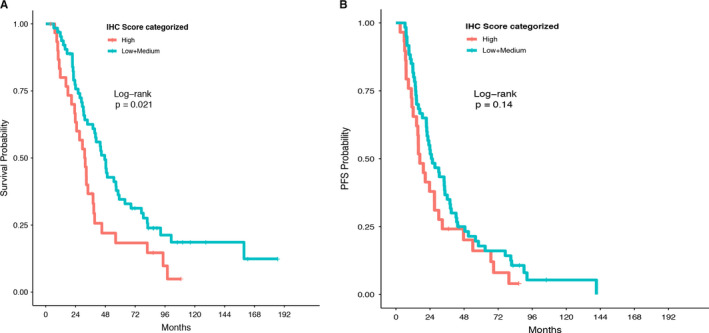
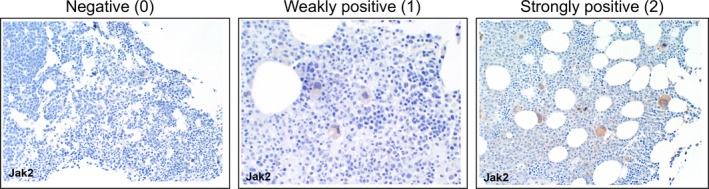
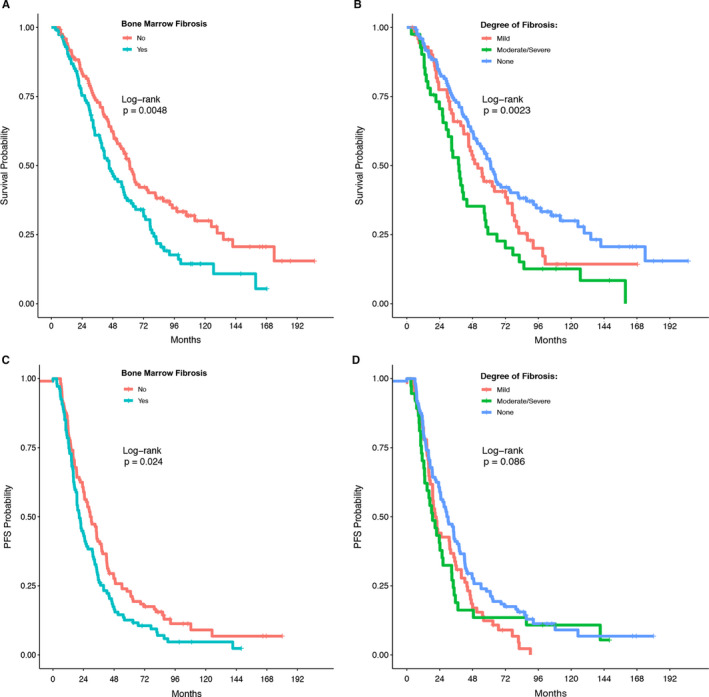
We determined the impact of bone marrow fibrosis (BMF) on the clinical outcomes of newly diagnosed multiple myeloma (NDMM) patients in the current era of myeloma therapy. A total of 393 MM patients were included in the final analysis. The median followup was 83 months (range: 3.9 to 212 months). BMF was noted in 122 (48.2%) evaluable patients. Median progression free survival (PFS) in patients without BMF was 30.2 (95% CI: 24.7-38.0) months, and 21.1 (95% CI: 18.8-27.5) months in patients with BMF present (P = .024). Median overall survival (OS) was 61.2 (95% CI: 51.5-81.2) months in patients without BMF, and 45.1 (95% CI: 38.7-57.0) months in patients with BMF (P = .0048). A subset of 99 patients had their bone marrow biopsies stained for JAK1 and JAK2 by immunohistochemistry. Of these samples 67 (67.7%) patients had detectable JAK2 expression predominantly noted on bone marrow megakaryocytes. JAK2 expression correlated with myeloma disease stage (P = .0071). Our study represents the largest dataset to date examining the association of BMF with prognosis in the era of novel therapies and widespread use of hematopoietic stem cell transplant (HSCT). Our data suggest that MM patients with BMF (particularly those with extensive BMF) have a poorer prognosis even when treated with immunomodulatory agents and proteasome inhibitors.
我们确定了骨髓纤维化(BMF)对多发性骨髓瘤(MM)新诊断患者(NDMM)临床结局的影响,该研究是在骨髓瘤治疗的当前时代进行的。共有 393 名 MM 患者被纳入最终分析。中位随访时间为 83 个月(范围:3.9-212 个月)。在可评估的 122 名患者中,有 48.2%的患者存在 BMF。无 BMF 的患者的无进展生存期(PFS)中位数为 30.2(95%CI:24.7-38.0)个月,有 BMF 的患者为 21.1(95%CI:18.8-27.5)个月(P=0.024)。无 BMF 的患者的总生存期(OS)中位数为 61.2(95%CI:51.5-81.2)个月,有 BMF 的患者为 45.1(95%CI:38.7-57.0)个月(P=0.0048)。99 名患者的骨髓活检标本进行了 JAK1 和 JAK2 的免疫组化染色。在这些样本中,67(67.7%)例患者的骨髓巨核细胞上检测到 JAK2 表达,主要为 JAK2 表达。JAK2 表达与骨髓瘤疾病分期相关(P=0.0071)。本研究代表了迄今为止最大的数据集,用于研究在新型治疗药物和广泛使用造血干细胞移植(HSCT)的时代,BMF 与预后的关系。我们的数据表明,即使接受免疫调节剂和蛋白酶体抑制剂治疗,存在 BMF 的 MM 患者(尤其是广泛存在 BMF 的患者)预后更差。