Tumor Immunology Lab, Radboud University Medical Center, Radboud Institute for Molecular Life Sciences, Geert Grooteplein 28, 6525 GA Nijmegen, The Netherlands.
Department of Neurology, Donders Institute for Brain, Cognition and Behaviour, Radboud University Medical Center, Geert Grooteplein 10, 6525 GA Nijmegen, The Netherlands.
Int J Mol Sci. 2020 Jun 30;21(13):4654. doi: 10.3390/ijms21134654.
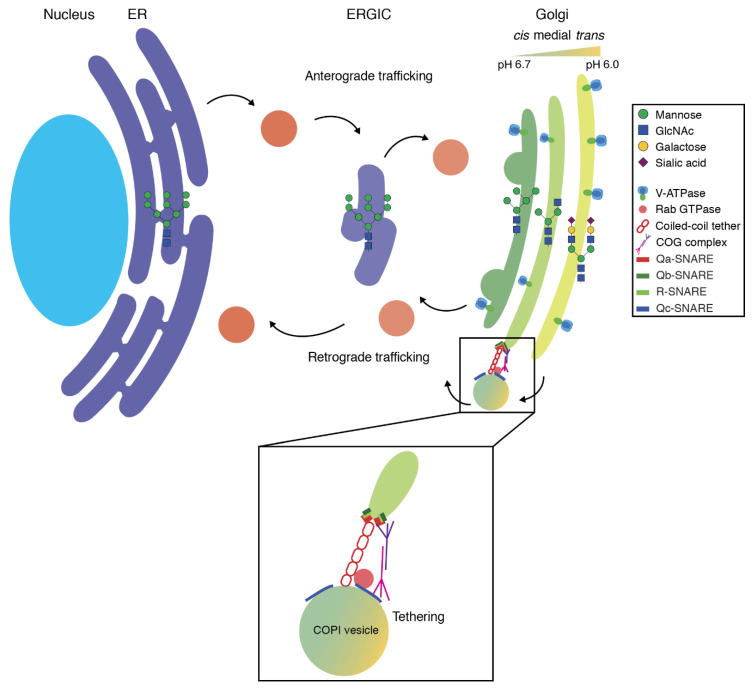
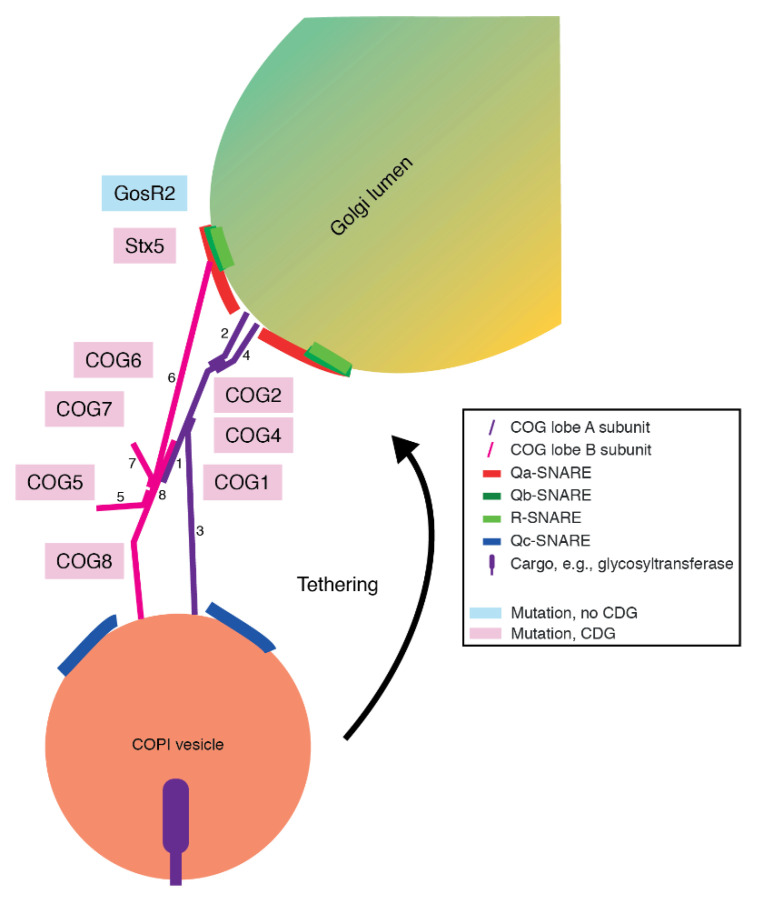
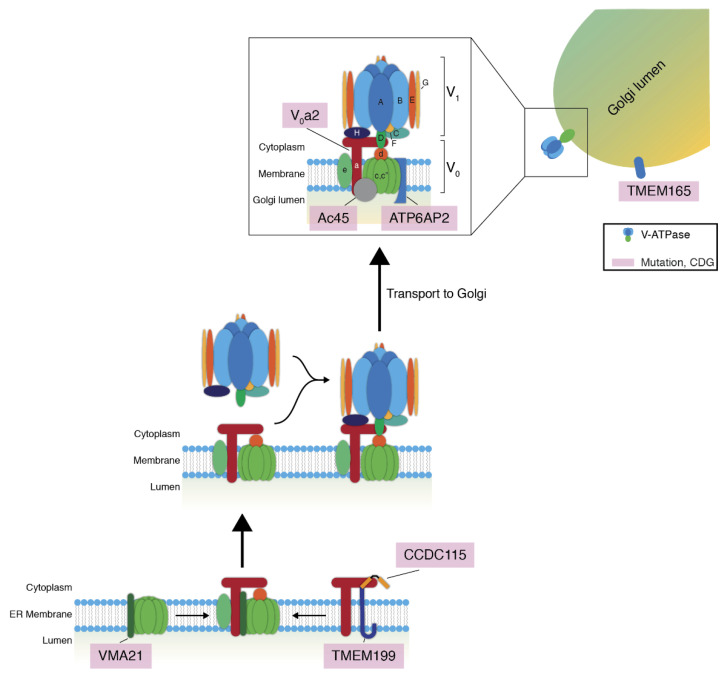
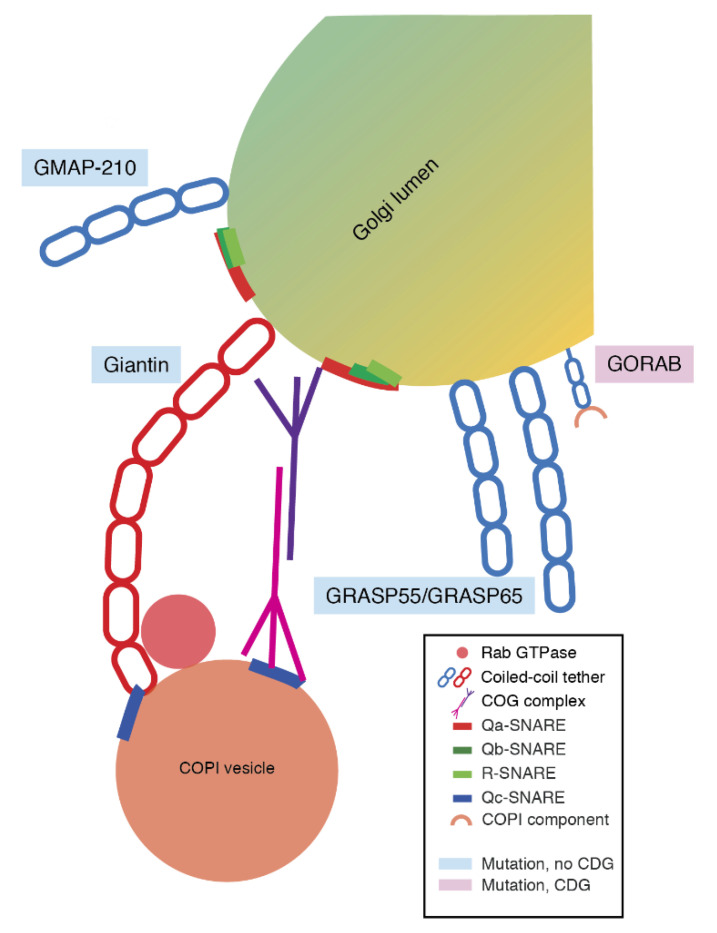
Glycosylation is an important post-translational modification for both intracellular and secreted proteins. For glycosylation to occur, cargo must be transported after synthesis through the different compartments of the Golgi apparatus where distinct monosaccharides are sequentially bound and trimmed, resulting in increasingly complex branched glycan structures. Of utmost importance for this process is the intraorganellar environment of the Golgi. Each Golgi compartment has a distinct pH, which is maintained by the vacuolar H-ATPase (V-ATPase). Moreover, tethering factors such as Golgins and the conserved oligomeric Golgi (COG) complex, in concert with coatomer (COPI) and soluble N-ethylmaleimide-sensitive factor attachment protein receptor (SNARE)-mediated membrane fusion, efficiently deliver glycosylation enzymes to the right Golgi compartment. Together, these factors maintain intra-Golgi trafficking of proteins involved in glycosylation and thereby enable proper glycosylation. However, pathogenic mutations in these factors can cause defective glycosylation and lead to diseases with a wide variety of symptoms such as liver dysfunction and skin and bone disorders. Collectively, this group of disorders is known as congenital disorders of glycosylation (CDG). Recent technological advances have enabled the robust identification of novel CDGs related to membrane trafficking components. In this review, we highlight differences and similarities between membrane trafficking-related CDGs.
糖基化是细胞内和分泌蛋白的重要翻译后修饰。为了发生糖基化,货物必须在合成后通过高尔基体的不同隔室运输,在那里不同的单糖依次结合和修剪,导致越来越复杂的分支聚糖结构。对于这个过程最重要的是高尔基体的细胞器内环境。每个高尔基体隔室都有独特的 pH 值,由液泡 H+-ATP 酶(V-ATPase)维持。此外, tethering 因子(如 Golgins 和保守的寡聚高尔基体(COG)复合物)与衣被蛋白(COPI)和可溶性 N-乙基马来酰亚胺敏感因子附着蛋白受体(SNARE)介导的膜融合协同作用,有效地将糖基化酶递送到正确的高尔基体隔室。这些因素共同维持参与糖基化的高尔基体蛋白的细胞内运输,从而实现正确的糖基化。然而,这些因素的致病突变会导致糖基化缺陷,并导致具有多种症状的疾病,如肝功能障碍和皮肤和骨骼疾病。总的来说,这组疾病被称为先天性糖基化障碍(CDG)。最近的技术进步使人们能够强有力地识别与膜运输成分相关的新型 CDG。在这篇综述中,我们强调了与膜运输相关的 CDG 之间的差异和相似之处。