School of Chinese Medicine, College of Chinese Medicine, China Medical University, Taichung 404, Taiwan.
Graduate Institute of Acupuncture Science, College of Chinese Medicine, China Medical University, Taichung 404, Taiwan.
Nutrients. 2020 Jun 30;12(7):1950. doi: 10.3390/nu12071950.
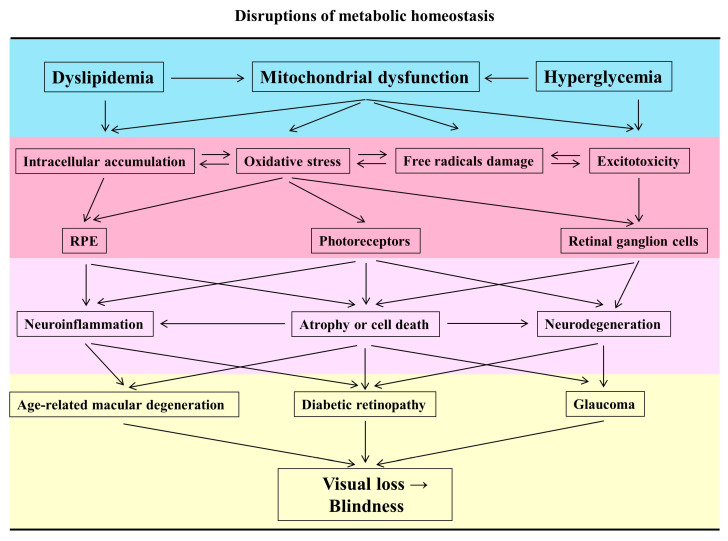
The eyes require a rich oxygen and nutrient supply; hence, the high-energy demand of the visual system makes it sensitive to oxidative stress. Excessive free radicals result in mitochondrial dysfunction and lead to retinal neurodegeneration, as an early stage of retinal metabolic disorders. Retinal cells are vulnerable because of their coordinated interaction and intricate neural networks. Nutraceuticals are believed to target multiple pathways and have shown neuroprotective benefits by scavenging free radicals and promoting mitochondrial gene expression. Furthermore, encouraging results demonstrate that nutraceuticals improve the organization of retinal cells and visual functions. This review discusses the mitochondrial impairments of retinal cells and the mechanisms underlying the neuroprotective effects of nutraceuticals. However, some unsolved problems still exist between laboratory study and clinical therapy. Poor bioavailability and bioaccessibility strongly limit their development. A new delivery system and improved formulation may offer promise for health care applications.
眼睛需要丰富的氧气和营养供应;因此,视觉系统的高能量需求使其容易受到氧化应激的影响。过多的自由基会导致线粒体功能障碍,并导致视网膜神经退行性变,这是视网膜代谢紊乱的早期阶段。视网膜细胞很脆弱,因为它们的协调相互作用和复杂的神经网络。营养保健品被认为可以针对多个途径,通过清除自由基和促进线粒体基因表达来显示神经保护作用。此外,令人鼓舞的结果表明,营养保健品可以改善视网膜细胞的组织和视觉功能。本文讨论了视网膜细胞的线粒体损伤以及营养保健品的神经保护作用的机制。然而,实验室研究和临床治疗之间仍然存在一些未解决的问题。较差的生物利用度和生物可及性强烈限制了它们的发展。新的传递系统和改进的配方可能为医疗保健应用带来希望。