Reproductive Genomics Group, Temasek Life Sciences Laboratory, Singapore 117604, Singapore.
School of Applied Science, Republic Polytechnic, 9 Woodlands Avenue 9, Singapore 738964, Singapore.
Genes (Basel). 2020 Jun 30;11(7):733. doi: 10.3390/genes11070733.
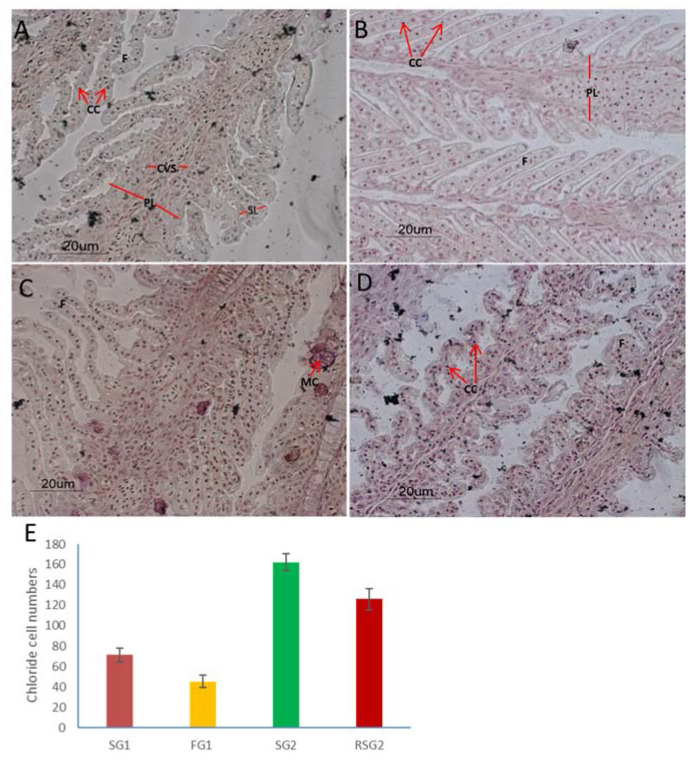
Asian seabass (or commonly known as barramundi), is a bony euryhaline teleost from the Family , inhabiting nearshore, estuarine, and marine connected freshwaters throughout the tropical Indo-West Pacific region. The species is catadromous, whereby adults spawn in salinities between 28 and 34 ppt at the mouth of estuaries, with resultant juveniles usually moving into brackish and freshwater systems to mature, before returning to the sea to spawn again as adults. The species lives in both marine and freshwater habitats and can move quickly between the two; thus, the species' ability to tolerate changes in salinity makes it a good candidate for studying the salinity acclimation response in teleosts. In this study, the transcriptome of two major osmoregulatory organs (gills and kidneys) of young juvenile Asian seabass reared in freshwater and seawater were compared. The euryhaline nature of Asian seabass was found to be highly pliable and the moldability of the trait was further confirmed by histological analyses of gills and kidneys. Differences in major expression pathways were observed, with differentially expressed genes including those related to osmoregulation, tissue/organ morphogenesis, and cell volume regulation as central to the osmo-adaptive response. Additionally, genes coding for mucins were upregulated specifically under saline conditions, whereas several genes important for growth and development, as well as circadian entrainment were specifically enriched in fish reared in freshwater. Routing of the circadian rhythm mediated by salinity changes could be the initial step in salinity acclimation and possibly migration in euryhaline fish species such as the Asian seabass.
亚洲羊头鱼(俗称巴浪鱼)是一种硬骨洄游性鱼类,属于隆头鱼科,分布于热带西太平洋至印度洋海域的近岸、河口和咸淡水水域。该物种为溯河洄游性,成鱼在河口盐度为 28-34 的区域产卵,幼鱼通常在进入河口咸淡水水域后发育成熟,然后洄游至海洋中产卵,再次发育成熟后洄游至河口产卵。该物种生活在海洋和淡水环境中,能够在两者之间快速移动;因此,该物种对盐度变化的耐受能力使其成为研究硬骨鱼类盐度适应反应的良好候选物种。本研究比较了在淡水和海水中饲养的幼鱼的两个主要渗透压调节器官(鳃和肾脏)的转录组。研究发现,亚洲羊头鱼的广盐性非常灵活,通过对鳃和肾脏的组织学分析进一步证实了这种特性的可塑造性。观察到主要表达途径的差异,差异表达的基因包括与渗透压调节、组织/器官形态发生和细胞体积调节相关的基因,这些基因是渗透压适应反应的核心。此外,在盐度条件下,编码粘蛋白的基因特异性地上调,而在淡水中饲养的鱼类中,几个与生长和发育以及昼夜节律同步相关的重要基因特异性富集。由盐度变化介导的昼夜节律的路由可能是盐度适应和可能的洄游的初始步骤,如亚洲羊头鱼等广盐性鱼类。