GRETEL-Research Group on Technology Enhanced Learning, La Salle Campus Barcelona, Universitat Ramon Llull, 08022 Barcelona, Spain.
Blanquerna, Universitat Ramon Llull, 08022 Barcelona, Spain.
Sensors (Basel). 2020 Jul 1;20(13):3698. doi: 10.3390/s20133698.
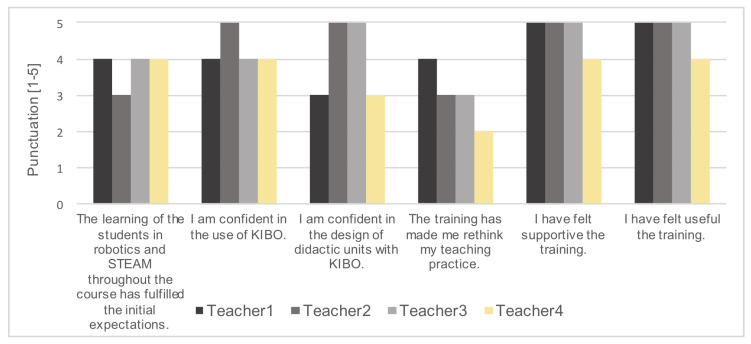
Robotics is one of the key learnings in a world where learners will interact with multiple robotic technologies and operating systems throughout their lives. However, school teachers, especially in the elementary and primary education stages, often have difficulties incorporating these tools in the classroom. Four elementary teachers in three schools in Catalonia were trained to introduce robotics in the classroom to seventy-five students. The main actions consisted in classroom accompaniment by a university-trained support teacher, curricular materials' development, and assessment of the students' and teachers' learning. The designed contents and evaluation criteria took into account the potential of educational robotics to improve soft skills and to promote Science, Technology, Engineering, Arts, and Mathematics (STEAM) interdisciplinary learning. Teachers perceived the training to be supportive and useful and ended the school year feeling confident with the used robotic platform (KIBO). The assessment of the students' learning showed an average mark of 7.1-7.7 over 10 in the final evaluation criteria. Moreover, students' learning was higher in the classes where the teachers had higher initial interest in the training. We present and analyse the actions carried out, with a critical and constructive look at extending the experience to other educational centers.
机器人技术是学习者在一生中将与多种机器人技术和操作系统互动的世界中的关键学习内容之一。然而,学校教师,特别是在小学和基础教育阶段,通常难以在课堂中引入这些工具。在加泰罗尼亚的三所学校中,有四名小学教师接受了培训,以便在课堂上引入机器人技术,涉及的学生人数为七十五人。主要的行动包括由受过大学培训的支持教师进行课堂辅导、课程材料的开发,以及对学生和教师学习的评估。设计的内容和评估标准考虑到了教育机器人在提高软技能和促进跨学科学习(STEAM)方面的潜力。教师们认为培训具有支持性和有用性,并在学年结束时对所使用的机器人平台(KIBO)充满信心。对学生学习的评估显示,在最终评估标准中,学生的平均得分为 7.1-7.7 分,满分 10 分。此外,在教师对培训更感兴趣的班级中,学生的学习成绩更高。我们展示并分析了所进行的行动,并以批判性和建设性的眼光看待将经验扩展到其他教育中心。