Zelber-Sagi Shira, Ivancovsky-Wajcman Dana, Fliss-Isakov Naomi, Hahn Michal, Webb Muriel, Shibolet Oren, Kariv Revital, Tirosh Oren
School of Public Health, University of Haifa, Haifa 3498838, Israel.
Department of Gastroenterology, Tel Aviv Medical Center, Tel Aviv 6423914, Israel.
Antioxidants (Basel). 2020 Jul 2;9(7):578. doi: 10.3390/antiox9070578.
Non-alcoholic fatty liver disease (NAFLD) and steatohepatitis (NASH) are associated with increased oxidative stress and lipid peroxidation, but large studies are lacking. The aim was to test the association of malondialdehyde (MDA), as a marker of oxidative damage of lipids, with NAFLD and liver damage markers, and to test the association between dietary vitamins E and C intake and MDA levels.
A cross-sectional study was carried out among subjects who underwent blood tests including FibroMax for non-invasive assessment of NASH and fibrosis. MDA was evaluated by reaction with Thiobarbituric acid and HPLC-fluorescence detection method. NAFLD was diagnosed by abdominal ultrasound.
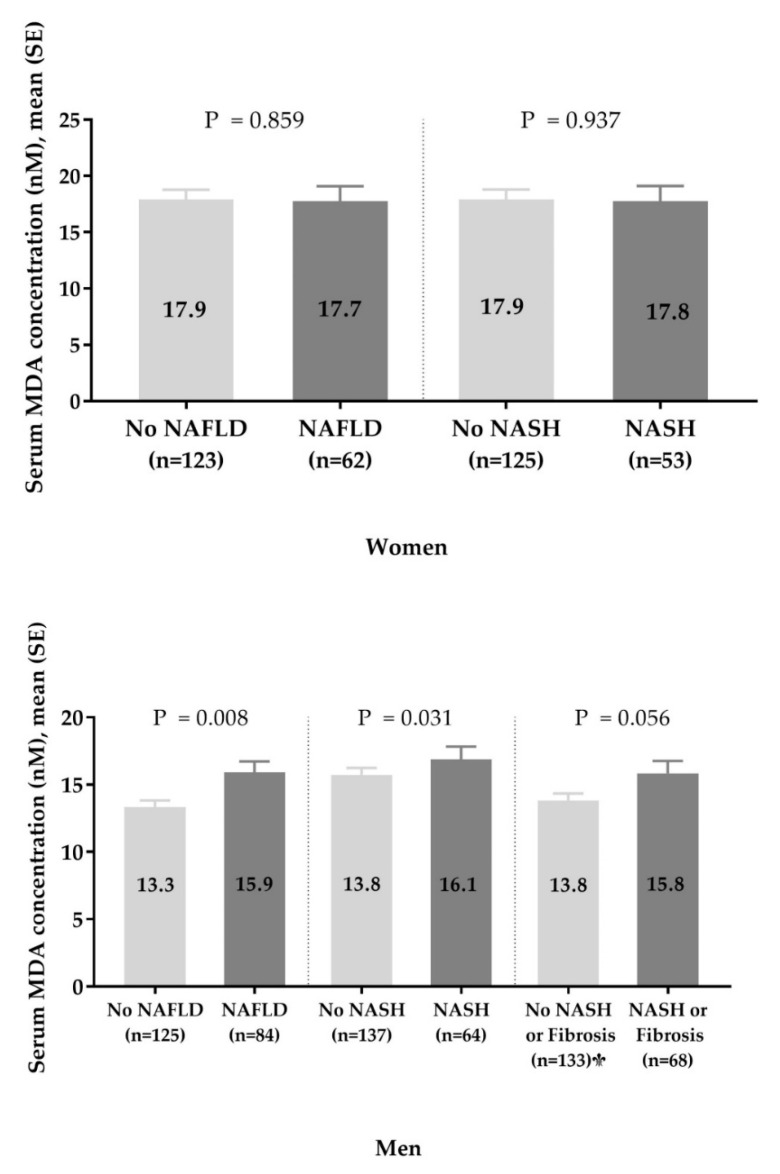
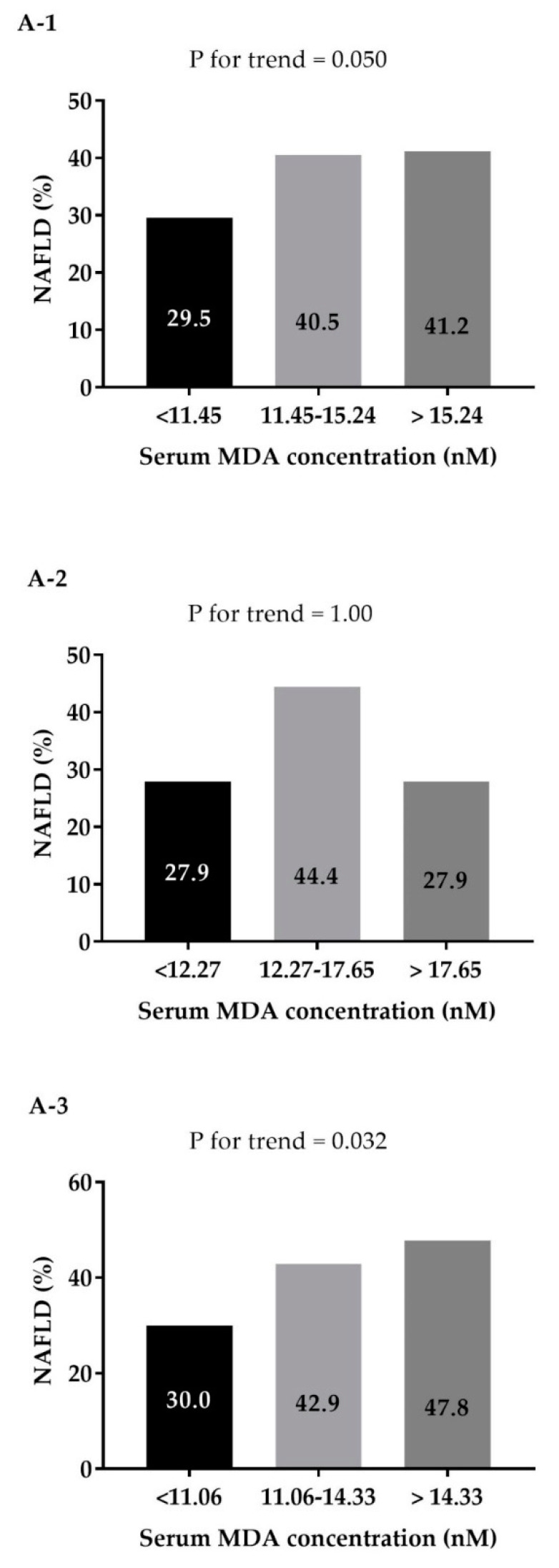
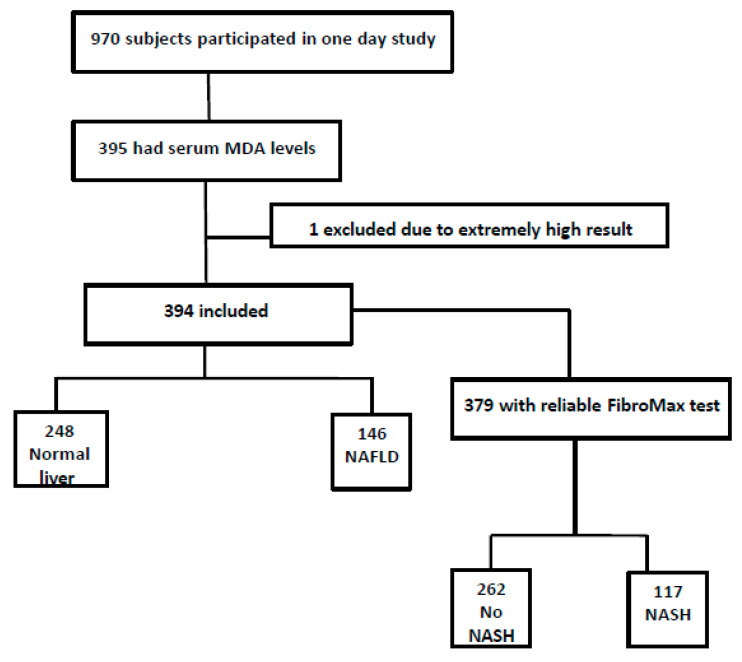
MDA measurements were available for 394 subjects. In multivariate analysis, the odds for NAFLD were higher with the rise of MDA levels in a dose-response manner, adjusting for age, gender, BMI, and lifestyle factors. Only among men, higher serum MDA was associated of higher odds for NAFLD and NASH and/or fibrosis (OR = 2.59, 95% CI 1.33-5.07, = 0.005; OR = 2.04, 1.02-4.06, = 0.043, respectively). Higher vitamin E intake was associated with lower odds of high serum MDA level (OR = 0.28 95% CI 0.13-0.62, = 0.002). In conclusion, serum MDA is associated with NAFLD and markers of NASH or fibrosis among men. Dietary vitamin E may be protective among women.
非酒精性脂肪性肝病(NAFLD)和脂肪性肝炎(NASH)与氧化应激增加和脂质过氧化有关,但缺乏大型研究。目的是测试作为脂质氧化损伤标志物的丙二醛(MDA)与NAFLD和肝损伤标志物之间的关联,并测试膳食维生素E和C摄入量与MDA水平之间的关联。
对接受血液检测(包括用于NASH和纤维化无创评估的FibroMax检测)的受试者进行了一项横断面研究。通过与硫代巴比妥酸反应和高效液相色谱-荧光检测法评估MDA。通过腹部超声诊断NAFLD。
394名受试者有MDA测量值。在多变量分析中,调整年龄、性别、BMI和生活方式因素后,NAFLD的几率随着MDA水平的升高呈剂量反应方式增加。仅在男性中,较高的血清MDA与NAFLD和NASH和/或纤维化的较高几率相关(OR = 2.59,95% CI 1.33 - 5.07,P = 0.005;OR = 2.04,1.02 - 4.06,P = 0.043)。较高的维生素E摄入量与高血清MDA水平的较低几率相关(OR = 0.28,95% CI 0.13 - 0.62,P = 0.002)。总之,血清MDA与男性中的NAFLD以及NASH或纤维化标志物相关。膳食维生素E可能对女性有保护作用。