Tanabe Hayato, Saito Haruka, Kudo Akihiro, Machii Noritaka, Hirai Hiroyuki, Maimaituxun Gulinu, Tanaka Kenichi, Masuzaki Hiroaki, Watanabe Tsuyoshi, Asahi Koichi, Kazama Junichiro, Shimabukuro Michio
Department of Diabetes, Endocrinology and Metabolism, Fukushima Medical University, Fukushima 960-1295, Japan.
Department of Internal Medicine, Ohara General Hospital, Fukushima 960-8611, Japan.
J Clin Med. 2020 Jul 2;9(7):2083. doi: 10.3390/jcm9072083.
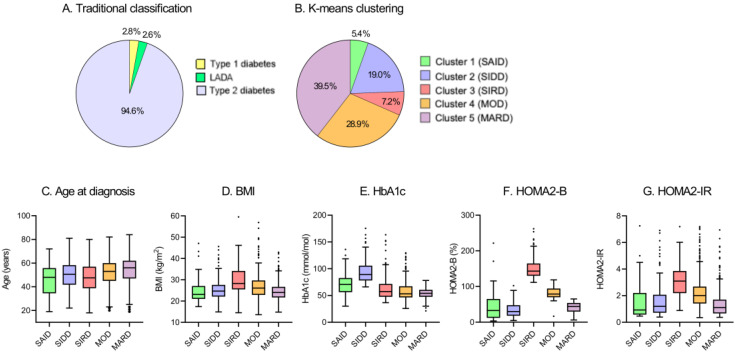
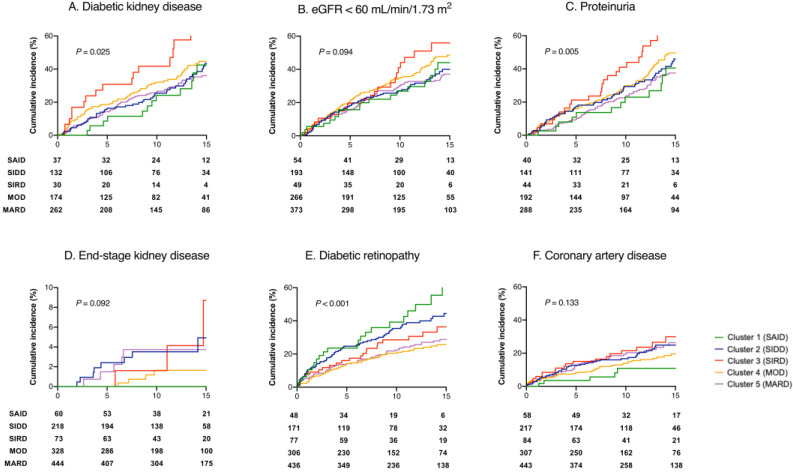
Diabetes is a complex and heterogeneous disease, making the prediction of the risks of diabetic complications challenging. Novel adult-onset diabetes subgroups have been studied using cluster analysis, but its application in East Asians remains unclear. We conducted a retrospective cohort study to elucidate the clinical utility of cluster-based subgroup analysis in the Japanese population. Cluster analysis based on anti-glutamate decarboxylase antibody (GAD antibody) levels, age at diagnosis, body mass index (BMI), hemoglobin A1c (A1c), and homeostatic model assessment 2 estimates of β-cell function and insulin resistance was performed in 1520 diabetic patients. The risk of developing diabetic complications was analyzed using Kaplan-Meier analysis and the Cox proportional hazards model. By cluster analysis, we identified five distinct subgroups of adult-onset diabetes in the Japanese population. The risk of diabetic complications varied greatly among the clusters. Patients with severe autoimmune diabetes or severe insulin deficiency diabetes were at an increased risk of diabetic retinopathy, and those with severe insulin resistant diabetes (SIRD) had the highest risk of developing diabetic kidney disease (DKD). After adjusting for uncorrectable and correctable risk factors, SIRD was found to be an independent risk factor for DKD. In conclusion, we identified five subgroups of adult-onset diabetes and the risk factors for diabetic complications in the Japanese population. This new classification system can be effective in predicting the risk of diabetic complications and for providing optimal treatment.
糖尿病是一种复杂的异质性疾病,这使得预测糖尿病并发症的风险具有挑战性。已使用聚类分析对新型成人发病型糖尿病亚组进行了研究,但其在东亚人群中的应用仍不明确。我们进行了一项回顾性队列研究,以阐明基于聚类的亚组分析在日本人群中的临床效用。对1520例糖尿病患者进行了基于抗谷氨酸脱羧酶抗体(GAD抗体)水平、诊断年龄、体重指数(BMI)、糖化血红蛋白(A1c)以及β细胞功能和胰岛素抵抗的稳态模型评估2的聚类分析。使用Kaplan-Meier分析和Cox比例风险模型分析发生糖尿病并发症的风险。通过聚类分析,我们在日本人群中确定了成人发病型糖尿病的五个不同亚组。各聚类之间糖尿病并发症的风险差异很大。重度自身免疫性糖尿病或重度胰岛素缺乏性糖尿病患者发生糖尿病视网膜病变的风险增加,而重度胰岛素抵抗性糖尿病(SIRD)患者发生糖尿病肾病(DKD)的风险最高。在对不可纠正和可纠正的风险因素进行调整后,发现SIRD是DKD的独立风险因素。总之,我们在日本人群中确定了成人发病型糖尿病的五个亚组以及糖尿病并发症的风险因素。这种新的分类系统可有效预测糖尿病并发症的风险并提供最佳治疗。