Department of Nutrition, School of Public Health, University of São Paulo, Av. Dr. Arnaldo, 715-Cerqueira César, São Paulo, 01246-904, Brazil.
Center for Epidemiological Studies in Health and Nutrition (NUPENS), Faculty of Public Health, University of São Paulo, Av. Dr. Arnaldo, 715-Cerqueira César, São Paulo, 01246-904, Brazil.
Nutr J. 2020 Jul 6;19(1):66. doi: 10.1186/s12937-020-00585-1.
Dietary Guidelines are an important tool for population health promotion efforts. However, current surveillance data suggest that only a small minority of the population meet the 2014 Brazilian Dietary Guidelines (BDG) recommendations. Translating recommendations into practice may not be immediately clear and behavior-change messages guiding the behaviors that need to be changed and identifying substitute practices to meet a specific recommendation, are required. This study details the methods undertaken to develop and refine messages supporting the adoption of healthy dietary choices and behaviors in adults, as outlined in the BDG.
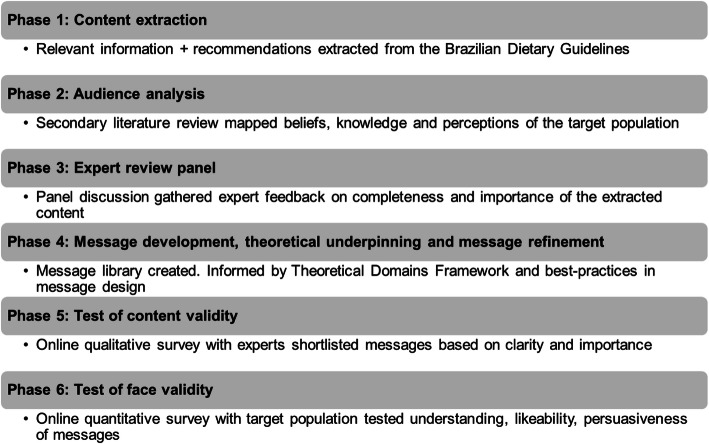
A sequential, five-step, mixed-methods approach, determined a priori, was followed for designing and refining messages. These included: (1) content extraction; (2) audience analysis; (3) input from an expert review panel; (4) message development and message refinement; and a (5) test of content validity.
The content extraction process led to the identification of 63 excerpts from the BDG, organized into themes. The audience analysis highlighted barriers to healthy eating that included lack of time (to eat, to cook), difficulty in accessing healthy food, the convenience and the ubiquitous marketing of ultra-processed foods. Twenty of the 63 DG excerpts reviewed by the expert panel were identified as being a priority for message development and total of 111 messages were developed. Messages were short, structured to be one-sided, conveyed the most important information at the beginning (anticlimactic), used simple language and were explicit in the information they relayed. They were positive and gain-framed and used an empathetic, solution- or substitution-based tone and were presented in the active voice. The messages focused on goals and skill development, behavior regulation, incentivized positive practices as time and/or cost saving. Content validity testing helped further messages and reduced the number of messages from 111 to 40.
This study provides the blue-print for the phase-wise development of messages that synthesize the key recommendations of the food-based BDG and communicate the adoption of behaviors and goals that are consistent with it's message. It details methods which could be adapted and replicated for message development in other contexts.
饮食指南是促进人口健康的重要工具。然而,目前的监测数据表明,只有少数人符合 2014 年巴西饮食指南(BDG)的建议。将建议转化为实践可能并不明显,需要有行为改变的信息来指导需要改变的行为,并确定替代实践来满足特定建议。本研究详细介绍了为支持成年人采用健康饮食选择和行为而制定和完善信息的方法,这些方法概述于 BDG 中。
采用预先确定的顺序、五步骤、混合方法方法来设计和完善信息。这些方法包括:(1)内容提取;(2)受众分析;(3)专家审查小组的意见;(4)信息的开发和完善;以及(5)内容有效性的测试。
内容提取过程导致从 BDG 中确定了 63 个摘录,组织成主题。受众分析突出了健康饮食的障碍,包括缺乏时间(吃饭、做饭)、难以获得健康食品、超加工食品的便利性和无处不在的营销。由专家小组审查的 63 个 BDG 摘录中的 20 个被确定为信息开发的优先事项,总共开发了 111 条信息。信息简短,结构为单边,开头传达最重要的信息(虎头蛇尾),使用简单的语言,并明确传达信息。它们是积极的,以获得为主导,使用有同理心、基于解决方案或替代方案的语气,并以主动语态呈现。这些信息侧重于目标和技能发展、行为调节、激励积极实践,以节省时间和/或成本。内容有效性测试有助于进一步完善信息,并将信息数量从 111 条减少到 40 条。
本研究为逐步制定信息提供了蓝图,这些信息综合了基于食物的 BDG 的关键建议,并传达了与该信息一致的行为和目标的采用。它详细介绍了可在其他背景下适应和复制的方法,用于信息开发。