Department of Preventive Medicine, Keck School of Medicine, University of Southern California, 2001 N. Soto St, Los Angeles, CA, 90032, USA.
Department of Psychology, Dornsife College of Letters, Arts, and Sciences, University of Southern California, Los Angeles, USA.
BMC Public Health. 2020 Sep 4;20(1):1351. doi: 10.1186/s12889-020-09429-3.
COVID-19 restrictions such as the closure of schools and parks, and the cancellation of youth sports and activity classes around the United States may prevent children from achieving recommended levels of physical activity (PA). This study examined the effects of the COVID-19 pandemic on PA and sedentary behavior (SB) in U.S. children.
Parents and legal guardians of U.S. children (ages 5-13) were recruited through convenience sampling and completed an online survey between April 25-May 16, 2020. Measures included an assessment of their child's previous day PA and SB by indicating time spent in 11 common types of PA and 12 common types of SB for children. Parents also reported perceived changes in levels of PA and SB between the pre-COVID-19 (February 2020) and early-COVID-19 (April-May 2020) periods. Additionally, parents reported locations (e.g., home/garage, parks/trails, gyms/fitness centers) where their children had performed PA and their children's use of remote/streaming services for PA.
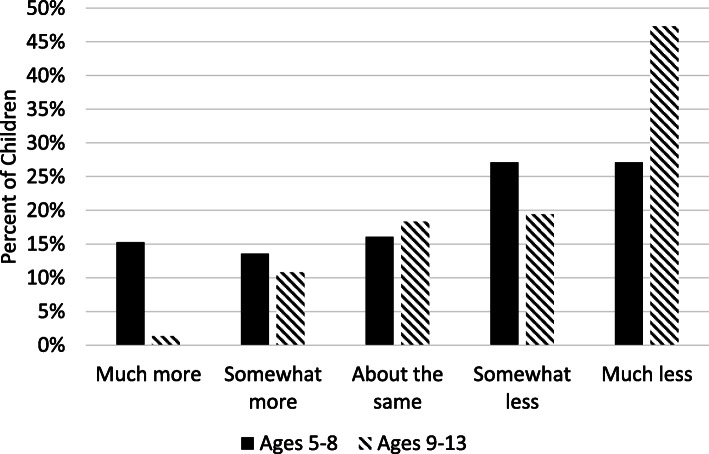
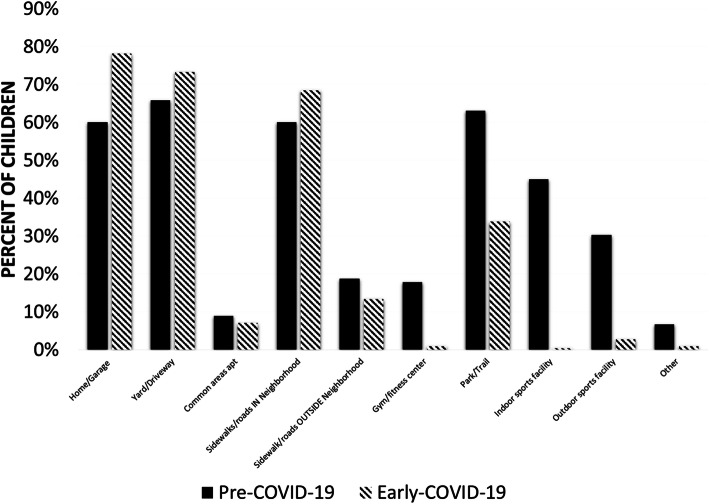
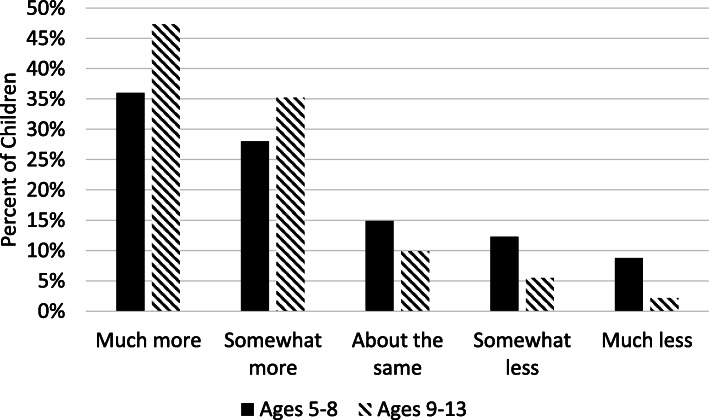
From parent reports, children (N = 211) (53% female, 13% Hispanic, M = 8.73 [SD = 2.58] years) represented 35 states and the District of Columbia. The most common physical activities during the early-COVID-19 period were free play/unstructured activity (e.g., running around, tag) (90% of children) and going for a walk (55% of children). Children engaged in about 90 min of school-related sitting and over 8 h of leisure-related sitting a day. Parents of older children (ages 9-13) vs. younger children (ages 5-8) perceived greater decreases in PA and greater increases in SB from the pre- to early-COVID-19 periods. Children were more likely to perform PA at home indoors or on neighborhood streets during the early- vs. pre-COVID-19 periods. About a third of children used remote/streaming services for activity classes and lessons during the early-COVID-19 period.
Short-term changes in PA and SB in reaction to COVID-19 may become permanently entrenched, leading to increased risk of obesity, diabetes, and cardiovascular disease in children. Programmatic and policy strategies should be geared towards promoting PA and reducing SB over the next 12 months.
美国的 COVID-19 限制措施,如学校和公园关闭,以及取消青少年体育和活动课程,可能会阻止儿童达到推荐的身体活动 (PA) 水平。本研究调查了 COVID-19 大流行对美国儿童 PA 和久坐行为 (SB) 的影响。
通过便利抽样招募了美国 5-13 岁儿童的父母和法定监护人,并于 2020 年 4 月 25 日至 5 月 16 日期间完成了在线调查。测量包括通过指示儿童在前一天进行的 11 种常见类型的 PA 和 12 种常见类型的 SB 中花费的时间来评估他们孩子的 PA 和 SB。父母还报告了 COVID-19 之前(2020 年 2 月)和 COVID-19 早期(2020 年 4-5 月)期间 PA 和 SB 水平的感知变化。此外,父母报告了儿童进行 PA 的地点(例如,家庭/车库、公园/小径、健身房/健身中心)以及他们的孩子使用远程/流媒体服务进行 PA 的情况。
从父母报告中,211 名儿童(53%为女性,13%为西班牙裔,M=8.73[SD=2.58]岁)代表了 35 个州和哥伦比亚特区。在 COVID-19 早期,最常见的体育活动是自由玩耍/无组织活动(例如奔跑、追逐)(90%的儿童)和散步(55%的儿童)。儿童每天大约有 90 分钟与学校相关的坐姿和超过 8 小时与休闲相关的坐姿。与年龄较小的儿童(5-8 岁)相比,年龄较大的儿童(9-13 岁)的父母认为从 COVID-19 前到 COVID-19 早期,PA 减少更多,SB 增加更多。与 COVID-19 前相比,儿童在 COVID-19 早期更有可能在家中室内或社区街道上进行 PA。大约三分之一的儿童在 COVID-19 早期期间使用远程/流媒体服务进行活动课程和课程。
COVID-19 短期的 PA 和 SB 变化可能会永久存在,导致儿童肥胖、糖尿病和心血管疾病的风险增加。未来 12 个月内应制定计划和政策策略,以促进 PA 和减少 SB。