Department of Radiation Oncology, University of California, San Francisco, CA, 94115, USA.
Sci Rep. 2020 Jul 6;10(1):11073. doi: 10.1038/s41598-020-68062-7.
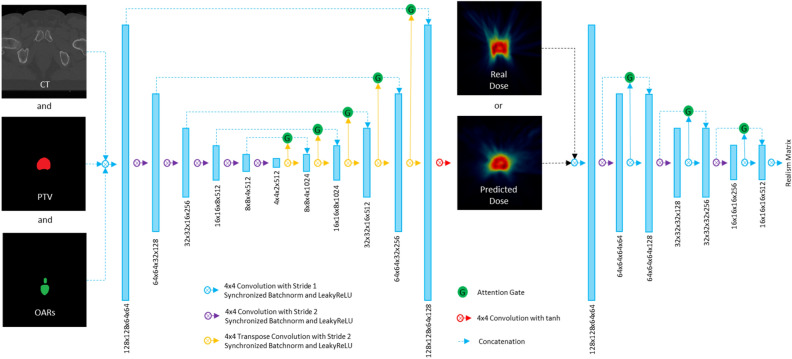
Deep learning algorithms have recently been developed that utilize patient anatomy and raw imaging information to predict radiation dose, as a means to increase treatment planning efficiency and improve radiotherapy plan quality. Current state-of-the-art techniques rely on convolutional neural networks (CNNs) that use pixel-to-pixel loss to update network parameters. However, stereotactic body radiotherapy (SBRT) dose is often heterogeneous, making it difficult to model using pixel-level loss. Generative adversarial networks (GANs) utilize adversarial learning that incorporates image-level loss and is better suited to learn from heterogeneous labels. However, GANs are difficult to train and rely on compromised architectures to facilitate convergence. This study suggests an attention-gated generative adversarial network (DoseGAN) to improve learning, increase model complexity, and reduce network redundancy by focusing on relevant anatomy. DoseGAN was compared to alternative state-of-the-art dose prediction algorithms using heterogeneity index, conformity index, and various dosimetric parameters. All algorithms were trained, validated, and tested using 141 prostate SBRT patients. DoseGAN was able to predict more realistic volumetric dosimetry compared to all other algorithms and achieved statistically significant improvement compared to all alternative algorithms for the V and V of the PTV, V of the rectum, and heterogeneity index.
深度学习算法最近已经被开发出来,可以利用患者解剖结构和原始成像信息来预测辐射剂量,以提高治疗计划效率和改善放射治疗计划质量。目前最先进的技术依赖于卷积神经网络 (CNN),它使用像素到像素的损失来更新网络参数。然而,立体定向体放射治疗 (SBRT) 剂量通常是不均匀的,因此很难使用像素级损失进行建模。生成对抗网络 (GAN) 利用对抗性学习,其中包括图像级损失,更适合从异构标签中学习。然而,GAN 很难训练,并且依赖于妥协的架构来促进收敛。本研究提出了一种注意力门控生成对抗网络 (DoseGAN),通过关注相关解剖结构来提高学习能力、增加模型复杂性和减少网络冗余。使用不均匀性指数、一致性指数和各种剂量学参数将 DoseGAN 与替代的最先进的剂量预测算法进行了比较。所有算法都使用 141 例前列腺 SBRT 患者进行了训练、验证和测试。与所有其他算法相比,DoseGAN 能够预测更逼真的体积剂量学,与所有替代算法相比,在 PTV 的 V 和 V、直肠的 V 和不均匀性指数方面都取得了统计学上的显著改善。