Department of Orthopaedic Surgery, College of Medicine, Hanyang University, Seoul, 04763, Republic of Korea.
Department of Computational Medicine, University of California, Los Angeles, CA, 90095, USA.
Sci Rep. 2020 Jul 6;10(1):11115. doi: 10.1038/s41598-020-68037-8.
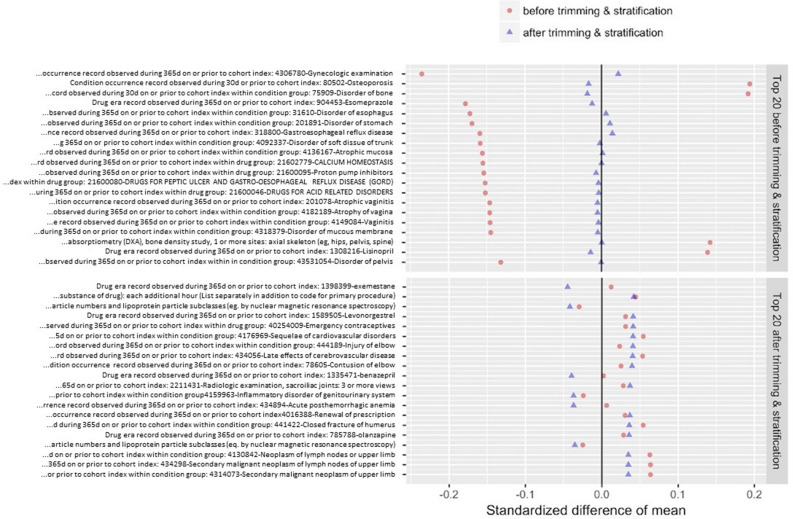
Alendronate and raloxifene are among the most popular anti-osteoporosis medications. However, there is a lack of head-to-head comparative effectiveness studies comparing the two treatments. We conducted a retrospective large-scale multicenter study encompassing over 300 million patients across nine databases encoded in the Observational Medical Outcomes Partnership (OMOP) Common Data Model (CDM). The primary outcome was the incidence of osteoporotic hip fracture, while secondary outcomes were vertebral fracture, atypical femoral fracture (AFF), osteonecrosis of the jaw (ONJ), and esophageal cancer. We used propensity score trimming and stratification based on an expansive propensity score model with all pre-treatment patient characteritistcs. We accounted for unmeasured confounding using negative control outcomes to estimate and adjust for residual systematic bias in each data source. We identified 283,586 alendronate patients and 40,463 raloxifene patients. There were 7.48 hip fracture, 8.18 vertebral fracture, 1.14 AFF, 0.21 esophageal cancer and 0.09 ONJ events per 1,000 person-years in the alendronate cohort and 6.62, 7.36, 0.69, 0.22 and 0.06 events per 1,000 person-years, respectively, in the raloxifene cohort. Alendronate and raloxifene have a similar hip fracture risk (hazard ratio [HR] 1.03, 95% confidence interval [CI] 0.94-1.13), but alendronate users are more likely to have vertebral fractures (HR 1.07, 95% CI 1.01-1.14). Alendronate has higher risk for AFF (HR 1.51, 95% CI 1.23-1.84) but similar risk for esophageal cancer (HR 0.95, 95% CI 0.53-1.70), and ONJ (HR 1.62, 95% CI 0.78-3.34). We demonstrated substantial control of measured confounding by propensity score adjustment, and minimal residual systematic bias through negative control experiments, lending credibility to our effect estimates. Raloxifene is as effective as alendronate and may remain an option in the prevention of osteoporotic fracture.
阿仑膦酸钠和雷洛昔芬是最常用的抗骨质疏松药物之一。然而,目前缺乏将这两种治疗方法进行头对头比较有效性研究的相关报道。我们进行了一项回顾性的、基于九大数据库的大型多中心研究,这些数据库均基于观察医疗结局伙伴关系(OMOP)通用数据模型(CDM)进行编码。主要结局是骨质疏松性髋部骨折的发生率,次要结局是椎体骨折、非典型股骨骨折(AFF)、颌骨骨坏死(ONJ)和食管癌。我们使用倾向评分修剪和基于广泛倾向评分模型的分层方法,对所有治疗前患者特征进行分层。我们使用阴性对照结局来估计和调整每个数据源中未测量的混杂因素,以估计和调整每个数据源中的残余系统偏差。我们共确定了 283586 例阿仑膦酸钠患者和 40463 例雷洛昔芬患者。阿仑膦酸钠组的每千人年髋部骨折、椎体骨折、AFF、食管癌和 ONJ 发生率分别为 7.48、8.18、1.14、0.21 和 0.09 例,雷洛昔芬组的发生率分别为 6.62、7.36、0.69、0.22 和 0.06 例。阿仑膦酸钠和雷洛昔芬的髋部骨折风险相似(风险比[HR]1.03,95%置信区间[CI]0.94-1.13),但阿仑膦酸钠使用者更易发生椎体骨折(HR 1.07,95%CI 1.01-1.14)。阿仑膦酸钠发生 AFF 的风险更高(HR 1.51,95%CI 1.23-1.84),但发生食管癌的风险相似(HR 0.95,95%CI 0.53-1.70),发生 ONJ 的风险也相似(HR 1.62,95%CI 0.78-3.34)。我们通过倾向评分调整,充分控制了可测量的混杂因素,通过阴性对照试验,最小化了残余系统偏差,为我们的效应估计提供了可信度。雷洛昔芬与阿仑膦酸钠同样有效,在预防骨质疏松性骨折方面可能仍是一种选择。