Department of Internal Medicine, Division of Nephrology, University of Groningen, University Medical Center Groningen, Groningen, The Netherlands.
Department of Epidemiology, University of Groningen, University Medical Center Groningen, Groningen, The Netherlands.
Endocrine. 2021 Feb;71(2):385-396. doi: 10.1007/s12020-020-02397-z. Epub 2020 Jul 6.
Although thyroid hormones are irrefutably implicated in cardiovascular physiology, the impact of within-reference range variations of thyroid function on cardiovascular disease (CVD) remains unclear. Elucidating this is important, since it could foster preventive treatment and reduce global CVD burden. We therefore investigated the impact of within-reference range variations of thyroid function on all-cause and cardiovascular mortality.
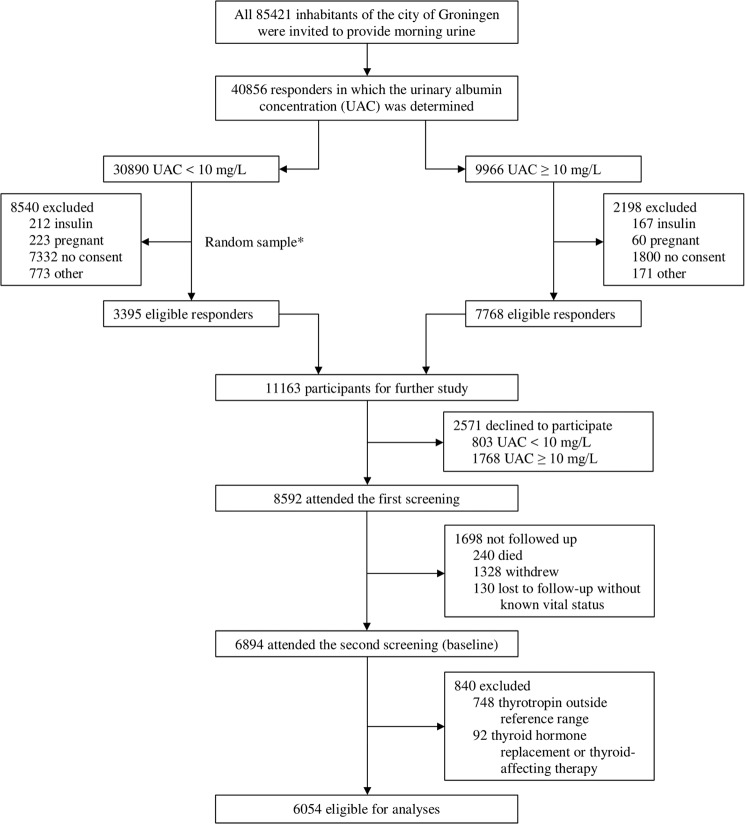
We included community-dwelling individuals aged 28-75 years from a prospective cohort study, without known use of thyroid-affecting therapy and with thyrotropin within reference range. Associations of thyroid function with mortality were quantified using Cox models and adjusted for sociodemographic and cardiovascular risk factors.
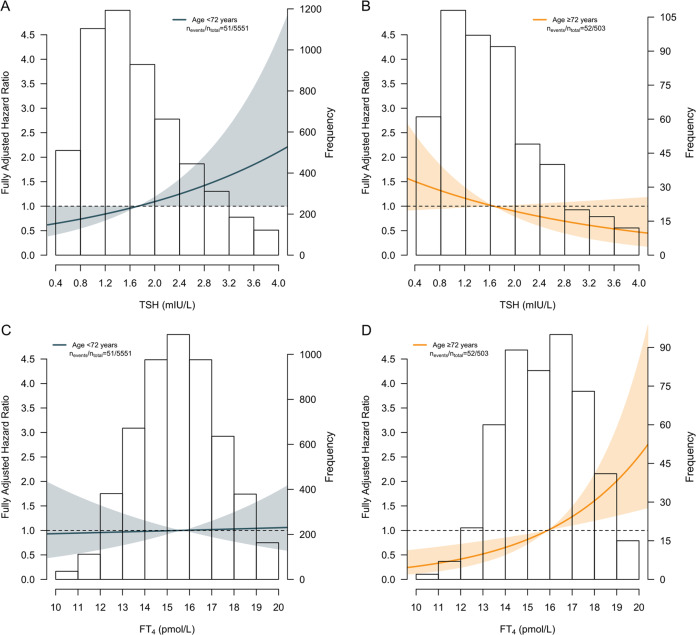
Mean (SD) age of the 6,054 participants (52.0% male) was 53.3 (12.0) years. During 47,594 person-years of follow-up, we observed 380 deaths from all causes and 103 from CVDs. Although higher thyrotropin was not associated with all-cause mortality (adjusted HR 1.02, 95% CI 0.92-1.14), point estimates for cardiovascular mortality diverged toward increased risk in younger (<72 years) participants (1.31, 1.00-1.72) and decreased risk in elderly (≥72 years) (0.77, 0.56-1.06). Higher free thyroxine (FT) was associated with all-cause mortality (1.18, 1.07-1.30) and with cardiovascular mortality only in elderly (1.61, 1.19-2.18), but not in younger participants (1.03, 0.78-1.34). Higher free triiodothyronine (FT) was associated with all-cause mortality in females only (1.18, 1.02-1.35). FT was not associated with cardiovascular mortality (0.91, 0.70-1.18).
Community-dwelling elderly individuals with high-normal thyroid function are at increased risk of all-cause and cardiovascular mortality, reinforcing the need of redefining the current reference ranges of thyroid function.
尽管甲状腺激素在心血管生理学中具有不可否认的作用,但甲状腺功能在参考范围内的变化对心血管疾病(CVD)的影响仍不清楚。阐明这一点很重要,因为它可以促进预防性治疗并降低全球 CVD 负担。因此,我们研究了甲状腺功能在参考范围内的变化对全因和心血管死亡率的影响。
我们纳入了一项前瞻性队列研究中的社区居民,年龄在 28-75 岁之间,无已知的甲状腺影响治疗,促甲状腺激素在参考范围内。使用 Cox 模型量化甲状腺功能与死亡率之间的关系,并调整了社会人口统计学和心血管危险因素。
6054 名参与者(52.0%为男性)的平均(SD)年龄为 53.3(12.0)岁。在 47594 人年的随访期间,我们观察到 380 例全因死亡和 103 例心血管疾病死亡。虽然较高的促甲状腺激素与全因死亡率无关(调整后的 HR 1.02,95%CI 0.92-1.14),但心血管死亡率的点估计值在年轻(<72 岁)参与者中趋于增加(1.31,1.00-1.72),在老年(≥72 岁)参与者中趋于降低(0.77,0.56-1.06)。较高的游离甲状腺素(FT)与全因死亡率相关(1.18,1.07-1.30),仅与老年参与者的心血管死亡率相关(1.61,1.19-2.18),而与年轻参与者无关(1.03,0.78-1.34)。较高的游离三碘甲状腺原氨酸(FT)仅与女性的全因死亡率相关(1.18,1.02-1.35)。FT 与心血管死亡率无关(0.91,0.70-1.18)。
社区居住的高龄甲状腺功能正常的个体全因和心血管死亡率增加,这强调了重新定义当前甲状腺功能参考范围的必要性。