Department of Cardiology, the Second Affiliated Hospital of Harbin Medical University, Harbin, China.
Key Laboratory of Myocardial Ischemia, Ministry of Education, Harbin Medical University, Harbin, China.
Front Endocrinol (Lausanne). 2022 Aug 18;13:964822. doi: 10.3389/fendo.2022.964822. eCollection 2022.
Thyroid hormones play a vital role in maintaining the homeostasis of the cardiovascular system. The FT3/FT4 ratio can be used to evaluate the rate of T4-to-T3 conversion, reflecting the peripheral sensitivity of thyroid hormones. There is no study to investigate its relationship with death and cardiovascular disease (CVD) in the general population.
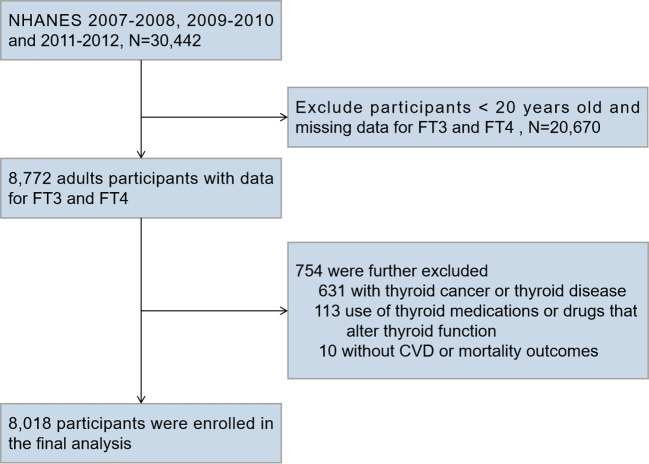
This retrospective cohort study involved 8,018 participants with measured thyroid function and no prior thyroid disease who participated in the National Health and Nutrition Examination Survey (NHANES) from 2007 to 2012. Mortality status was determined by routine follow-up using the National Death Index through December 31, 2015.
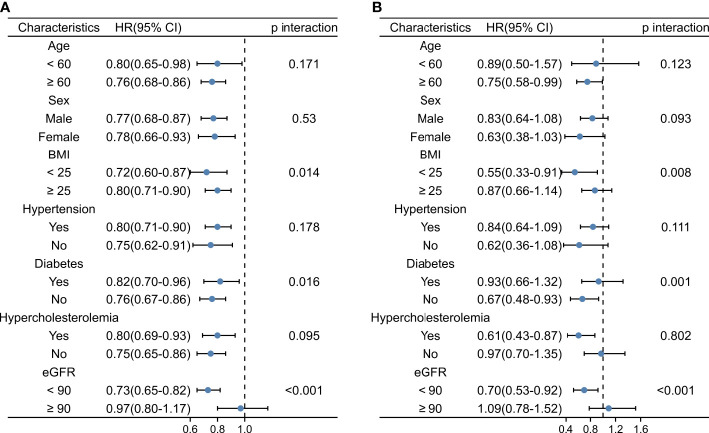
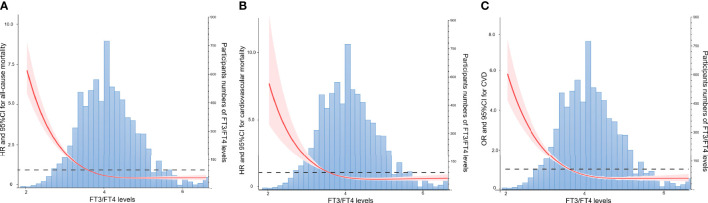
During a median of 87 months of follow-up, we observed 699 all-cause deaths, including 116 cardiovascular deaths. In multivariate adjusted models, higher free thyroxine (FT4) was linked to increased all-cause mortality (HR, 1.15 per SD; 95% CI, 1.09-1.22), cardiovascular mortality (HR, 1.18 per SD; 95% CI, 1.01-1.39), and CVD risk (HR, 1.17 per SD; 95% CI, 1.08-1.27). Higher free triiodothyronine (FT3) was linked to decreased all-cause mortality (HR 0.81 per SD; 95% CI, 0.70-0.93). Higher FT3/FT4 ratio was linked to decreased all-cause mortality (HR, 0.77 per SD; 95% CI, 0.69-0.85), cardiovascular mortality (HR, 0.79 per SD; 95% CI, 0.62-1.00), and CVD risk (HR, 0.82 per SD; 95% CI, 0.74-0.92). The FT3/FT4 ratio stratified findings were broadly consistent with the overall results.
FT3, FT4, and the FT3/FT4 ratio were all independent predictors of all-cause death. FT4 and the FT3/FT4 ratio, but not FT3, were independent predictors of cardiovascular mortality and CVD risk. Along with FT3 and FT4, we should pay equal attention to the FT3/FT4 ratio in the general population.
甲状腺激素在维持心血管系统内环境稳定方面起着至关重要的作用。FT3/FT4 比值可用于评估 T4 向 T3 的转化速率,反映甲状腺激素的外周敏感性。目前尚无研究探讨其与普通人群死亡和心血管疾病(CVD)的关系。
本回顾性队列研究纳入了 8018 名甲状腺功能检测且无甲状腺疾病史的参与者,他们参加了 2007 年至 2012 年的国家健康和营养调查(NHANES)。通过国家死亡指数对参与者进行常规随访,截至 2015 年 12 月 31 日,确定死亡状态。
在中位数为 87 个月的随访期间,我们观察到 699 例全因死亡,包括 116 例心血管死亡。在多变量调整模型中,较高的游离甲状腺素(FT4)与全因死亡率增加相关(HR,每 SD 增加 1.15;95%CI,1.09-1.22)、心血管死亡率(HR,每 SD 增加 1.18;95%CI,1.01-1.39)和 CVD 风险(HR,每 SD 增加 1.17;95%CI,1.08-1.27)。较高的游离三碘甲状腺原氨酸(FT3)与全因死亡率降低相关(HR 每 SD 降低 0.81;95%CI,0.70-0.93)。较高的 FT3/FT4 比值与全因死亡率降低相关(HR,每 SD 降低 0.77;95%CI,0.69-0.85)、心血管死亡率(HR,每 SD 降低 0.79;95%CI,0.62-1.00)和 CVD 风险(HR,每 SD 降低 0.82;95%CI,0.74-0.92)。FT3/FT4 比值分层的研究结果与总体结果基本一致。
FT3、FT4 和 FT3/FT4 比值均是全因死亡的独立预测因子。FT4 和 FT3/FT4 比值(而非 FT3)是心血管死亡率和 CVD 风险的独立预测因子。除了 FT3 和 FT4,我们还应该关注普通人群中的 FT3/FT4 比值。