Graduate Group in Microbiology, University of California, Berkeley, Berkeley, California, United States of America.
Department of Molecular and Cell Biology, University of California, Berkeley, Berkeley, California, United States of America.
PLoS Pathog. 2020 Jul 7;16(7):e1008622. doi: 10.1371/journal.ppat.1008622. eCollection 2020 Jul.
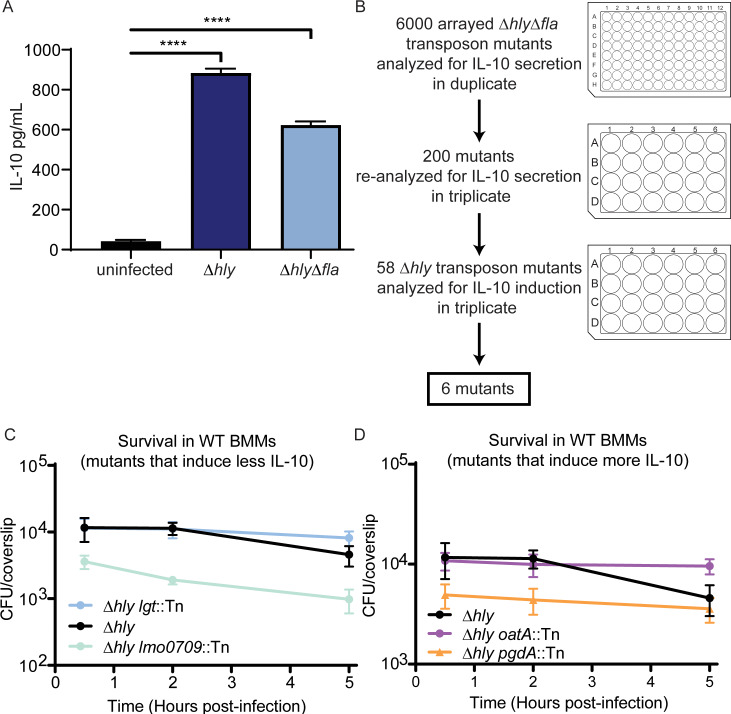
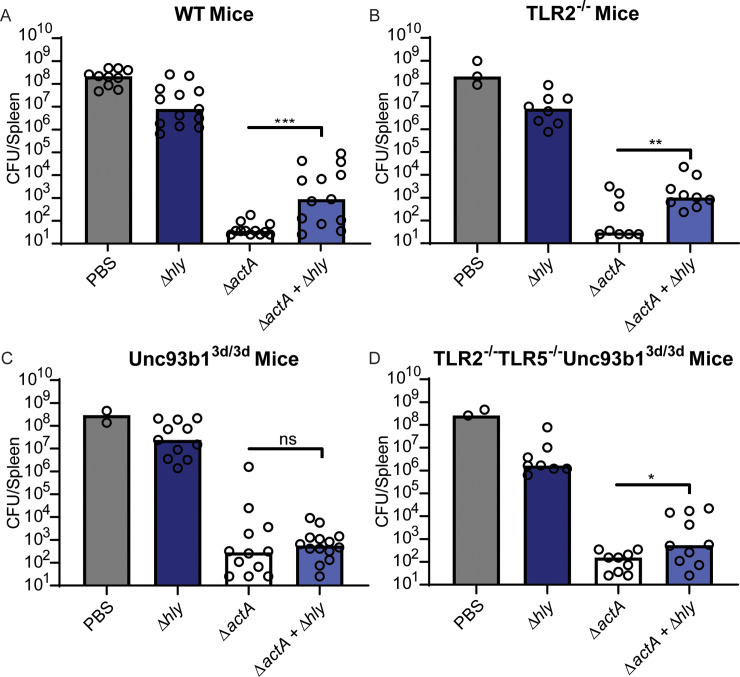
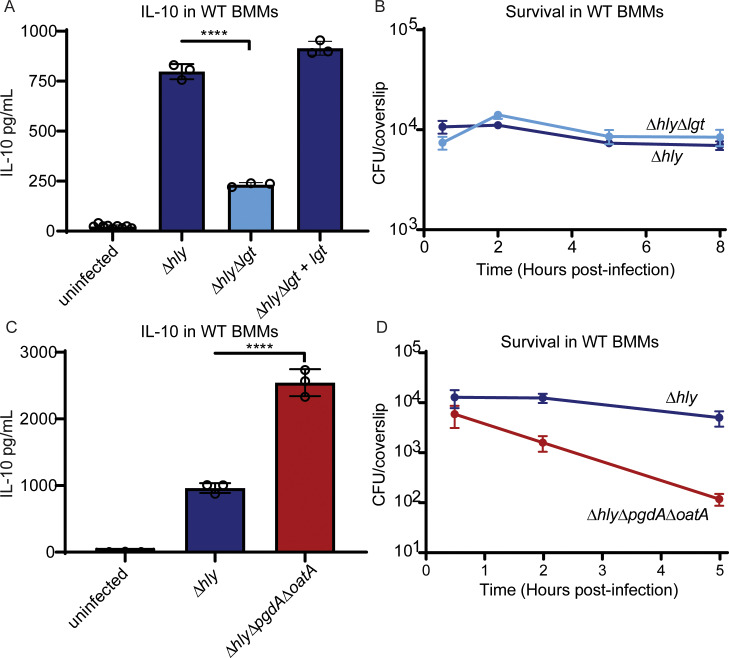
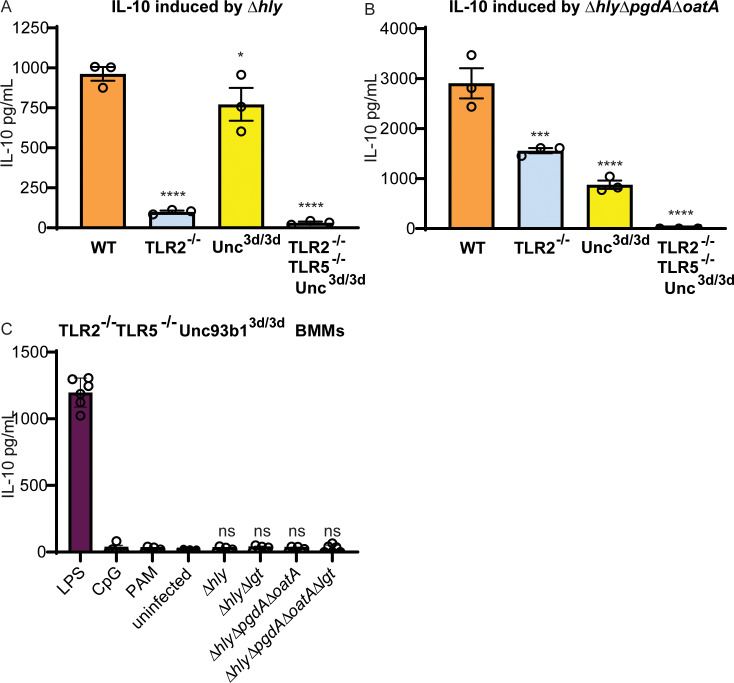
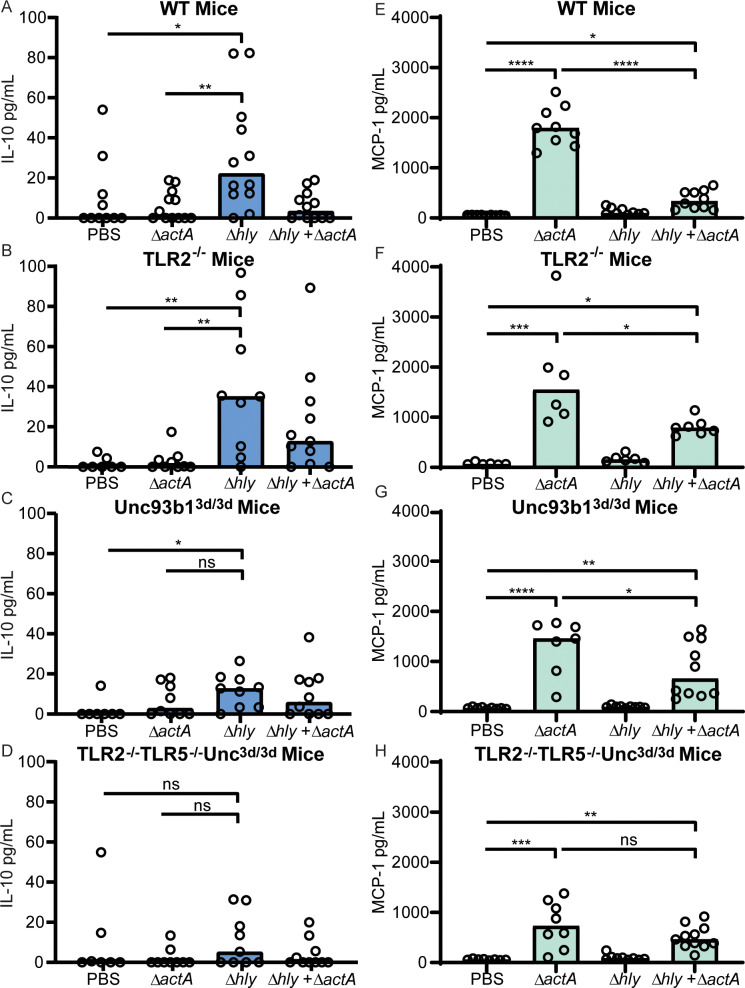
Listeria monocytogenes is a facultative intracellular bacterial pathogen that escapes from phagosomes and induces a robust adaptive immune response in mice, while mutants unable to escape phagosomes fail to induce a robust adaptive immune response and suppress the immunity to wildtype bacteria when co-administered. The capacity to suppress immunity can be reversed by blocking IL-10. In this study, we sought to understand the host receptors that lead to secretion of IL-10 in response to phagosome-confined L. monocytogenes (Δhly), with the ultimate goal of generating strains that fail to induce IL-10. We conducted a transposon screen to identify Δhly L. monocytogenes mutants that induced significantly more or less IL-10 secretion in bone marrow-derived macrophages (BMMs). A transposon insertion in lgt, which encodes phosphatidylglycerol-prolipoprotein diacylglyceryl transferase and is essential for the formation of lipoproteins, induced significantly reduced IL-10 secretion. Mutants with transposon insertions in pgdA and oatA, which encode peptidoglycan N-acetylglucosamine deacetylase and O-acetyltransferase, are sensitive to lysozyme and induced enhanced IL-10 secretion. A ΔhlyΔpgdAΔoatA strain was killed in BMMs and induced enhanced IL-10 secretion that was dependent on Unc93b1, a trafficking molecule required for signaling of nucleic acid-sensing TLRs. These data revealed that nucleic acids released by bacteriolysis triggered endosomal TLR-mediated IL-10 secretion. Secretion of IL-10 in response to infection with the parental strain was mostly TLR2-dependent, while IL-10 secretion in response to lysozyme-sensitive strains was dependent on TLR2 and Unc93b1. In mice, the IL-10 response to vacuole-confined L. monocytogenes was also dependent on TLR2 and Unc93b1. Co-administration of Δhly and ΔactA resulted in suppressed immunity in WT mice, but not in mice with mutations in Unc93b1. These data revealed that secretion of IL-10 in response to L. monocytogenes infection in vitro is mostly TLR2-dependent and immune suppression by phagosome-confined bacteria in vivo is mostly dependent on endosomal TLRs.
李斯特菌属单核细胞增生李斯特菌是一种兼性胞内细菌病原体,它能从吞噬体中逃逸出来,并在小鼠中诱导强烈的适应性免疫反应,而不能从吞噬体中逃逸的突变体则不能诱导强烈的适应性免疫反应,并在共同给药时抑制对野生型细菌的免疫。阻断 IL-10 可以逆转抑制免疫的能力。在这项研究中,我们试图了解宿主受体,这些受体导致针对被吞噬体限制的李斯特菌属单核细胞增生李斯特菌(Δhly)分泌 IL-10,最终目的是产生不能诱导 IL-10 的菌株。我们进行了转座子筛选,以鉴定在骨髓来源的巨噬细胞(BMMs)中诱导明显更多或更少 IL-10 分泌的 Δhly 李斯特菌属单核细胞增生李斯特菌突变体。在编码磷脂酰甘油-脂蛋白二酰甘油转移酶的 lgt 中的转座子插入,对于脂蛋白的形成是必需的,导致 IL-10 分泌显著减少。在 pgdA 和 oatA 中具有转座子插入的突变体,编码肽聚糖 N-乙酰葡萄糖胺脱乙酰酶和 O-乙酰基转移酶,对溶菌酶敏感,并诱导增强的 IL-10 分泌。ΔhlyΔpgdAΔoatA 株在 BMMs 中被杀死,并诱导增强的 IL-10 分泌,该分泌依赖于 Unc93b1,Unc93b1 是一种用于核酸感应 TLR 信号转导的运输分子。这些数据表明,由细菌溶解释放的核酸触发内体 TLR 介导的 IL-10 分泌。对亲本菌株感染的反应中 IL-10 的分泌主要依赖于 TLR2,而对溶菌酶敏感菌株的反应中 IL-10 的分泌依赖于 TLR2 和 Unc93b1。在小鼠中,对被液泡限制的李斯特菌属单核细胞增生李斯特菌的 IL-10 反应也依赖于 TLR2 和 Unc93b1。在 WT 小鼠中,共同给予 Δhly 和 ΔactA 导致免疫抑制,但在 Unc93b1 突变小鼠中则没有。这些数据表明,体外对李斯特菌属单核细胞增生李斯特菌感染的反应中 IL-10 的分泌主要依赖于 TLR2,而体内被吞噬体限制的细菌的免疫抑制主要依赖于内体 TLR。