Rees William D, Lorenzo-Leal Ana C, Steiner Theodore S, Bach Horacio
Department of Medicine, Division of Infectious Diseases, University of British Columbia, Vancouver, BC V5Z3J5, Canada.
BC Children's Hospital Research Institute, Vancouver, BC V6H3N1, Canada.
Microorganisms. 2020 Jul 3;8(7):994. doi: 10.3390/microorganisms8070994.
subspecies (MAP), a member of the mycobacteriaceae family, causes Johne's disease in ruminants, which resembles Crohn's disease (CD) in humans. MAP was proposed to be one of the causes of human CD, but the evidence remains elusive. Macrophages were reported to be the only cell where MAP proliferates in ruminants and humans and is likely the major producer of TNFα-associated inflammation. However, whether human dendritic cells (DCs), another major antigen-presenting cell (APC), have the ability to harbor MAP and disseminate infection, remains unknown.
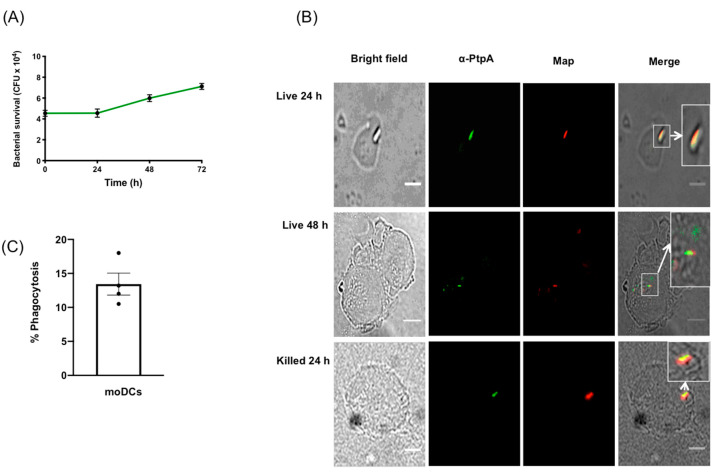
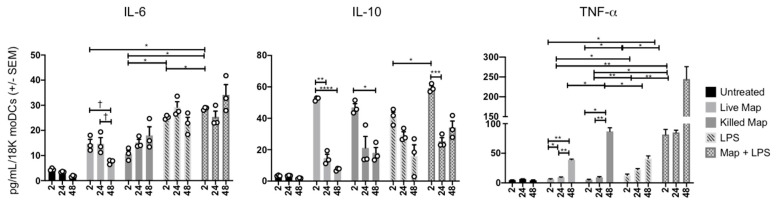
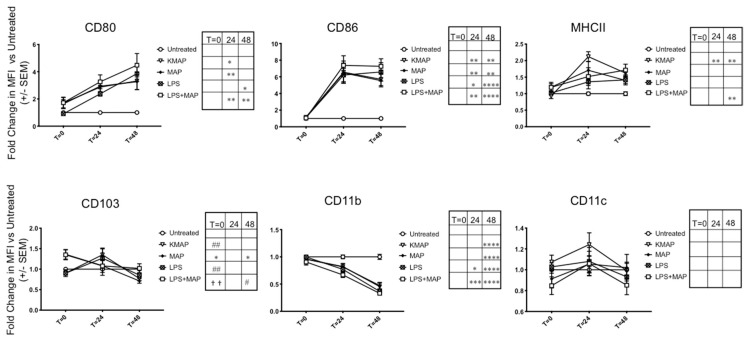
Human monocyte-derived dendritic cells (moDCs) were infected with MAP and phagocytosis and intracellular survival were quantified by immunofluorescence (IF) and colony counts, respectively. MoDC cytokine expression was measured via ELISA and their activation state was measured via flow cytometry.
We showed that MAP can infect and replicate in human moDCs as means to evade the immune system for successful infection, through inhibition of the phago-lysosome fusion via the secretion of protein tyrosine phosphatase PtpA. This mechanism initially led to a state of tolerance in moDCs and then subsequently caused a pro-inflammatory response as infection persisted, characterized by the upregulation of IL-6 and TNFα, and downregulation of IL-10. Moreover, we showed that moDCs have the ability to phagocytose up to 18% of MAP, when exposed at a multiplicity of infection of 1:1.
Infection and subsequent proliferation of MAP within moDCs could provide a unique means for the dissemination of MAP to lymphoid tissue, while altering immune responses to facilitate the persistence of infection of host tissues in CD.
副结核分枝杆菌(MAP)是分枝杆菌科的成员,可引起反刍动物的副结核病,该病与人类的克罗恩病(CD)相似。有人提出MAP是人类CD的病因之一,但证据仍然难以捉摸。据报道,巨噬细胞是MAP在反刍动物和人类中增殖的唯一细胞,并且可能是TNFα相关炎症的主要产生者。然而,另一种主要的抗原呈递细胞(APC)——人类树突状细胞(DCs)是否有能力容纳MAP并传播感染,仍然未知。
用MAP感染人单核细胞衍生的树突状细胞(moDCs),分别通过免疫荧光(IF)和菌落计数对吞噬作用和细胞内存活情况进行定量。通过ELISA检测moDC细胞因子表达,并通过流式细胞术检测其激活状态。
我们发现,MAP可以感染人moDCs并在其中复制,作为逃避免疫系统以成功感染的手段,它通过分泌蛋白酪氨酸磷酸酶PtpA抑制吞噬溶酶体融合。这种机制最初导致moDCs处于耐受状态,随后随着感染持续引发促炎反应,其特征是IL-6和TNFα上调,IL-10下调。此外,我们发现,当以1:1的感染复数暴露时,moDCs有能力吞噬高达18%的MAP。
MAP在moDCs内的感染及随后的增殖可为MAP传播至淋巴组织提供一种独特方式,同时改变免疫反应以促进CD中宿主组织感染的持续存在。