Division of Immunology and Pathogenesis, Department of Molecular and Cell Biology, University of California, Berkeley, CA, 94720, USA.
Howard Hughes Medical Institute, University of California, Berkeley, CA, 94720, USA.
Nat Commun. 2020 Jul 7;11(1):3382. doi: 10.1038/s41467-020-17156-x.
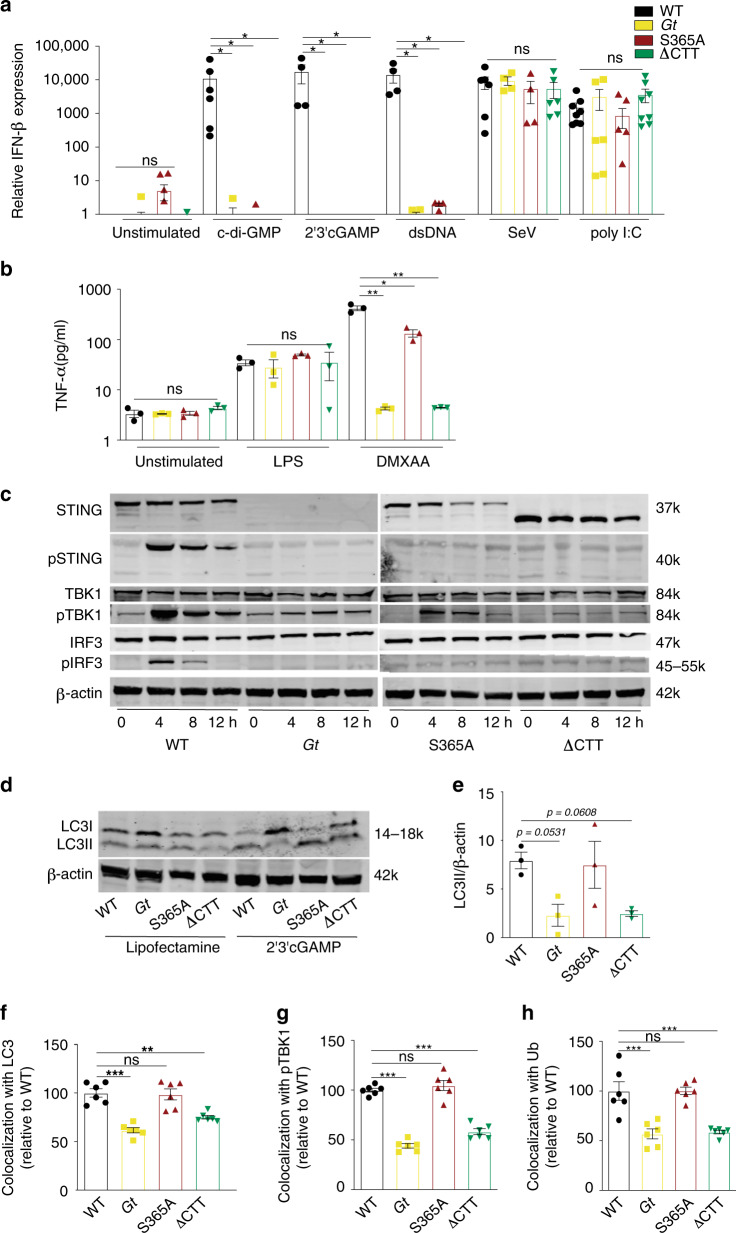
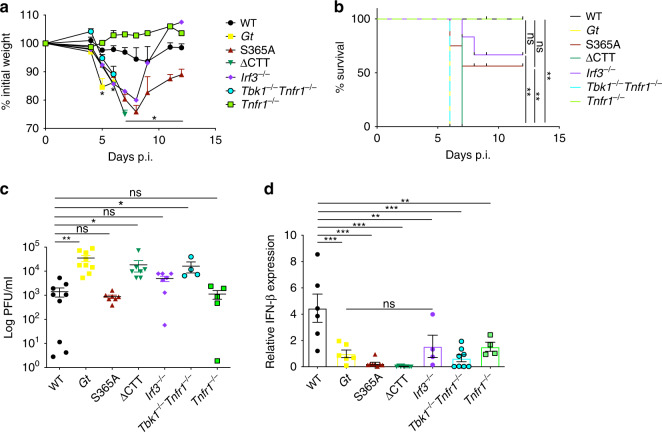
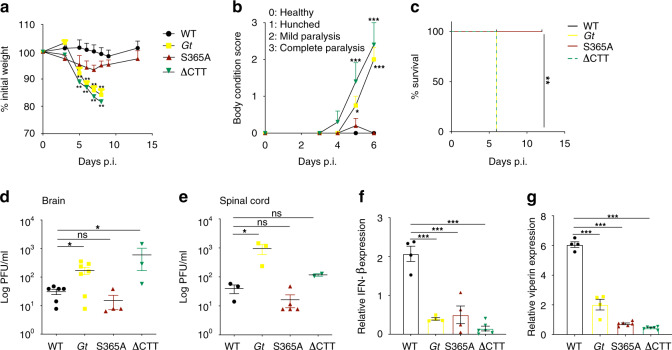
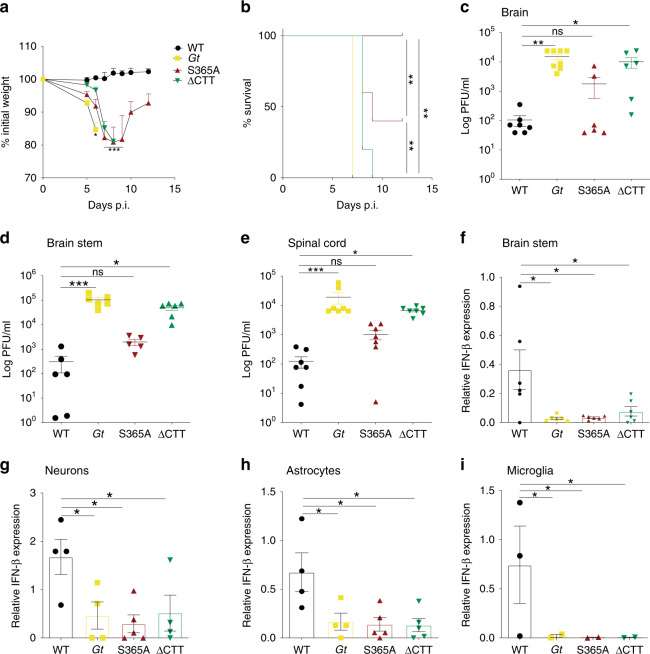
The Stimulator of Interferon Genes (STING) pathway initiates potent immune responses upon recognition of DNA. To initiate signaling, serine 365 (S365) in the C-terminal tail (CTT) of STING is phosphorylated, leading to induction of type I interferons (IFNs). Additionally, evolutionary conserved responses such as autophagy also occur downstream of STING, but their relative importance during in vivo infections remains unclear. Here we report that mice harboring a serine 365-to-alanine (S365A) mutation in STING are unexpectedly resistant to Herpes Simplex Virus (HSV)-1, despite lacking STING-induced type I IFN responses. By contrast, resistance to HSV-1 is abolished in mice lacking the STING CTT, suggesting that the STING CTT initiates protective responses against HSV-1, independently of type I IFNs. Interestingly, we find that STING-induced autophagy is a CTT- and TBK1-dependent but IRF3-independent process that is conserved in the STING S365A mice. Thus, interferon-independent functions of STING mediate STING-dependent antiviral responses in vivo.
干扰素基因刺激物 (STING) 途径在识别 DNA 时启动有效的免疫反应。为了启动信号转导,STING C 端尾部 (CTT) 中的丝氨酸 365 (S365) 被磷酸化,导致 I 型干扰素 (IFNs) 的诱导。此外,STING 下游还会发生进化保守的反应,如自噬,但它们在体内感染过程中的相对重要性尚不清楚。在这里,我们报告说,尽管缺乏 STING 诱导的 I 型 IFN 反应,但 STING 中丝氨酸 365 到丙氨酸 (S365A) 突变的小鼠出人意料地对单纯疱疹病毒 (HSV)-1 具有抗性。相比之下,缺乏 STING CTT 的小鼠对 HSV-1 的抗性被消除,这表明 STING CTT 独立于 I 型 IFNs 引发针对 HSV-1 的保护性反应。有趣的是,我们发现 STING 诱导的自噬是一种 CTT 和 TBK1 依赖性但 IRF3 非依赖性的过程,在 STING S365A 小鼠中保守。因此,STING 的干扰素非依赖性功能介导体内 STING 依赖性抗病毒反应。