Bernabeu-Mora Roberto, Sánchez-Martínez M Piedad, Montilla-Herrador Joaquina, Oliveira-Sousa Silvana L, Gacto-Sánchez Mariano, Medina-Mirapeix Francesc
Division of Pneumology, Hospital General Universitario Morales Meseguer, Murcia, Spain.
Department of Internal Medicine, University of Murcia, Murcia, Spain.
Int J Chron Obstruct Pulmon Dis. 2020 Jun 30;15:1519-1527. doi: 10.2147/COPD.S254434. eCollection 2020.
Despite wide use of the Global Initiative for Chronic Obstructive Pulmonary Disease (GOLD) 2011, little is known about between-stage transitions and what factors predict worsening transitions in patients with chronic obstructive pulmonary disease (COPD).
To investigate the transition frequency between GOLD 2011 stages among patients with stable COPD over a 2-year follow-up, to identify potential non-pulmonary predictor factors for worsening transitions, and to compare transition frequencies between GOLD 2011 stages and the new GOLD 2017 stages.
We prospectively included 137 patients with stable COPD (mean age, 66.9 ± 8.3 years). GOLD 2011 and GOLD 2017 stages were measured at baseline, 1-year follow-up, and 2-year follow-up. To evaluate non-pulmonary variables as potential predictors of worsening transitions, we used regression models adjusted for sociodemographic, clinical, and pulmonary variables using generalized estimating equations.
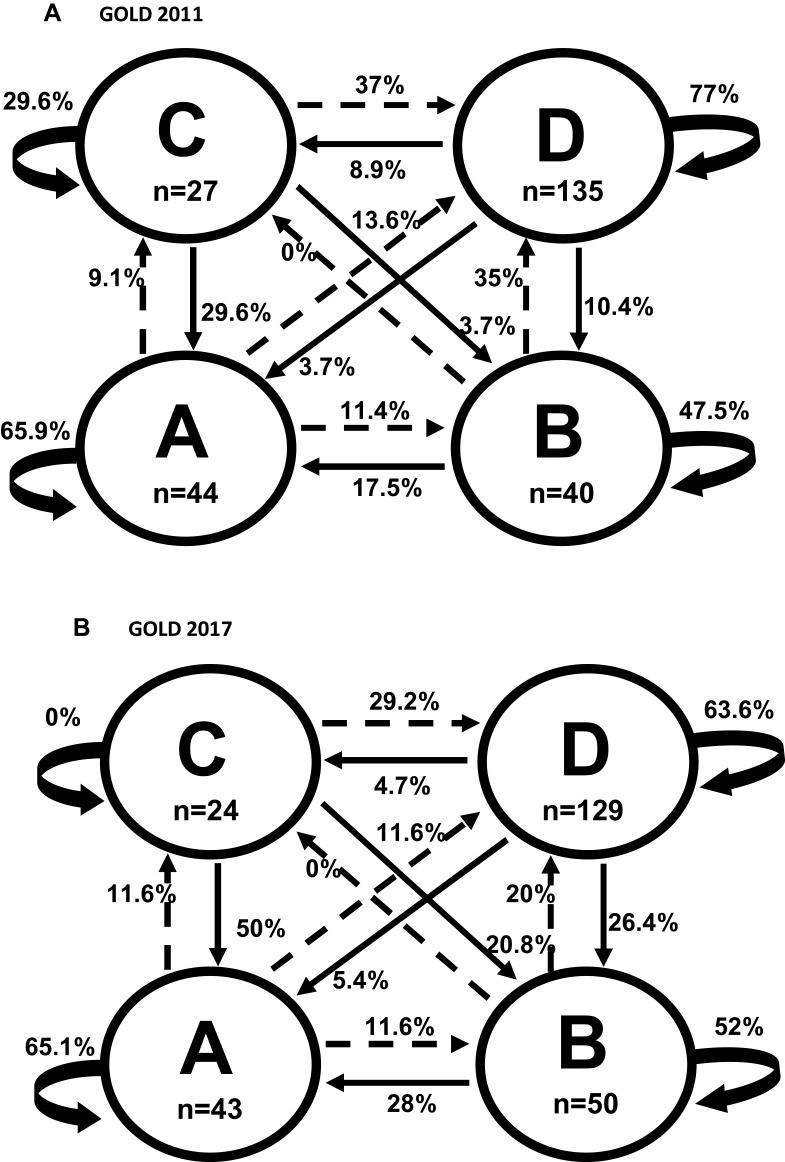
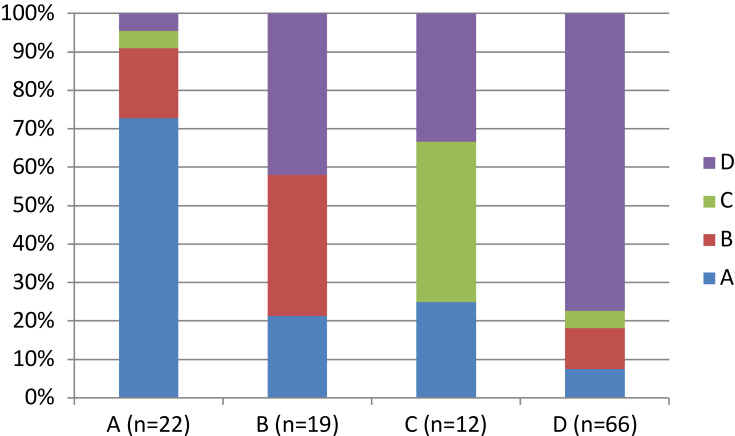
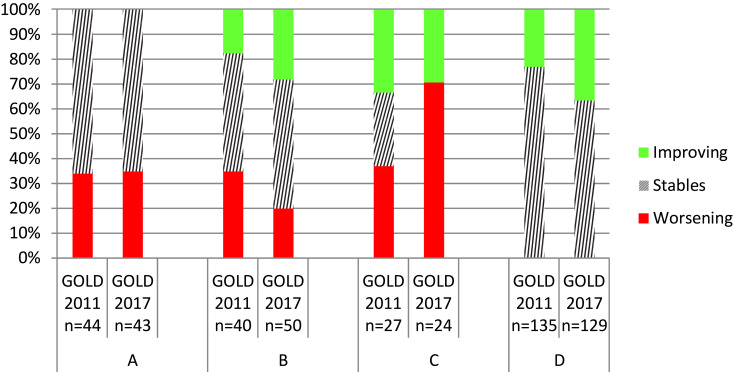
The study period included 246 opportunities for transition, and 39 worsening transitions occurred within GOLD 2011 stages. Predictors of worsening transitions included BODE index (OR, 1.20; 95% CI, 1.00-1.44), quadriceps strength (OR, 0.87; 95% CI, 0.76-0.99), and limited mobility activities (OR, 1.02; 95% CI, 1.00-1.05). The frequency of worsening transitions for stages B and C differed between GOLD 2011 and GOLD 2017. Stages A and D were the most stable in both classifications.
Non-pulmonary factors predicted worsening transitions among the GOLD 2011 stages of COPD severity. The choice of GOLD 2011 versus GOLD 2017 may influence transition identification, especially for stages B and C.
尽管慢性阻塞性肺疾病全球倡议组织(GOLD)2011版指南被广泛应用,但对于慢性阻塞性肺疾病(COPD)患者的阶段转换情况以及哪些因素可预测病情恶化的转换情况,我们知之甚少。
调查稳定期COPD患者在2年随访期间GOLD 2011各阶段之间的转换频率,确定病情恶化转换的潜在非肺部预测因素,并比较GOLD 2011各阶段与新的GOLD 2017各阶段之间的转换频率。
我们前瞻性纳入了137例稳定期COPD患者(平均年龄66.9±8.3岁)。在基线、1年随访和2年随访时测量GOLD 2011和GOLD 2017阶段。为了评估非肺部变量作为病情恶化转换的潜在预测因素,我们使用广义估计方程对社会人口统计学、临床和肺部变量进行调整的回归模型。
研究期间共有246次转换机会,GOLD 2011各阶段内发生了39次病情恶化的转换。病情恶化转换的预测因素包括BODE指数(OR,1.20;95%CI,1.00-1.44)、股四头肌力量(OR,0.87;95%CI,0.76-0.99)和活动能力受限(OR,1.02;95%CI,1.00-1.05)。GOLD 2011和GOLD 2017之间,B期和C期病情恶化转换的频率有所不同。在两种分类中,A期和D期最稳定。
非肺部因素可预测COPD严重程度GOLD 2011各阶段之间病情恶化的转换。选择GOLD 2011还是GOLD 2017可能会影响转换的识别,尤其是对于B期和C期。