Sachdeva Meenakshi, Arora Sunil K
Department of Translational & Regenerative Medicine, Post Graduate Institute of Medical Education and Research (PGIMER), Chandigarh, India.
Department of Immunopathology & Department of Translational & Regenerative Medicine, Post Graduate Institute of Medical Education and Research (PGIMER), Chandigarh, India.
EXCLI J. 2020 Jun 3;19:718-733. doi: 10.17179/excli2020-1455. eCollection 2020.
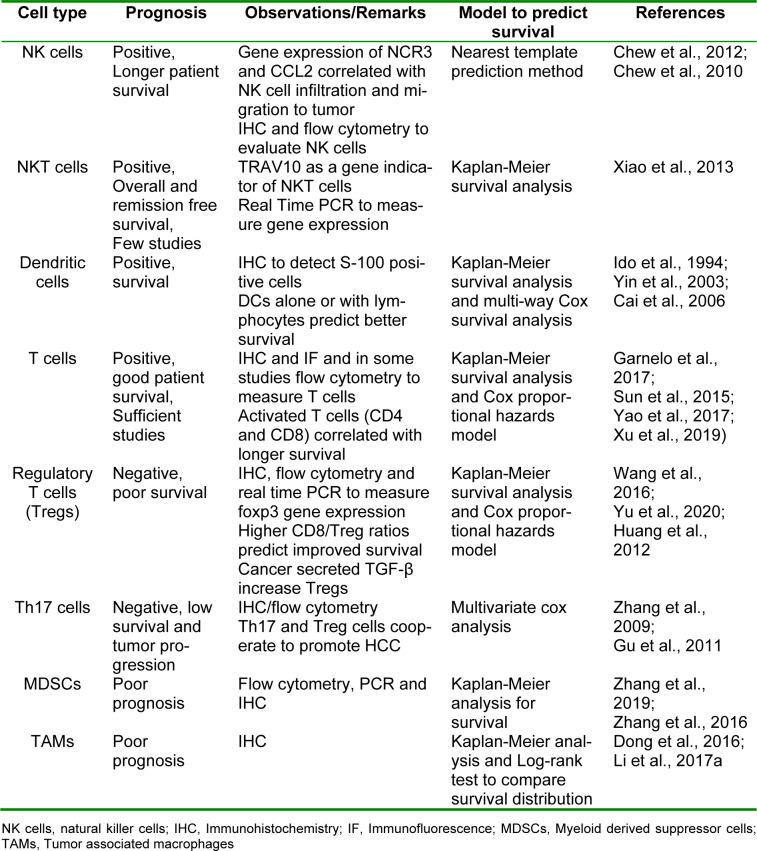
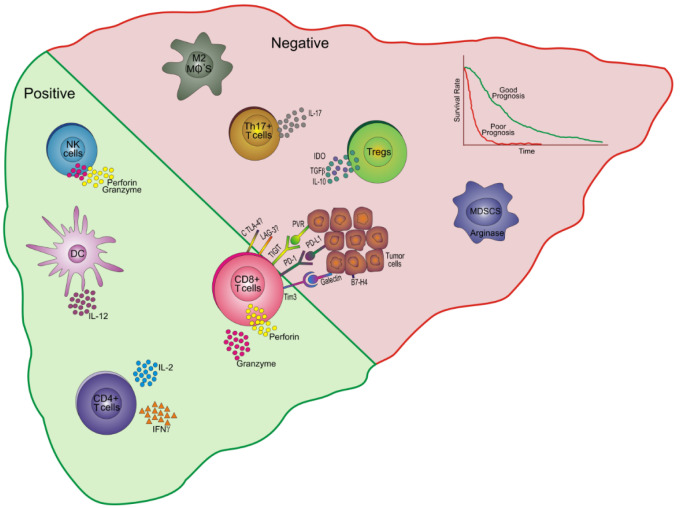
Hepatocellular carcinoma (HCC), with rising incidence rates, is the most commonly occurring malignancy of the liver that exerts a heavy disease burden particularly in developing countries. A dynamic cross-talk between immune cells and malignant cells in tumor microenvironment governs the hepatocarcinogenesis. Monitoring immune contexture as prognostic markers is quite relevant and essential to evaluate clinical outcomes and to envisage response to therapy. In this review, we present an overview of the prognostic value of various tumor infiltrating immune cells and the continually evolving immune checkpoints as novel biomarkers during HCC. Tumor infiltration by immune cells such as T cells, NK cells and dendritic cells is linked with improved prognosis and favorable outcome, while the intra-tumoral presence of regulatory T cells (Tregs) or myeloid derived suppressor cells (MDSCs) on the other hand is associated with poor clinical outcome. In addition to these, the overexpression of negative regulatory molecules on tumor cells also provides inhibitory signals to T cells and is associated with poor prognosis. The limitation of a single marker can be overcome by advanced prognostication models and algorithms that evaluate multiple prognostic factors and ultimately aid the clinician in improving the disease free and overall survival of HCC patients.
肝细胞癌(HCC)的发病率呈上升趋势,是最常见的肝脏恶性肿瘤,尤其在发展中国家造成了沉重的疾病负担。肿瘤微环境中免疫细胞与恶性细胞之间的动态相互作用支配着肝癌的发生发展。将免疫微环境作为预后标志物进行监测,对于评估临床结局和预测治疗反应非常相关且至关重要。在本综述中,我们概述了各种肿瘤浸润免疫细胞以及不断演变的免疫检查点作为HCC期间新型生物标志物的预后价值。T细胞、NK细胞和树突状细胞等免疫细胞的肿瘤浸润与预后改善和良好结局相关,而肿瘤内调节性T细胞(Tregs)或髓源性抑制细胞(MDSCs)的存在则与不良临床结局相关。除此之外,肿瘤细胞上负性调节分子的过表达也会向T细胞提供抑制信号,并与不良预后相关。先进的预后模型和算法可以评估多个预后因素,最终帮助临床医生提高HCC患者的无病生存期和总生存期,从而克服单一标志物的局限性。