Köhler Matias, Reginato Marcelo, Souza-Chies Tatiana Teixeira, Majure Lucas C
Programa de Pós-Graduação em Botânica, Universidade Federal do Rio Grande do Sul, Porto Alegre, Brazil.
Florida Museum of Natural History, University of Florida Herbarium (FLAS), Gainesville, FL, United States.
Front Plant Sci. 2020 Jun 19;11:729. doi: 10.3389/fpls.2020.00729. eCollection 2020.
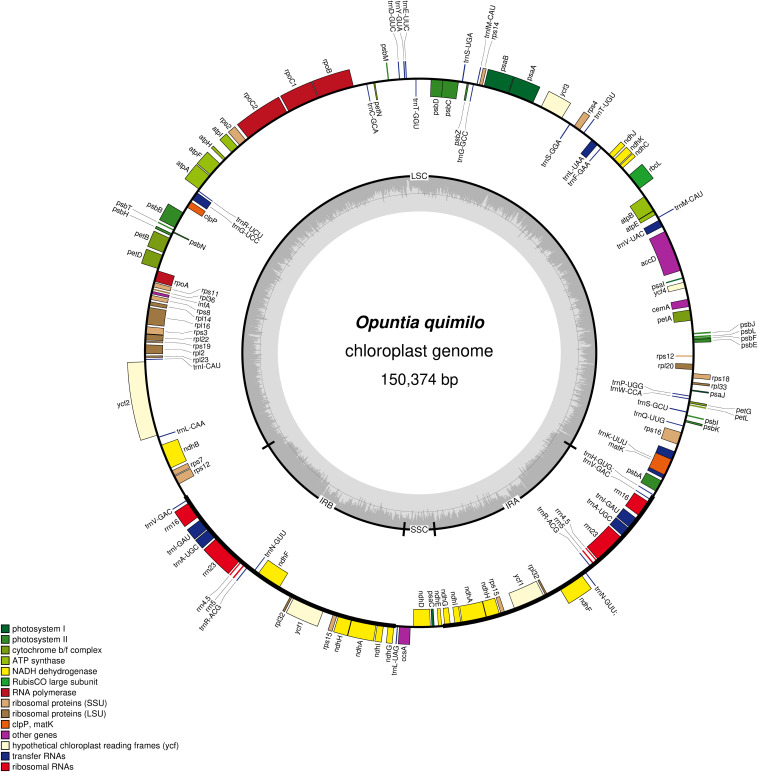
Chloroplast genomes (plastomes) are frequently treated as highly conserved among land plants. However, many lineages of vascular plants have experienced extensive structural rearrangements, including inversions and modifications to the size and content of genes. Cacti are one of these lineages, containing the smallest plastome known for an obligately photosynthetic angiosperm, including the loss of one copy of the inverted repeat (∼25 kb) and the gene suite, but only a few cacti from the subfamily Cactoideae have been sufficiently characterized. Here, we investigated the variation of plastome sequences across the second-major lineage of the Cactaceae, the subfamily Opuntioideae, to address (1) how variable is the content and arrangement of chloroplast genome sequences across the subfamily, and (2) how phylogenetically informative are the plastome sequences for resolving major relationships among the clades of Opuntioideae. Our assembly of the plastome recovered an organelle of 150,347 bp in length with both copies of the inverted repeat and the presence of all the gene suite. An expansion of the large single copy unit and a reduction of the small single copy unit was observed, including translocations and inversion of genes, as well as the putative pseudogenization of some loci. Comparative analyses among all clades within Opuntioideae suggested that plastome structure and content vary across taxa of this subfamily, with putative independent losses of the gene suite and pseudogenization of genes across disparate lineages, further demonstrating the dynamic nature of plastomes in Cactaceae. Our plastome dataset was robust in resolving three tribes with high support within Opuntioideae: Cylindropuntieae, Tephrocacteae and Opuntieae. However, conflicting topologies were recovered among major clades when exploring different assemblies of markers. A plastome-wide survey for highly informative phylogenetic markers revealed previously unused regions for future use in Sanger-based studies, presenting a valuable dataset with primers designed for continued evolutionary studies across Cactaceae. These results bring new insights into the evolution of plastomes in cacti, suggesting that further analyses should be carried out to address how ecological drivers, physiological constraints and morphological traits of cacti may be related with the common rearrangements in plastomes that have been reported across the family.
叶绿体基因组(质体基因组)在陆生植物中通常被视为高度保守。然而,维管植物的许多谱系都经历了广泛的结构重排,包括倒位以及基因大小和内容的改变。仙人掌是这些谱系之一,其质体基因组是已知专性光合被子植物中最小的,包括一个反向重复序列(约25 kb)和基因套的一个拷贝的缺失,但只有少数仙人掌亚科的仙人掌得到了充分的特征描述。在这里,我们研究了仙人掌科第二大谱系仙人掌亚科质体基因组序列的变异,以解决(1)该亚科叶绿体基因组序列的内容和排列有多可变,以及(2)质体基因组序列在解决仙人掌亚科各分支之间的主要关系方面在系统发育上有多大信息量。我们对质体基因组的组装得到了一个长度为150,347 bp的细胞器,有反向重复序列的两个拷贝以及所有基因套的存在。观察到大单拷贝单元的扩展和小单拷贝单元的减少,包括基因的易位和倒位,以及一些位点的假定假基因化。仙人掌亚科内所有分支之间的比较分析表明,该亚科不同分类群的质体基因组结构和内容各不相同,在不同谱系中存在假定的基因套独立缺失和基因假基因化,进一步证明了仙人掌科质体基因组的动态性质。我们的质体基因组数据集在解决仙人掌亚科内得到高支持的三个族方面很稳健:圆柱仙人掌族、刺叶仙人掌族和仙人掌族。然而,在探索不同的标记组装时,主要分支之间出现了相互矛盾的拓扑结构。全质体基因组范围内对高信息量系统发育标记的调查揭示了以前未使用的区域,供未来基于桑格测序的研究使用,提供了一个有价值的数据集,并设计了引物用于整个仙人掌科的持续进化研究。这些结果为仙人掌质体基因组的进化带来了新的见解,表明应该进行进一步的分析,以解决仙人掌的生态驱动因素、生理限制和形态特征可能如何与整个科中报道的质体基因组常见重排相关。