Policicchio Domenico, Casu Gina, Dipellegrini Giosuè, Doda Artan, Muggianu Giampiero, Boccaletti Riccardo
Department of Neurosurgery, Azienda Ospedaliero Universitaria di Sassari, Via Enrico De Nicola, Sassari, Italy.
Surg Neurol Int. 2020 Jun 13;11:148. doi: 10.25259/SNI_35_2020. eCollection 2020.
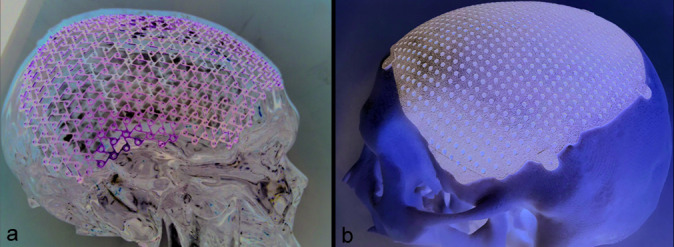
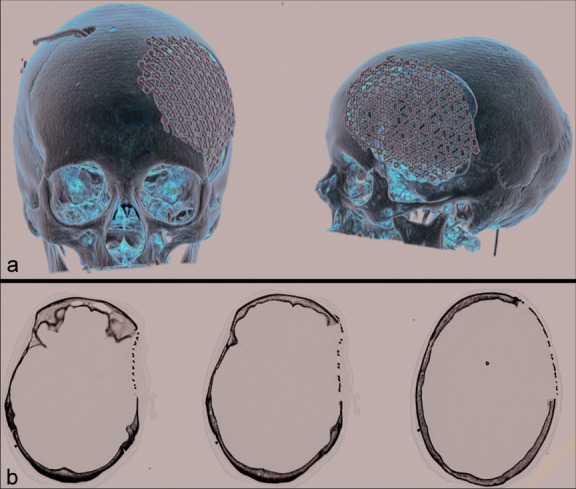
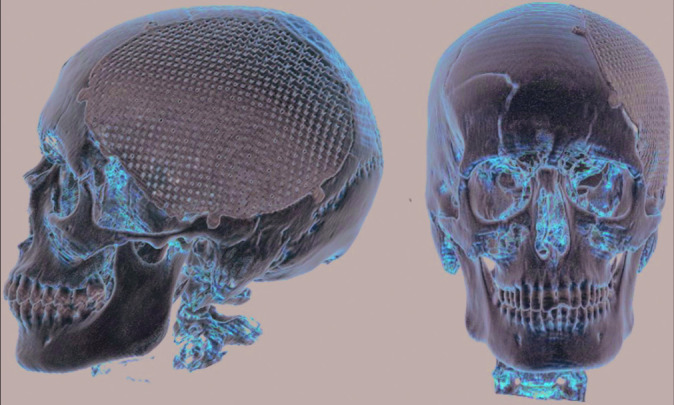
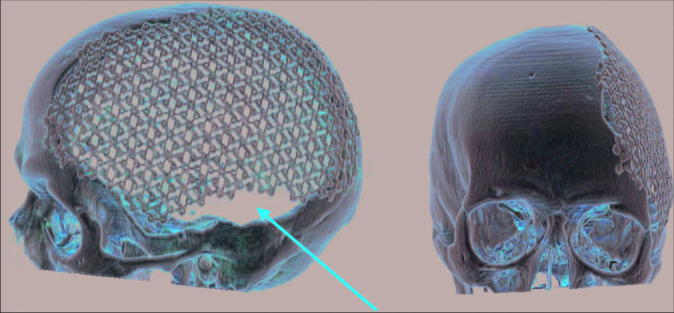
The aim of this study was to compare the results of two different titanium cranioplasties for reconstructing skull defects: standard precurved mesh versus custom-made prostheses.
Retrospective analysis of 23 patients submitted to titanium cranioplasty between January 2014 and January 2019. Ten patients underwent delayed cranioplasty using custom-made prostheses; and 13 patients were treated using precurved titanium mesh (ten delayed cranioplasties, and three single-stage resection- reconstructions). Demographic, clinical, and radiological data were recorded. Results and complications of the two methods were compared, including duration of surgery, cosmetic results (visual analog scale for cosmesis [VASC]), and costs of the implants.
Complications: one epidural hematoma in the custom-made group, one delayed failure in precurved group due to wound dehiscence with mesh exposure. There were no infections in either group. All custom-made prostheses perfectly fitted on the defect; eight of 13 precurved mesh prostheses incompletely covered the defect. Custom-made cranioplasty obtained better cosmetic results (average VASC 94 vs. 68), shorter surgical time (141min vs. 186min), and -fewer screws was needed to fix the prostheses in place (6 vs. 15). However, satisfactory results were obtained using precurved mesh in cases of small defects and in single-stage reconstruction. Precurved mesh was found to be cheaper (€1,500 vs. €5,500).
Custom-made cranioplasty obtained better results and we would suggest that this should be a first choice, particularly for young patients with a large cranial defect. Precurved mesh was cheaper and useful for single-stage resection-reconstruction. Depending on the individual conditions, both prostheses have their place in cranioplasty therapies.
本研究旨在比较两种不同的钛颅骨修补术用于重建颅骨缺损的结果:标准预弯网与定制假体。
回顾性分析2014年1月至2019年1月期间接受钛颅骨修补术的23例患者。10例患者使用定制假体进行延迟颅骨修补术;13例患者使用预弯钛网治疗(10例延迟颅骨修补术,3例一期切除-重建术)。记录人口统计学、临床和放射学数据。比较两种方法的结果和并发症,包括手术时间、美容效果(美容视觉模拟量表[VASC])和植入物成本。
并发症:定制组发生1例硬膜外血肿,预弯组1例因伤口裂开伴网片外露导致延迟失败。两组均无感染。所有定制假体均完美贴合缺损;13个预弯网假体重8个未完全覆盖缺损。定制颅骨修补术获得了更好的美容效果(平均VASC 94对68)、更短的手术时间(141分钟对186分钟),并且固定假体到位所需的螺钉更少(6个对15个)。然而,在小缺损和一期重建的情况下,使用预弯网也获得了满意的结果。发现预弯网更便宜(1500欧元对5500欧元)。
定制颅骨修补术取得了更好的效果,我们建议这应作为首选,特别是对于有大颅骨缺损的年轻患者。预弯网更便宜,适用于一期切除-重建术。根据个体情况,两种假体在颅骨修补治疗中都有其应用价值。