Amalia Lisda, Sadeli Henny Anggraini, Parwati Ida, Rizal Ahmad, Panigoro Ramdan
Department of Neurology, Faculty of Medicine, Universitas Padjadjaran, Hasan Sadikin General Hospital Bandung, Indonesia.
Department of Clinical Pathology Faculty of Medicine, Universitas Padjadjaran, Hasan Sadikin General Hospital Bandung, Indonesia.
Heliyon. 2020 Jun 28;6(6):e04286. doi: 10.1016/j.heliyon.2020.e04286. eCollection 2020 Jun.
Hypoxia-inducible factor-1α (HIF-1α) is a transcription factor which maintains cellular homeostasis in response to hypoxia. It can trigger apoptosis while stimulating angiogenesis process and decrease neurological deficit after an ischemic stroke. Up until now, this protein complex has not been widely investigated especially in stroke patient.
Here, we examined the potential of HIF-1α as a marker for neuroplasticity process after ischemic stroke.
Serum HIF-1α were measured in acute ischemic stroke patients. National Institute of Health Stroke Scale (NIHSS) were assessed on the admission and discharge day (between days 7 and 14). Ischemic stroke divided into 2 groups: large vessel disease (LVD, n = 31) and small vessel disease (SVD, n = 27). Statistical significances were calculated with Spearman rank test.
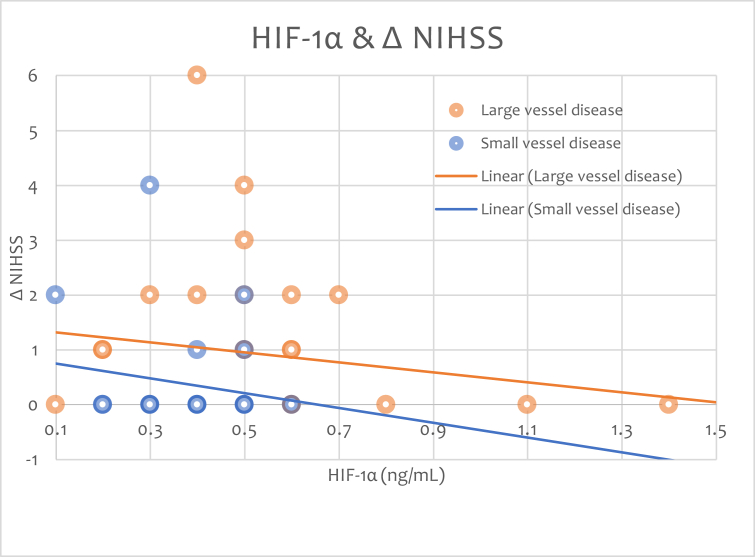
A total of 58 patients, 31 with large artery atherosclerosis LVD and 27 with small vessel disease (SVD) were included in this study. HIF-1α level in LVD group was 0.5225 ± 0.2459 ng/mL and in SVD group was 0.3815 ± 0.121 ng/mL. HIF-1α was higher (p = 0.004) in LVD group than in SVD group. The initial NIHSS score in LVD group was 15.46 ± 2.61 and discharge NIHSS score was 13.31 ± 3.449. Initial NIHSS score in SVD group was 6.07 ± 1.82 and the discharge NIHSS was 5.703 ± 1.7055. In both SVD and LVD group, HIF-1α were significantly correlated with initial NIHSS (both p < 0.001) and discharge NIHSS (p < 0.0383 r = 0.94, p < 0.001, r = 0.93, respectively).
HIF-1α has a strong correlation with NIHSS and it may be used as predictor in acute ischemic stroke outcome.
缺氧诱导因子-1α(HIF-1α)是一种转录因子,可在缺氧状态下维持细胞内环境稳定。它能在刺激血管生成过程的同时引发细胞凋亡,并减轻缺血性中风后的神经功能缺损。到目前为止,这种蛋白质复合物尚未得到广泛研究,尤其是在中风患者中。
在此,我们研究了HIF-1α作为缺血性中风后神经可塑性过程标志物的潜力。
检测急性缺血性中风患者血清中的HIF-1α水平。在入院当天和出院当天(第7至14天之间)评估美国国立卫生研究院卒中量表(NIHSS)。缺血性中风分为两组:大血管疾病(LVD,n = 31)和小血管疾病(SVD,n = 27)。采用Spearman秩和检验计算统计学意义。
本研究共纳入58例患者,其中31例患有大动脉粥样硬化性LVD,27例患有小血管疾病(SVD)。LVD组的HIF-1α水平为0.5225±0.2459 ng/mL,SVD组为0.3815±0.121 ng/mL。LVD组的HIF-1α水平高于SVD组(p = 0.004)。LVD组的初始NIHSS评分为15.46±2.61,出院时NIHSS评分为13.31±3.449。SVD组的初始NIHSS评分为6.07±1.82,出院时NIHSS评分为5.703±1.7055。在SVD组和LVD组中,HIF-1α均与初始NIHSS显著相关(p均<0.001),与出院时NIHSS也显著相关(分别为p<0.0383,r = 0.94;p<0.001,r = 0.93)。
HIF-1α与NIHSS密切相关,可能作为急性缺血性中风预后的预测指标。