Chandan Joht Singh, Keerthy Deepiksana, Zemedikun Dawit Tefra, Okoth Kelvin, Gokhale Krishna Margadhamane, Raza Karim, Bandyopadhyay Siddhartha, Taylor Julie, Nirantharakumar Krishnarajah
Warwick Medical School, University of Warwick, Coventry CV47HL, United Kingdom.
Institute of Applied Health Research, College of Medical and Dental Sciences, University of Birmingham, B152TT, United Kingdom.
EClinicalMedicine. 2020 Jun 6;23:100392. doi: 10.1016/j.eclinm.2020.100392. eCollection 2020 Jun.
Childhood maltreatment is a global public health issue linked to a vast mortality and morbidity burden. This study builds on current literature to explore the risk of developing central sensitivity syndromes (CSS) (consisting of somatic and visceral pain syndromes) subsequent to childhood maltreatment exposure.
A retrospective population based open cohort study using the UK primary care database, 'The Health Improvement Network,' between 1st January 1995-31st December 2018. 80,657 adult patients who had experienced childhood maltreatment or maltreatment related concerns (exposed patients) were matched to 161,314 unexposed patients by age and sex. Outcomes of interest were the development of CSS: either somatic (Fibromyalgia, chronic fatigue syndrome, temporomandibular joint disorder, chronic lower back pain, chronic headache, myofascial pain syndrome and restless leg syndrome) or visceral (Interstitial cystitis, vulvodynia, chronic prostatitis and irritable bowel syndrome) in nature. Effect sizes are presented as adjusted incidence rate ratios (aIRR) with confidence intervals (CI). Models were adjusted for the following covariates at cohort entry: age, sex, deprivation, anxiety, depression and serious mental ill health.
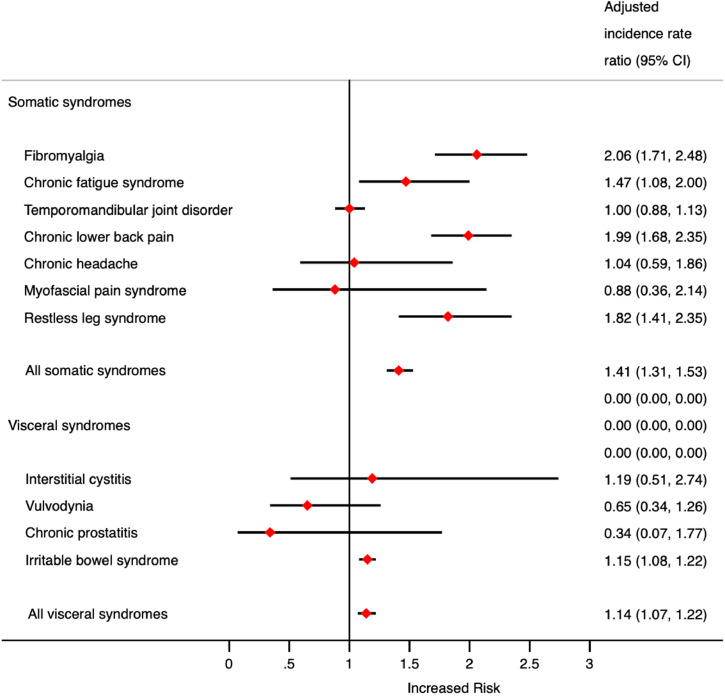
The average age at cohort entry was 23.4 years and the median follow was 2.2 years. There was an increased risk of developing fibromyalgia (aIRR 2.06; 95% CI 1.71-2.48), chronic fatigue syndrome (1.47; 1.08-2.00), chronic lower back pain (1.99; 1.68-2.35), restless leg syndrome (1.82; 1.41-2.35) and irritable bowel syndrome (1.15; 1.08-1.22) when compared to the unexposed group, whereas no statistical association was seen with the development of temporomandibular joint disorder (1.00; 0.88-1.13), chronic headache (1.04; 0.59-1.86), interstitial cystitis (1.19; 0.51-2.74), vulvodynia (0.65; 0.34-1.26), chronic prostatitis (0.34; 0.07-1.77) and myofascial pain syndrome (0.88; 0.36-2.14). Outcome numbers were low, most likely, due to the rarity of visceral conditions (aside from irritable bowel syndrome). The association between a history of childhood maltreatment and CSS were mainly observed in somatic CSS.
The debilitating effects of CSS carry a substantial physical, psychological and economic burden to both the individuals who are diagnosed with them and the health services who serve them. Primary prevention approaches targeting childhood maltreatment as well as secondary preventative approaches should be considered to minimise the associated burden of CSS.
儿童期受虐是一个全球性的公共卫生问题,与巨大的死亡和发病负担相关。本研究以现有文献为基础,探讨儿童期遭受虐待后发生中枢敏感综合征(CSS,包括躯体和内脏疼痛综合征)的风险。
一项基于人群的回顾性开放队列研究,使用英国初级保健数据库“健康改善网络”,时间跨度为1995年1月1日至2018年12月31日。80657名有儿童期受虐经历或与受虐相关问题的成年患者(暴露组患者)按年龄和性别与161314名未暴露患者进行匹配。感兴趣的结局是CSS的发生:躯体性(纤维肌痛、慢性疲劳综合征、颞下颌关节紊乱、慢性下背痛、慢性头痛、肌筋膜疼痛综合征和不安腿综合征)或内脏性(间质性膀胱炎、外阴痛、慢性前列腺炎和肠易激综合征)。效应量以调整后的发病率比(aIRR)及置信区间(CI)表示。模型在队列进入时针对以下协变量进行了调整:年龄、性别、贫困程度、焦虑、抑郁和严重精神疾病。
队列进入时的平均年龄为23.4岁,中位随访时间为2.2年。与未暴露组相比,发生纤维肌痛(aIRR 2.06;95%CI 1.71 - 2.48)、慢性疲劳综合征(1.47;1.08 - 2.00)、慢性下背痛(1.99;1.68 - 2.35)、不安腿综合征(1.82;1.41 - 2.35)和肠易激综合征(1.15;1.08 - 1.22)的风险增加,而与颞下颌关节紊乱(1.00;0.88 - 1.13)、慢性头痛(1.04;0.59 - 1.86)、间质性膀胱炎(1.19;0.51 - 2.74)、外阴痛(0.65;0.34 - 1.26)、慢性前列腺炎(0.34;0.07 - 1.77)和肌筋膜疼痛综合征(0.88;0.36 - 2.14)的发生无统计学关联。结局数量较少,很可能是由于内脏疾病(肠易激综合征除外)罕见。儿童期受虐史与CSS之间的关联主要见于躯体性CSS。
CSS的致残效应给被诊断患有该病的个体以及为他们服务的医疗服务机构带来了巨大的身体、心理和经济负担。应考虑针对儿童期受虐的一级预防方法以及二级预防方法,以尽量减少CSS的相关负担。