Public Health and Community Medicine Department, Faculty of Medicine, Fayoum University, Fayoum, Egypt.
Microbiological Department, Faculty of Medicine, Fayoum University, Fayoum, Egypt.
J Community Health. 2020 Dec;45(6):1242-1251. doi: 10.1007/s10900-020-00882-0.
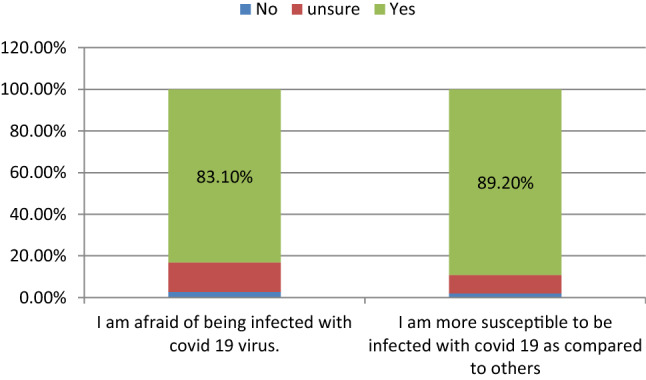
Healthcare workers (HCWs) are at the frontline defense against the coronavirus disease 2019 (COVID-19) pandemic. Inadequate knowledge and incorrect attitudes among HCWs can directly influence practices and lead to delayed diagnosis, poor infection control practice, and spread of disease. This study aimed to assess the knowledge, perception, and attitude of the Egyptian HCWs towards the COVID-19 disease. A descriptive cross-sectional study was conducted in Egypt, among 407 HCWs using a self-administered questionnaire. The mean correct answer rate was 80.4% with a mean knowledge score of 18.5 ± 2.7 out of 24. A positive correlation between knowledge and attitude scores was detected (r = 0.215, p < 0.001). About 83.1% of our participants reported that they were afraid of being infected with COVID-19, and 89.2% stated that they were more susceptible to COVID-19 infection as compared to others. Unavailability of personal protective equipment (PPE), fear of transmitting the disease to their families, and social stigma were the most frequently reported reasons for increased risk perception. The overall knowledge level of HCWs was generally good especially among physicians. A positive attitude was detected among allied health professionals more than physicians. Risk perception was high among HCWs. Causes of increased risk perception need to considered by the government and the Egyptian Ministry of Health.
医护人员(HCWs)是抗击 2019 年冠状病毒病(COVID-19)大流行的第一线防御者。医护人员知识不足和态度不正确会直接影响他们的实践,并导致诊断延误、感染控制实践不佳和疾病传播。本研究旨在评估埃及医护人员对 COVID-19 疾病的知识、看法和态度。在埃及进行了一项描述性的横断面研究,共纳入了 407 名医护人员,使用自我管理问卷进行调查。平均正确回答率为 80.4%,平均知识得分为 24 分中的 18.5±2.7 分。知识和态度得分之间存在正相关关系(r=0.215,p<0.001)。约 83.1%的参与者表示他们害怕感染 COVID-19,89.2%的人表示与其他人相比,他们更容易感染 COVID-19。个人防护设备(PPE)缺乏、担心将疾病传染给家人以及社会污名化是增加风险认知的最常见原因。医护人员的总体知识水平普遍良好,尤其是医生。辅助卫生专业人员的态度比医生更积极。医护人员的风险认知较高。政府和埃及卫生部需要考虑增加风险认知的原因。