
选择最佳光谱带以提高多光子显微镜中自体荧光生物标志物的检测能力。
Selecting optimal spectral bands for improved detection of autofluorescent biomarkers in multiphoton microscopy.
机构信息
DTU Fotonik, Denmark.
DTU Fotonik, Technical Univ. of Denmark, Denmark.
出版信息
J Biomed Opt. 2020 Jul;25(7):1-13. doi: 10.1117/1.JBO.25.7.071206.
SIGNIFICANCE
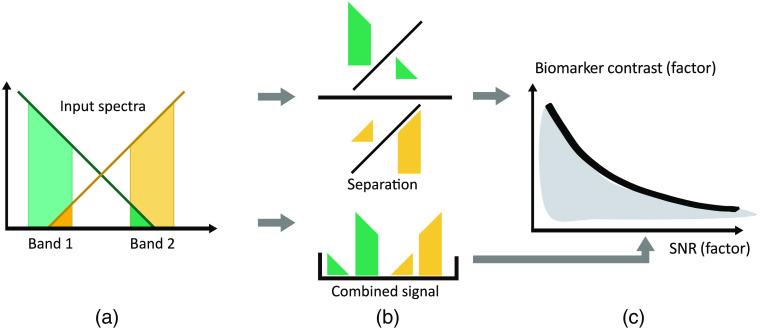
In multiphoton microscopy, two-photon excited fluorescence (TPEF) spectra carry valuable information on morphological and functional biological features. For measuring these biomarkers, separation of different parts of the fluorescence spectrum into channels is typically achieved by the use of optical band pass filters. However, spectra from different biomarkers can be unknown or overlapping, creating a crosstalk in between the channels. Previously, establishing these channels relied on prior knowledge or heuristic testing.
AIM
The presented method aims to provide spectral bands with optimal separation between groups of specimens expressing different biomarkers.
APPROACH
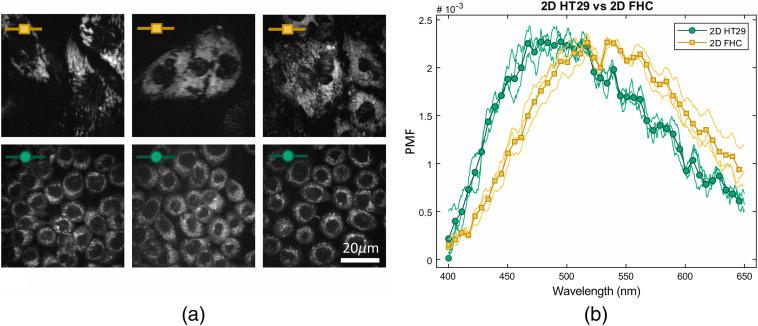
We have developed a system capable of resolving TPEF with high spectral resolution for the characterization of biomarkers. In addition, an algorithm is created to simulate and optimize optical band pass filters for fluorescence detection channels. To demonstrate the potential improvements in cell and tissue classification using these optimized channels, we recorded spectrally resolved images of cancerous (HT29) and normal epithelial colon cells (FHC), cultivated in 2D layers and in 3D to form spheroids. To provide an example of an application, we relate the results with the widely used redox ratio.
RESULTS
We show that in the case of two detection channels, our system and algorithm enable the selection of optimized band pass filters without the need of knowing involved fluorophores. An improvement of 31,5% in separating different 2D cell cultures is achieved, compared to using established spectral bands that assume NAD(P)H and FAD as main contributors of autofluorescence. The compromise is a reduced SNR in the images.
CONCLUSIONS
We show that the presented method has the ability to improve imaging contrast and can be used to tailor a given label-free optical imaging system using optical band pass filters targeting a specific biomarker or application.
意义
在多光子显微镜中,双光子激发荧光(TPEF)光谱携带有关形态和功能生物特征的有价值信息。为了测量这些生物标志物,通常通过使用光学带通滤波器将荧光光谱的不同部分分离到通道中。然而,不同生物标志物的光谱可能未知或重叠,从而在通道之间产生串扰。以前,建立这些通道依赖于先验知识或启发式测试。
目的
本方法旨在提供具有最佳分离度的光谱带,以分离表达不同生物标志物的样本组。
方法
我们开发了一种能够以高光谱分辨率解析 TPEF 的系统,用于生物标志物的表征。此外,创建了一种算法来模拟和优化荧光检测通道的光学带通滤波器。为了演示使用这些优化通道在细胞和组织分类方面的潜在改进,我们记录了培养在 2D 层和 3D 中形成球体的癌(HT29)和正常上皮结肠细胞(FHC)的光谱分辨图像。为了提供一个应用示例,我们将结果与广泛使用的氧化还原比联系起来。
结果
我们表明,在两个检测通道的情况下,我们的系统和算法能够在不需要知道涉及荧光团的情况下选择优化的带通滤波器。与使用假设 NAD(P)H 和 FAD 为自发荧光主要贡献者的既定光谱带相比,实现了对不同 2D 细胞培养物的分离提高了 31.5%。图像中的 SNR 降低是一个折衷方案。
结论
我们表明,所提出的方法具有改善成像对比度的能力,并且可以用于使用针对特定生物标志物或应用的光学带通滤波器来定制给定的无标记光学成像系统。





 Zotero 插件