Smrke Alannah, Younger Eugenie, Wilson Roger, Husson Olga, Farag Sheima, Merry Eve, Macklin-Doherty Aislinn, Cojocaru Elena, Arthur Amani, Benson Charlotte, Miah Aisha B, Zaidi Shane, Gennatas Spyridon, Jones Robin L
The Royal Marsden Hospital NHS Trust, London, United Kingdom.
Sarcoma Patients Euronet e.V./Association, Wölfersheim, Germany.
JCO Glob Oncol. 2020 Jul;6:1046-1051. doi: 10.1200/GO.20.00220.
Many patients with cancer, often those with rare cancers such as sarcomas, travel long distances to access expert care. The COVID-19 pandemic necessitated widespread changes in delivery of cancer care, including rapid adoption of telemedicine-based care. We aimed to evaluate the impact of telemedicine on patients, clinicians, and care delivery at the Royal Marsden Hospital (RMH) Sarcoma Unit during the pandemic.
Data were extracted from patient records for all planned outpatient appointments at the RMH Sarcoma Unit from March 23 to April 24, 2020. Patients and clinicians completed separate questionnaires to understand their experiences.
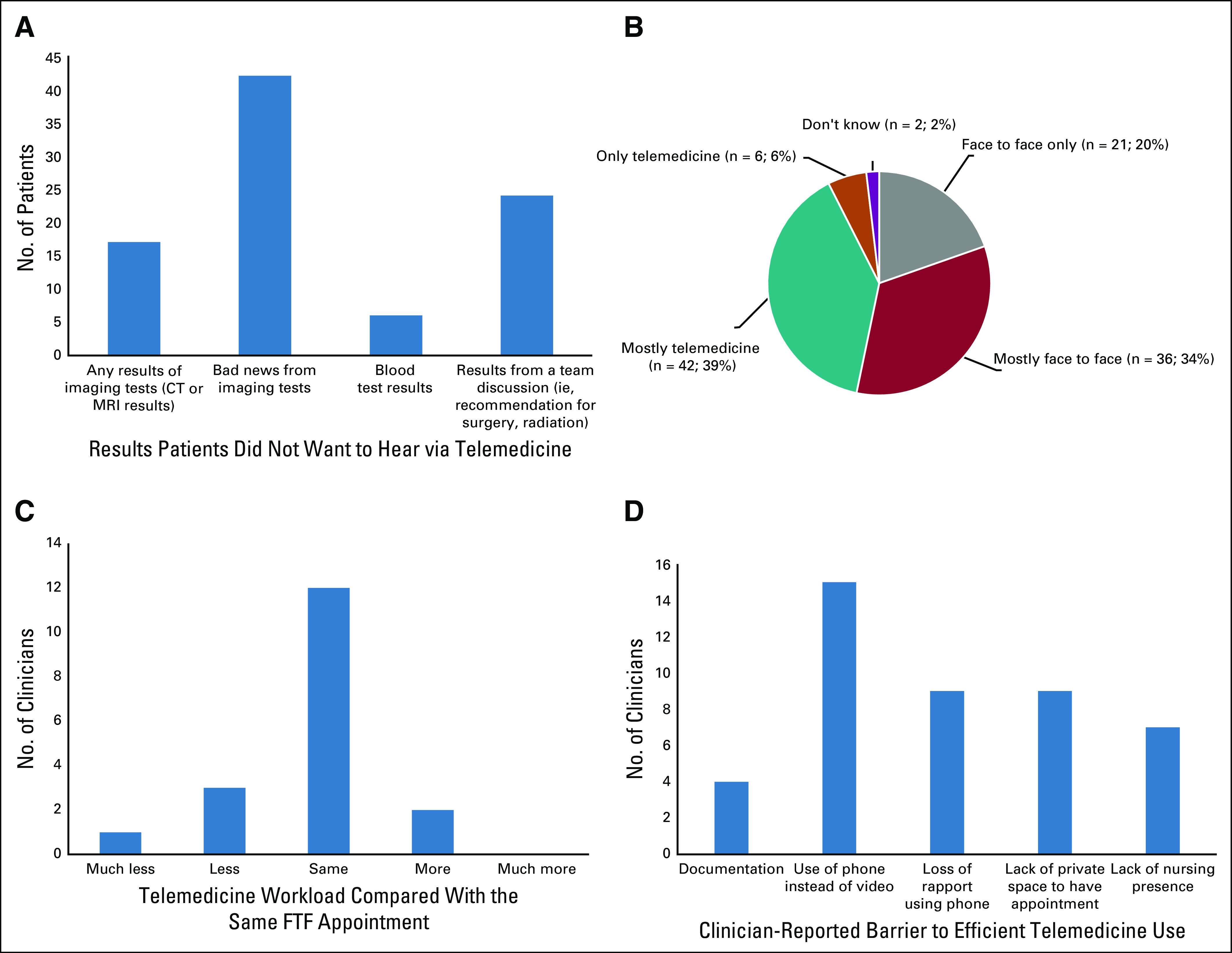
Of 379 planned face-to-face appointments, 283 (75%) were converted to telemedicine. Face-to-face appointments remained for patients who needed urgent start of therapy or performance status assessment. Patients lived on average > 1.5 hours from RMH. Patient satisfaction (n = 108) with telemedicine was high (mean, 9/10), and only 48% (n = 52/108) would not want to hear bad news using telemedicine. Clinicians found telemedicine efficient, with no associated increased workload, compared with face-to-face appointments. Clinicians indicated lack of physical examination did not often affect care provision when using telemedicine. Most clinicians (n = 17; 94%) believed telemedicine use was practice changing; congruently, 80% (n = 86/108) of patients desired some telemedicine as part of their future care, citing reduced cost and travel time.
Telemedicine can revolutionize delivery of cancer care, particularly for patients with rare cancers who often live far away from expert centers. Our study demonstrates important patient and clinician benefits; assessment of longer-term impact on patient outcomes and health care systems is needed.
许多癌症患者,尤其是那些患有肉瘤等罕见癌症的患者,需要长途跋涉才能获得专家治疗。2019年冠状病毒病(COVID-19)大流行使得癌症护理的提供方式发生了广泛变化,包括迅速采用基于远程医疗的护理。我们旨在评估大流行期间远程医疗对皇家马斯登医院(RMH)肉瘤科患者、临床医生和护理提供的影响。
从2020年3月23日至4月24日RMH肉瘤科所有计划门诊预约的患者记录中提取数据。患者和临床医生分别填写问卷以了解他们的经历。
在379次计划的面对面预约中,283次(75%)改为远程医疗。需要紧急开始治疗或进行体能状态评估的患者仍保留面对面预约。患者居住地距离RMH平均超过1.5小时车程。患者(n = 108)对远程医疗的满意度很高(平均9/10),只有48%(n = 52/108)的患者不想通过远程医疗听到坏消息。与面对面预约相比,临床医生发现远程医疗效率高,且没有增加相关工作量。临床医生表示,在使用远程医疗时,缺乏体格检查通常不会影响护理提供。大多数临床医生(n = 17;94%)认为使用远程医疗改变了医疗实践;同样,80%(n = 86/108)的患者希望在未来护理中采用一些远程医疗方式,理由是成本降低和出行时间减少。
远程医疗可以彻底改变癌症护理的提供方式,特别是对于那些居住在远离专家中心的罕见癌症患者。我们的研究证明了对患者和临床医生有重要益处;需要评估对患者预后和医疗保健系统的长期影响。