• 文献检索
  • 文档翻译
  • 深度研究
  • 学术资讯
  • Suppr Zotero 插件Zotero 插件
  • 邀请有礼
  • 套餐&价格
  • 历史记录
应用&插件
Suppr Zotero 插件Zotero 插件浏览器插件Mac 客户端Windows 客户端微信小程序
定价
高级版会员购买积分包购买API积分包
服务
文献检索文档翻译深度研究API 文档MCP 服务
关于我们
关于 Suppr公司介绍联系我们用户协议隐私条款
关注我们

Suppr 超能文献

核心技术专利:CN118964589B侵权必究
粤ICP备2023148730 号-1Suppr @ 2026

文献检索

告别复杂PubMed语法,用中文像聊天一样搜索,搜遍4000万医学文献。AI智能推荐,让科研检索更轻松。

立即免费搜索

文件翻译

保留排版,准确专业,支持PDF/Word/PPT等文件格式,支持 12+语言互译。

免费翻译文档

深度研究

AI帮你快速写综述,25分钟生成高质量综述,智能提取关键信息,辅助科研写作。

立即免费体验

展望美国后新冠疫情时代,远程医疗板块金融估值和预期将重新调整。

A Rebalancing of Financial Valuations and Expectations Moving Forward in the Telehealth Sector as the United States Moves Toward a Post-COVID-19 Reality.

机构信息

Boston Strategic Partners, Boston, MA, United States.

出版信息

J Med Internet Res. 2023 Jul 31;25:e35857. doi: 10.2196/35857.

DOI:10.2196/35857
PMID:37523216
原文链接:https://pmc.ncbi.nlm.nih.gov/articles/PMC10425816/
Abstract

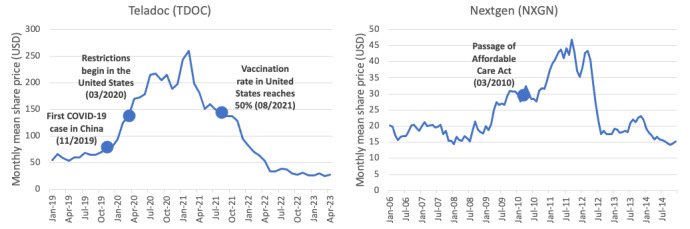
The telehealth sector of health care delivery experienced significant growth at the start of the pandemic as web-based care quickly became essential for the ongoing safety of patients and health care providers, such as clinicians and other health care professionals. After vaccines were introduced, however, telehealth companies lost value as the need for web-based care appeared to lessen. Presently, both existing telehealth companies and new entrants to the space are seeking ways to innovate, gain investor and customer buy-in, and overcome competitors. New companies are hoping to be seen not as pandemic-era substitutes, but instead as reinforcements to in-person care, valuable in their own right thanks to the convenience and technological advancements they bring. This struggle to reframe the value proposition, or perceived benefit, of telehealth is reflected in fluctuating stock prices and dropping valuations. This viewpoint summarizes the market volatility seen in the telehealth sector since the start of the COVID-19 pandemic and suggests potential opportunities for growth in the space. This is accomplished through a qualitative secondary research approach, leveraging contemporary sources, financial references such as Yahoo! Finance, and peer-reviewed literature to support predictions for the future market. We found that, in 2020, the size of the US telehealth market rose to US $17.9 billion and is estimated to reach US $140.7 billion by 2030. Additionally, digital health venture funding nearly doubled in 2020 over the prior 2 years with total funding rising to US $14.1 billion. However, these factors produced an oversaturated market in which the volume of supply was higher than demand, resulting in a sharp drop in valuations for some as vaccination rates climbed in 2021. In the face of this rebalancing, or return to normal following excessively high or unsustainable valuations, we suggest a possible path forward for telehealth companies in the postpandemic era. Suppliers' current role in the telehealth space-whether health care industry incumbents, that is, traditional health care delivery systems and companies, or "telehealth-first" challengers-are especially relevant to the specific growth strategies they should pursue. Furthermore, consideration of the areas of medicine and characteristics that best lend themselves to web-based care may lead to a greater chance for long-term success in a postpandemic health care delivery system. In the future, we believe investors should expect a bullish market, that is, one characterized by growing share prices. Success is likely to occur in part through changing the actual models of care, as opposed to moving traditional care to a web-based format. The oversaturated market will likely condense into select established telehealth giants who were able to adapt to the changing landscape. While investors may be reasonably hesitant regarding individual telehealth companies, the industry can expect slowed but continued growth.
https://cdn.ncbi.nlm.nih.gov/pmc/blobs/5f4a/10425816/f41230092d91/jmir_v25i1e35857_fig1.jpg
摘要

在大流行开始时,医疗保健提供领域的远程医疗经历了显著的增长,因为基于网络的护理迅速成为患者和医疗保健提供者(如临床医生和其他医疗保健专业人员)持续安全的必要条件。然而,在引入疫苗后,随着对基于网络的护理的需求似乎减少,远程医疗公司的价值下降。目前,现有的远程医疗公司和该领域的新进入者都在寻找创新的方法,获得投资者和客户的认可,并克服竞争对手。新公司希望被视为不仅仅是大流行时期的替代品,而是作为面对面护理的补充,由于它们带来的便利性和技术进步,它们本身就具有价值。这种重新构建远程医疗的价值主张或感知收益的努力反映在波动的股价和不断下降的估值中。这一观点总结了自 COVID-19 大流行开始以来远程医疗领域的市场波动,并为该领域的未来增长提供了潜在机会。这是通过定性的二次研究方法实现的,利用当代资源、雅虎金融等金融参考资料以及同行评议文献来支持对未来市场的预测。我们发现,2020 年,美国远程医疗市场规模增长到 179 亿美元,预计到 2030 年将达到 1407 亿美元。此外,2020 年数字医疗风险投资几乎是前两年的两倍,总投资上升至 141 亿美元。然而,这些因素导致了一个供过于求的市场,供应数量高于需求,导致一些公司的估值在 2021 年疫苗接种率上升时大幅下降。面对这种再平衡,或者说在过高或不可持续的估值之后回归正常,我们为大流行后时代的远程医疗公司提出了一个可能的前进道路。供应商在远程医疗领域的当前角色——无论是医疗保健行业的现有企业,即传统的医疗保健提供系统和公司,还是“远程医疗优先”的挑战者——对于他们应该追求的具体增长战略特别重要。此外,考虑到最适合基于网络的护理的医学领域和特征,可能会增加在大流行后医疗保健提供系统中取得长期成功的机会。未来,我们相信投资者将预期市场看涨,也就是说,股价不断上涨。成功可能部分是通过改变实际的护理模式,而不是将传统护理转移到基于网络的模式。供过于求的市场可能会集中到少数能够适应不断变化的格局的成熟远程医疗巨头。虽然投资者对个别远程医疗公司可能会有合理的犹豫,但该行业预计将继续保持缓慢但持续的增长。

相似文献

1
A Rebalancing of Financial Valuations and Expectations Moving Forward in the Telehealth Sector as the United States Moves Toward a Post-COVID-19 Reality.展望美国后新冠疫情时代,远程医疗板块金融估值和预期将重新调整。
J Med Internet Res. 2023 Jul 31;25:e35857. doi: 10.2196/35857.
2
The future of Cochrane Neonatal.考克兰新生儿协作网的未来。
Early Hum Dev. 2020 Nov;150:105191. doi: 10.1016/j.earlhumdev.2020.105191. Epub 2020 Sep 12.
3
Pandemic-Triggered Adoption of Telehealth in Underserved Communities: Descriptive Study of Pre- and Postshutdown Trends.大流行引发的医疗资源匮乏社区远程医疗的采用:关停前后趋势的描述性研究。
J Med Internet Res. 2022 Jul 15;24(7):e38602. doi: 10.2196/38602.
4
Digital Approaches to Remote Pediatric Health Care Delivery During the COVID-19 Pandemic: Existing Evidence and a Call for Further Research.COVID-19大流行期间远程儿科医疗服务的数字方法:现有证据及进一步研究的呼吁。
JMIR Pediatr Parent. 2020 Jun 25;3(1):e20049. doi: 10.2196/20049.
5
"A decade's worth of work in a matter of days": The journey to telehealth for the whole population in Australia.“十年的工作在几天内完成”:澳大利亚全民普及远程医疗的历程。
Int J Med Inform. 2021 Jul;151:104483. doi: 10.1016/j.ijmedinf.2021.104483. Epub 2021 May 7.
6
Impact of COVID-19 on Characteristics and Funding of U.S. Healthcare Startups: Retrospective Review.COVID-19 对美国医疗保健初创企业的特征和资金的影响:回顾性研究。
JMIR Form Res. 2024 Aug 27;8:e56327. doi: 10.2196/56327.
7
Digital Orientation of Health Systems in the Post-COVID-19 "New Normal" in the United States: Cross-sectional Survey.美国后 COVID-19“新常态”下的卫生系统数字化定位:横断面调查。
J Med Internet Res. 2021 Aug 16;23(8):e30453. doi: 10.2196/30453.
8
Rapid Transition to Telehealth and the Digital Divide: Implications for Primary Care Access and Equity in a Post-COVID Era.快速向远程医疗和数字鸿沟过渡:在后 COVID-19 时代对初级保健可及性和公平性的影响。
Milbank Q. 2021 Jun;99(2):340-368. doi: 10.1111/1468-0009.12509. Epub 2021 Jun 1.
9
Challenges and Implications for Menopausal Health and Help-Seeking Behaviors in Midlife Women From the United States and China in Light of the COVID-19 Pandemic: Web-Based Panel Surveys.鉴于新冠疫情,美国和中国中年女性更年期健康及求助行为面临的挑战与影响:基于网络的小组调查
JMIR Public Health Surveill. 2024 Jan 26;10:e46538. doi: 10.2196/46538.
10
The Technological Impact of COVID-19 on the Future of Education and Health Care Delivery.新冠疫情对教育和医疗保健服务未来的技术影响。
Pain Physician. 2020 Aug;23(4S):S367-S380.

引用本文的文献

1
Virtual urgent care in an integrated value based healthcare system.综合价值医疗体系中的虚拟紧急护理
NPJ Digit Med. 2025 Apr 14;8(1):206. doi: 10.1038/s41746-025-01590-6.
2
Analysis of Telehealth Discussion Trends on Reddit (2019-2022).Reddit上远程医疗讨论趋势分析(2019 - 2022年)
Telemed J E Health. 2024 Jun;30(6):e1790-e1797. doi: 10.1089/tmj.2023.0651. Epub 2024 Feb 23.

本文引用的文献

1
Patient Satisfaction with Telemedicine during the COVID-19 Pandemic-A Systematic Review.《COVID-19 大流行期间的远程医疗患者满意度:系统评价》。
Int J Environ Res Public Health. 2022 May 17;19(10):6113. doi: 10.3390/ijerph19106113.
2
Physician Satisfaction With Telehealth: A Systematic Review and Agenda for Future Research.医生对远程医疗的满意度:系统评价及未来研究议程。
Qual Manag Health Care. 2022;31(3):160-169. doi: 10.1097/QMH.0000000000000359. Epub 2022 Feb 7.
3
Comparison of care accessibility, costs, and quality with face-to-face and telehealth epilepsy clinic visits.
面对面和远程医疗癫痫诊所就诊的护理可及性、成本和质量比较。
Epilepsy Behav. 2022 Feb;127:108510. doi: 10.1016/j.yebeh.2021.108510. Epub 2022 Jan 3.
4
Utilisation of telehealth for outpatient diabetes management during COVID-19 pandemic: how did the patients fare?新冠疫情期间利用远程医疗进行门诊糖尿病管理:患者情况如何?
Intern Med J. 2021 Dec;51(12):2021-2026. doi: 10.1111/imj.15441.
5
Clinical Efficiency and Safety Outcomes of Virtual Care for Oncology Patients During the COVID-19 Pandemic.COVID-19 大流行期间肿瘤患者虚拟护理的临床效率和安全性结果。
JCO Oncol Pract. 2021 Sep;17(9):e1327-e1332. doi: 10.1200/OP.21.00092. Epub 2021 Jun 21.
6
Understanding Telemedicine's "New Normal": Variations in Telemedicine Use by Specialty Line and Patient Demographics.理解远程医疗的“新常态”:按专业类别和患者特征划分的远程医疗使用变化。
Telemed J E Health. 2022 Jan;28(1):51-59. doi: 10.1089/tmj.2021.0041. Epub 2021 Mar 25.
7
Telehealth in cancer care: during and beyond the COVID-19 pandemic.癌症护理中的远程医疗:在 COVID-19 大流行期间和之后。
Intern Med J. 2021 Jan;51(1):125-133. doi: 10.1111/imj.15039.
8
Physician Perspective and Key Satisfaction Indicators with Rapid Telehealth Adoption During the Coronavirus Disease 2019 Pandemic.在 2019 年冠状病毒病大流行期间快速采用远程医疗的医生视角和关键满意度指标。
Telemed J E Health. 2021 Nov;27(11):1225-1234. doi: 10.1089/tmj.2020.0492. Epub 2021 Jan 29.
9
Efficacy of telemedicine for persons with type 1 diabetes during Covid19 lockdown.新冠疫情封锁期间 1 型糖尿病患者远程医疗的疗效。
Nutr Diabetes. 2021 Jan 5;11(1):1. doi: 10.1038/s41387-020-00147-8.
10
A Multimodal Telehealth Strategy to Improve Pediatric Epilepsy Care.多模态远程医疗策略改善儿科癫痫护理。
Pediatr Clin North Am. 2020 Aug;67(4):629-634. doi: 10.1016/j.pcl.2020.04.004. Epub 2020 Jun 11.