From the Department of Diabetes and Endocrinology, Toranomon Hospital Kajigaya, Kanagawa, Japan (T.T.).
Department of Diabetes, Endocrinology, and Metabolism, Center Hospital, National Center for Global Health and Medicine, Tokyo, Japan (T.T., H.K.).
Hypertension. 2020 Aug;76(2):432-441. doi: 10.1161/HYPERTENSIONAHA.120.15154. Epub 2020 Jul 8.
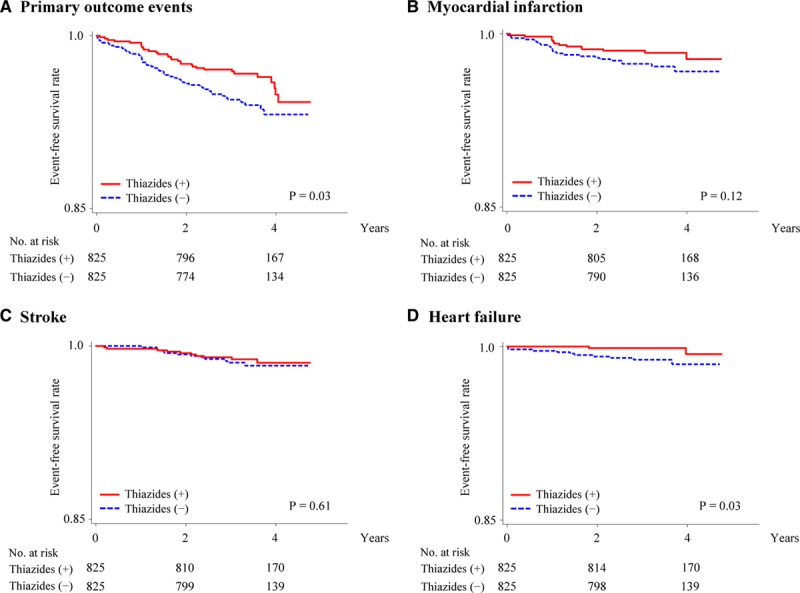
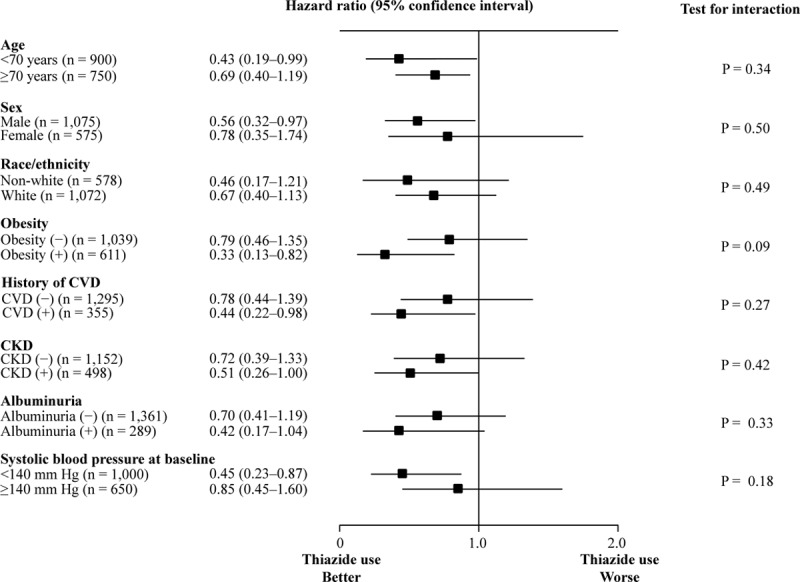
The SPRINT (Systolic Blood Pressure Intervention Trial) study reported that intensive blood pressure (BP) treatment with a systolic BP target of <120 mm Hg decreased the risks of cardiovascular events. However, it remains unknown whether specific medications can further improve cardiovascular outcome in patients receiving intensive BP treatment. This study examined whether thiazide use improves cardiovascular outcome in patients receiving intensive BP treatment. We used data of nondiabetic patients receiving intensive BP treatment in the SPRINT study. The primary outcome was a composite end point of myocardial infarction, acute coronary syndrome, stroke, heart failure, or cardiovascular death. We analyzed hazard ratios for outcomes with 95% CIs in patients taking thiazides compared with those not taking thiazides using Cox proportional hazard models. This study included 2847 patients and the mean follow-up period was 3.3 years. The risk of primary outcome events was significantly lower in patients taking thiazides than in those not taking thiazides in both entire and propensity score-matched cohorts. Particularly, heart failure risk was significantly lower in those taking thiazides. These associations were also observed in various subgroups. In addition, thiazide use was associated with decreased risk of all-cause mortality. Hypokalemia occurred more frequently in patients taking thiazides than in those not taking thiazides. Thiazide use decreased risk of cardiovascular events, particularly heart failure, in nondiabetic high-risk patients receiving intensive BP treatment.
SPRINT(收缩压干预试验)研究报告称,将收缩压目标值控制在<120mmHg 以下的强化血压治疗可降低心血管事件的风险。然而,目前尚不清楚特定药物是否可以进一步改善接受强化血压治疗的患者的心血管结局。本研究旨在探讨噻嗪类药物的使用是否可以改善接受强化血压治疗的患者的心血管结局。我们使用 SPRINT 研究中接受强化血压治疗的非糖尿病患者的数据。主要终点是心肌梗死、急性冠状动脉综合征、卒中等复合终点。我们使用 Cox 比例风险模型分析了服用噻嗪类药物与未服用噻嗪类药物患者的结局风险比及其 95%置信区间。这项研究共纳入 2847 例患者,平均随访时间为 3.3 年。在整个队列和倾向评分匹配队列中,服用噻嗪类药物的患者主要结局事件的风险均明显低于未服用噻嗪类药物的患者。特别是,服用噻嗪类药物的心力衰竭风险显著降低。在各种亚组中也观察到了这些关联。此外,噻嗪类药物的使用与全因死亡率降低相关。服用噻嗪类药物的患者比未服用噻嗪类药物的患者更易发生低钾血症。噻嗪类药物的使用可降低接受强化血压治疗的非糖尿病高危患者的心血管事件风险,特别是心力衰竭风险。