The Key Laboratory of Cardiovascular Remodeling and Function Research, Chinese Ministry of Education and Chinese Ministry of Health, and The State and Shandong Province Joint Key Laboratory of Translational Cardiovascular Medicine, Qilu Hospital of Shandong University, Jinan, Shandong, China.
Department of Pediatrics and Department of Cardiology, Shandong Provincial Hospital Affiliated to Shandong University, Jinan, Shandong, China.
J Cell Mol Med. 2017 Nov;21(11):2634-2642. doi: 10.1111/jcmm.13205. Epub 2017 Jun 19.
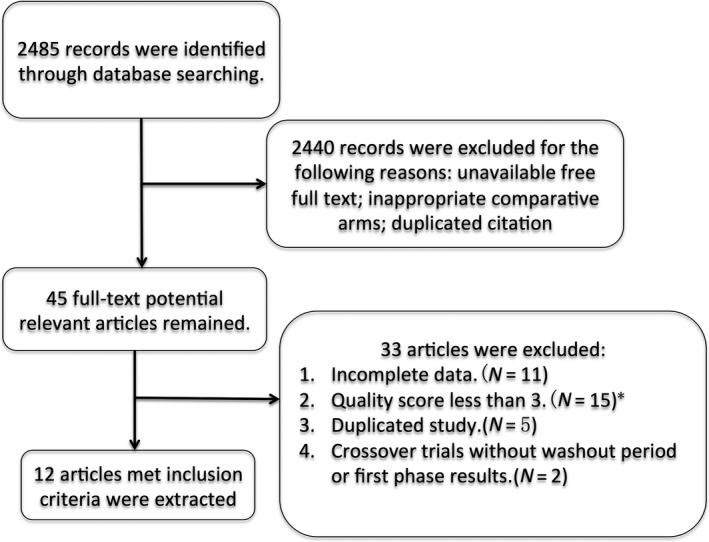
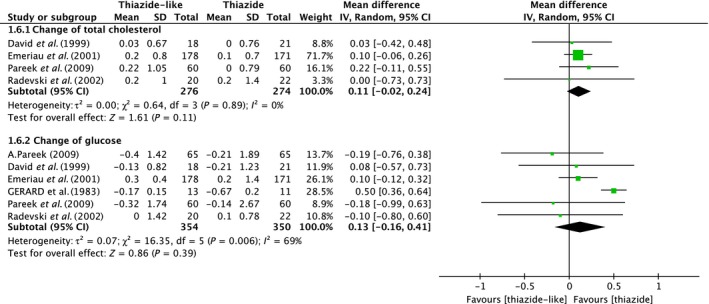
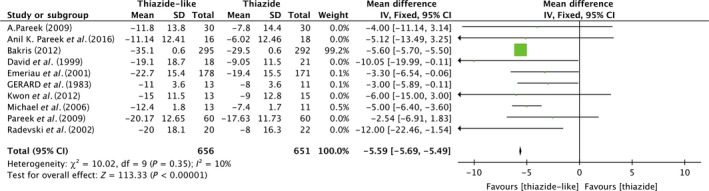
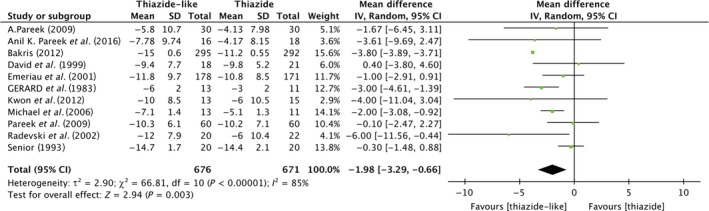
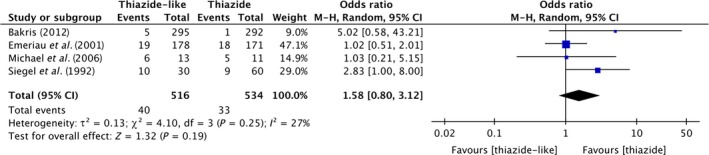
Thiazide diuretics are widely used for the management of hypertension. In recent years, it has been actively debated that there is interchangeability of thiazide-type diuretics hydrochlorothiazide and thiazide-like diuretics including indapamide and chlorthalidone for the treatment of hypertension. With the purpose of seeking out the best thiazide diuretic for clinicians, we summarized the existing evidence on the two types of drugs and conducted a meta-analysis on their efficacy in lowering blood pressure and effects on blood electrolyte, glucose and total cholesterol. Twelve trials were identified: five based on the comparison of indapamide versus hydrochlorothiazide and seven based on the chlorthalidone versus hydrochlorothiazide. In the meta-analysis of blood pressure reduction, thiazide-like diuretics seemed to further reduce systolic BP ([95% CI]; -5.59 [-5.69, -5.49]; P < 0.001) and diastolic BP ([95% CI]; -1.98 [-3.29, -0.66]; P = 0.003). Meanwhile, in the analysis of side effects, the incidence of hypokalemia ([95% CI]; 1.58 [0.80, 3.12]; P = 0.19), hyponatremia ([95% CI]; -0.14 [-0.57, 0.30], P = 0.54), change of blood glucose ([95% CI];0.13 [-0.16, 0.41], P = 0.39) and total cholesterol ([95% CI]; 0.13 [-0.16, 0.41], P = 0.39) showed that there is no statistical significant differences between the two groups of drugs. In conclusion, using thiazide-like diuretics is superior to thiazide-type diuretics in reducing blood pressure without increasing the incidence of hypokalemia, hyponatraemia and any change of blood glucose and serum total cholesterol.
噻嗪类利尿剂被广泛用于高血压的治疗。近年来,人们积极讨论噻嗪型利尿剂氢氯噻嗪和噻嗪样利尿剂(包括吲达帕胺和氯噻酮)在治疗高血压方面是否可以相互替代。为了寻找最适合临床医生的噻嗪类利尿剂,我们总结了这两种药物的现有证据,并对它们降低血压的疗效和对血电解质、血糖和总胆固醇的影响进行了荟萃分析。共确定了 12 项试验:5 项基于吲达帕胺与氢氯噻嗪的比较,7 项基于氯噻酮与氢氯噻嗪的比较。在血压降低的荟萃分析中,噻嗪样利尿剂似乎能进一步降低收缩压([95% CI];-5.59[-5.69,-5.49];P<0.001)和舒张压([95% CI];-1.98[-3.29,-0.66];P=0.003)。同时,在不良反应分析中,低钾血症的发生率([95% CI];1.58[0.80,3.12];P=0.19)、低钠血症([95% CI];-0.14[-0.57,0.30],P=0.54)、血糖变化([95% CI];0.13[-0.16,0.41],P=0.39)和总胆固醇([95% CI];0.13[-0.16,0.41],P=0.39)两组间无统计学差异。总之,噻嗪样利尿剂在降低血压方面优于噻嗪型利尿剂,且不会增加低钾血症、低钠血症以及血糖和血清总胆固醇任何变化的发生率。