Department of Social Policy and Intervention, University of Oxford, Oxford, UK
MRC/CSO Social and Public Health Sciences Unit, University of Glasgow, Glasgow, UK.
BMJ Glob Health. 2020 Jul;5(7). doi: 10.1136/bmjgh-2020-002349.
Parenting programmes may reduce the risk of violence against children and improve child well-being. However, additional economic support may be necessary in highly deprived rural communities in sub-Saharan Africa. Furthermore, delivering programmes within farmer groups may increase male caregiver recruitment and engagement.
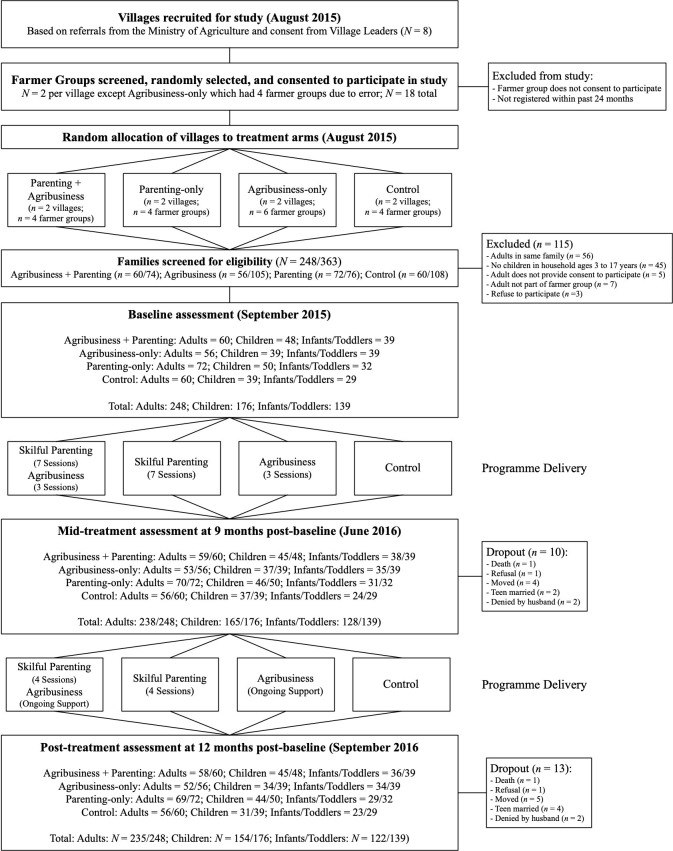
A parallel cluster randomised controlled trial examined the combined and separate effects of parenting and economic strengthening programmes on reducing violence against children aged 0-18 years in farming communities in Tanzania (n=248 families; 63% male caregivers). Eight villages were randomly assigned to four conditions (2:2:2:2): (1) 12-session parenting programme (n=60); (2) agribusiness training (n=56); (3) parenting and agribusiness combined (n=72); (4) control (n=60). Parent-report, child-report and early childhood observation assessments were conducted at baseline, mid-treatment and post-treatment. Primary outcomes were child maltreatment and parenting behaviour. Secondary outcomes included corporal punishment endorsement, parenting stress, parent/child depression, child behaviour, economic well-being and child development.
At post-treatment, parents and children receiving the combined interventions reported less maltreatment (parents: incidence rate ratio (IRR=0.40, 95% CI 0.24 to 0.65; children: IRR=0.40, 95% CI 0.17 to 0.92). Parents reported reduced endorsement of corporal punishment ( =-0.43, 95% CI -0.79 to 0.07) and fewer child behaviour problems ( =-0.41, 95% CI -0.77 to 0.05). Parents in parenting-only villages reported less abuse (IRR=0.36, 95% CI 0.21 to 0.63) and fewer child behaviour problems ( =-0.47, 95% CI -0.84 to 0.11). Parents in agribusiness-only villages reported fewer child behaviour problems ( =-0.43, 95% CI -0.77 to 0.08) and greater household wealth ( =0.57, 95% CI 0.08 to 1.06). However, children in agribusiness-only villages reported increased physical abuse (IRR=2.26, 95% CI 1.00 to 5.12) and less positive parenting ( =-0.50, 95% CI -0.91 to 0.10). There were no other adverse effects.
Parent training may be the active ingredient in reducing maltreatment in farmer groups with majority male caregivers, while agribusiness training programmes may have unintended negative consequences on children when delivered alone. Locating parenting support in existing farmer groups can engage much higher proportions of fathers than stand-alone programmes.ClinicalTrials.gov: NCT02633319.
育儿计划可能会降低儿童遭受暴力的风险,并提高儿童的幸福感。然而,在撒哈拉以南非洲的高度贫困农村社区,可能需要额外的经济支持。此外,在农民群体中提供计划可能会增加男性照顾者的招募和参与。
一项平行群组随机对照试验研究了育儿和经济强化计划对减少坦桑尼亚农村社区 0-18 岁儿童暴力的综合和单独影响(n=248 个家庭;63%的男性照顾者)。8 个村庄被随机分配到 4 个条件(2:2:2:2):(1)12 节育儿课程(n=60);(2)农业企业培训(n=56);(3)育儿和农业企业相结合(n=72);(4)对照组(n=60)。在基线、治疗中期和治疗后进行父母报告、儿童报告和幼儿观察评估。主要结果是儿童虐待和育儿行为。次要结果包括身体惩罚的认可、育儿压力、父母/儿童抑郁、儿童行为、经济福祉和儿童发展。
在治疗后,接受综合干预的父母和儿童报告的虐待行为较少(父母:发病率比(IRR)=0.40,95%CI 0.24 至 0.65;儿童:IRR=0.40,95%CI 0.17 至 0.92)。父母报告的身体惩罚认可减少(=-0.43,95%CI-0.79 至 0.07),儿童行为问题减少(=-0.41,95%CI-0.77 至 0.05)。仅接受育儿计划的村庄的父母报告的虐待行为较少(IRR=0.36,95%CI 0.21 至 0.63),儿童行为问题较少(=-0.47,95%CI-0.84 至 0.11)。仅接受农业企业计划的村庄的父母报告的儿童行为问题较少(=-0.43,95%CI-0.77 至 0.08),家庭财富增加(=0.57,95%CI 0.08 至 1.06)。然而,仅接受农业企业计划的村庄的儿童报告的身体虐待增加(IRR=2.26,95%CI 1.00 至 5.12),积极育儿减少(=-0.50,95%CI-0.91 至 0.10)。没有其他不良影响。
育儿培训可能是减少以男性照顾者为主的农民群体中虐待行为的有效方法,而农业企业培训计划单独实施可能对儿童产生意想不到的负面影响。将育儿支持纳入现有的农民群体中,可以比独立计划吸引更高比例的父亲参与。ClinicalTrials.gov:NCT02633319。