Devlin Alison M, Wight Daniel, Fenton Candida
MRC/CSO Social and Public Health Sciences Unit, Institute of Health and Wellbeing, University of Glasgow, Glasgow, UK.
Cochrane Vascular, Usher Institute of Population Health Sciences and Informatics, University of Edinburgh, Medical School, Teviot Place, Edinburgh, United Kingdom.
BMJ Glob Health. 2018 Dec 27;3(6):e000912. doi: 10.1136/bmjgh-2018-000912. eCollection 2018.
There is increasing interest in the transferability of parenting interventions from high-income countries (HICs) to low-income countries (LICs) in order to improve child development and health outcomes. This is based on the premise that associations between parenting practices and child outcomes are similar in both settings. Many parenting interventions in HICs are evidence-based, but less evidence exists on associations of parenting practices with child outcomes in LICs, in particular, sub-Saharan African (SSA) countries. This review synthesises evidence on the association of parenting practices with child outcomes in SSA in order to compare findings with those from HICs.
We searched electronic databases-Web of Science, ASSIA, Embase, IBSS and PsycINFO-to identify studies from SSA that reported quantitative associations between parenting practices and child health or psychosocial outcomes (eg, sexual and reproductive health (SRH), mental health, conduct disorders). Due to inconsistent conceptual framing of parenting across studies, we used a modified version of the international WHO classification of parenting dimensions to guide synthesis of the results.
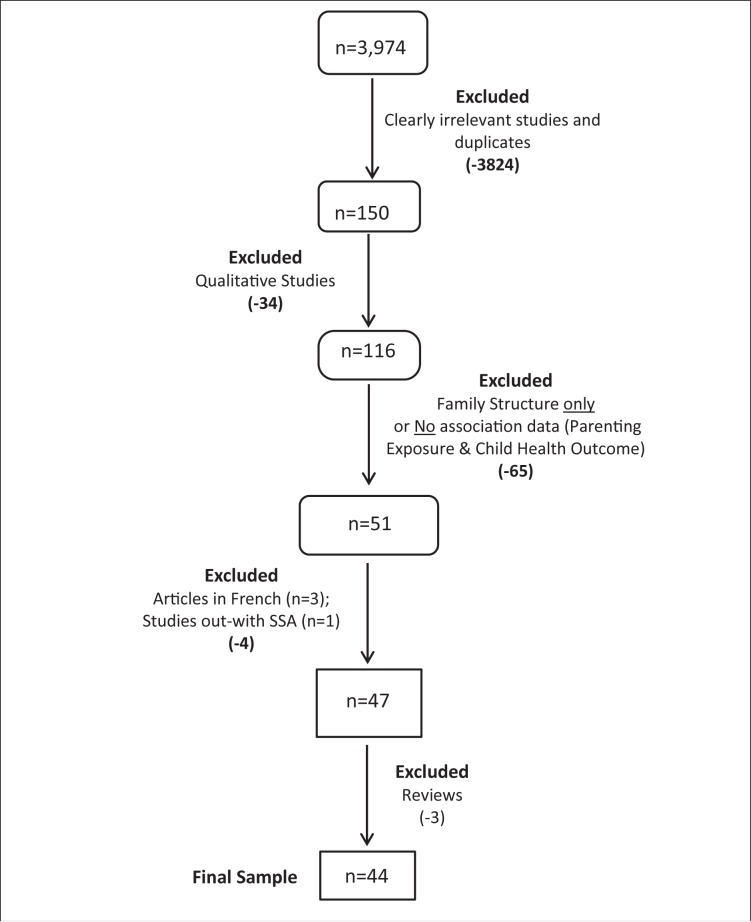
Forty-four studies met our inclusion criteria. They were conducted in 13 SSA countries and included cross-sectional and longitudinal studies, and were predominantly descriptive studies rather than intervention research. Synthesis of results showed that associations between patterns of parenting ('positive'/'harsh') and child outcomes (including SRH, mental health and conduct disorders) in studies from SSA were broadly similar to those found in HICs.
These findings suggest that the impacts of parenting practices on child outcomes are similar across contrasting global regions and, therefore, parenting interventions from HICs might be successfully transferred to SSA, subject to appropriate adaptation. However, this review also highlights the paucity of evidence in this area and the urgent need for higher quality studies to confirm these findings to help develop effective parenting interventions in SSA.
为改善儿童发展和健康状况,将高收入国家(HICs)的育儿干预措施推广至低收入国家(LICs)受到越来越多的关注。这基于这样一个前提,即育儿方式与儿童发展结果之间的关联在这两种环境中是相似的。高收入国家的许多育儿干预措施都有循证依据,但关于低收入国家,特别是撒哈拉以南非洲(SSA)国家育儿方式与儿童发展结果之间的关联,证据较少。本综述综合了撒哈拉以南非洲地区育儿方式与儿童发展结果之间关联的证据,以便与高收入国家的研究结果进行比较。
我们检索了电子数据库——科学网、非洲社会科学索引(ASSIA)、Embase、国际社会科学期刊索引(IBSS)和心理学文摘数据库(PsycINFO),以识别撒哈拉以南非洲地区报告育儿方式与儿童健康或心理社会结果(如性与生殖健康(SRH)、心理健康、行为障碍)之间定量关联的研究。由于不同研究中育儿概念框架不一致,我们使用了世界卫生组织国际育儿维度分类的修订版来指导结果的综合分析。
44项研究符合我们的纳入标准。这些研究在13个撒哈拉以南非洲国家开展,包括横断面研究和纵向研究,且主要是描述性研究而非干预性研究。结果综合分析表明,撒哈拉以南非洲地区研究中育儿模式(“积极型”/“严厉型”)与儿童发展结果(包括性与生殖健康、心理健康和行为障碍)之间的关联与高收入国家的研究结果大致相似。
这些发现表明,在不同的全球区域,育儿方式对儿童发展结果的影响是相似的,因此,高收入国家的育儿干预措施经适当调整后可能成功推广至撒哈拉以南非洲地区。然而,本综述也凸显了该领域证据的匮乏,以及迫切需要开展更高质量的研究来证实这些发现,以帮助在撒哈拉以南非洲地区制定有效的育儿干预措施。