Department of Industrial and Systems Engineering, University of Florida, Gainesville, United States.
John Hopkins University School of Medicine, Baltimore, United States.
Sci Data. 2020 Jul 8;7(1):219. doi: 10.1038/s41597-020-0563-y.
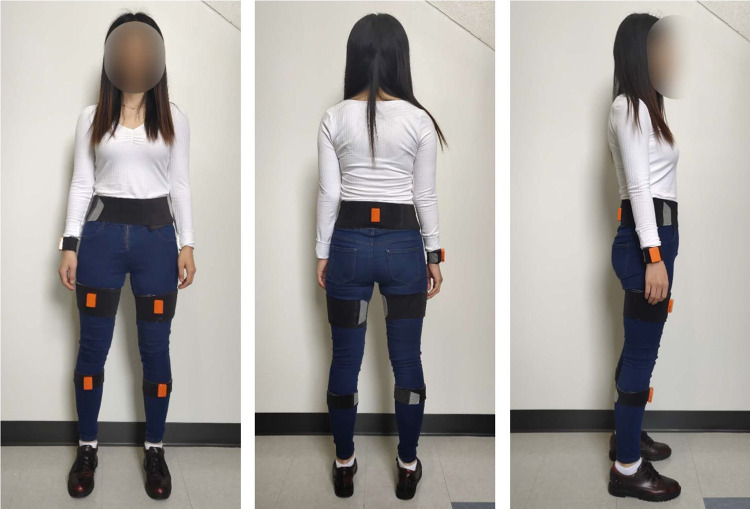
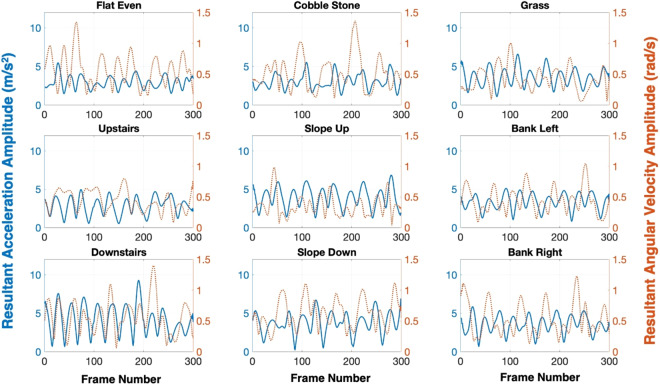
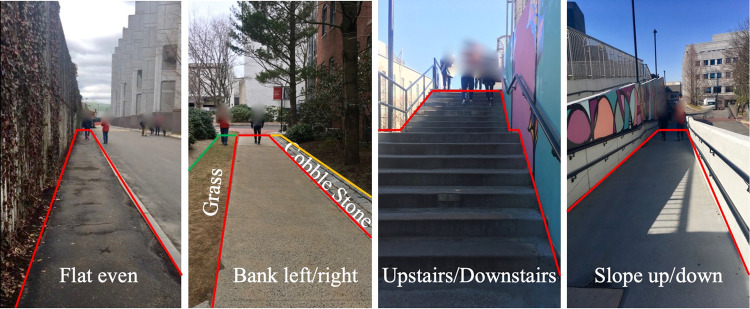
Gait analysis has traditionally relied on laborious and lab-based methods. Data from wearable sensors, such as Inertial Measurement Units (IMU), can be analyzed with machine learning to perform gait analysis in real-world environments. This database provides data from thirty participants (fifteen males and fifteen females, 23.5 ± 4.2 years, 169.3 ± 21.5 cm, 70.9 ± 13.9 kg) who wore six IMUs while walking on nine outdoor surfaces with self-selected speed (16.4 ± 4.2 seconds per trial). This is the first publicly available database focused on capturing gait patterns of typical real-world environments, such as grade (up-, down-, and cross-slopes), regularity (paved, uneven stone, grass), and stair negotiation (up and down). As such, the database contains data with only subtle differences between conditions, allowing for the development of robust analysis techniques capable of detecting small, but significant changes in gait mechanics. With analysis code provided, we anticipate that this database will provide a foundation for research that explores machine learning applications for mobile sensing and real-time recognition of subtle gait adaptations.
步态分析传统上依赖于繁琐的实验室方法。可使用机器学习分析来自可穿戴传感器(如惯性测量单元 (IMU))的数据,以在现实环境中执行步态分析。该数据库提供了三十名参与者的数据(十五名男性和十五名女性,23.5±4.2 岁,169.3±21.5cm,70.9±13.9kg),他们在户外九种表面上以自选速度(每次试验 16.4±4.2 秒)行走时佩戴了六个 IMU。这是第一个专注于捕获典型现实环境步态模式的公开可用数据库,例如坡度(上坡、下坡和横坡)、规律性(铺砌、不平石、草皮)和楼梯协商(上下)。因此,该数据库包含条件之间只有细微差异的数据,这使得能够开发出能够检测步态力学中微小但显著变化的稳健分析技术。提供了分析代码,我们预计该数据库将为探索移动感应和实时识别细微步态适应的机器学习应用的研究提供基础。