Department of Computer and Information Sciences, Northumbria University, Newcastle upon Tyne NE1 8ST, UK.
Department of Sport, Exercise and Rehabilitation, Northumbria University, Newcastle upon Tyne NE1 8ST, UK.
Sensors (Basel). 2021 Sep 28;21(19):6476. doi: 10.3390/s21196476.
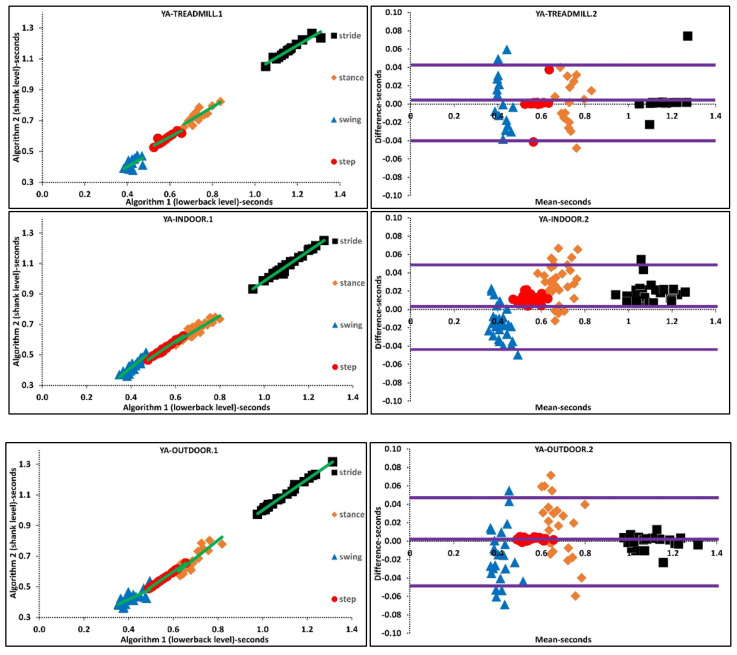
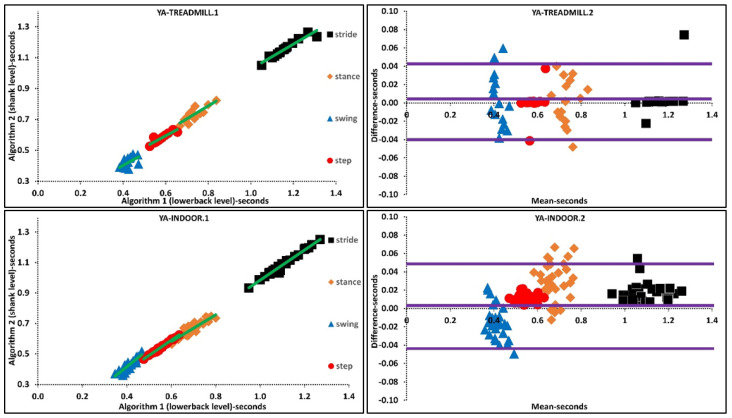
Wearable inertial measurement units (IMUs) are used in gait analysis due to their discrete wearable attachment and long data recording possibilities within indoor and outdoor environments. Previously, lower back and shin/shank-based IMU algorithms detecting initial and final contact events (ICs-FCs) were developed and validated on a limited number of healthy young adults (YA), reporting that both IMU wear locations are suitable to use during indoor and outdoor gait analysis. However, the impact of age (e.g., older adults, OA), pathology (e.g., Parkinson's Disease, PD) and/or environment (e.g., indoor vs. outdoor) on algorithm accuracy have not been fully investigated. Here, we examined IMU gait data from 128 participants (72-YA, 20-OA, and 36-PD) to thoroughly investigate the suitability of ICs-FCs detection algorithms (1 × lower back and 1 × shin/shank-based) for quantifying temporal gait characteristics depending on IMU wear location and walking environment. The level of agreement between algorithms was investigated for different cohorts and walking environments. Although mean temporal characteristics from both algorithms were significantly correlated for all groups and environments, subtle but characteristically nuanced differences were observed between cohorts and environments. The lowest absolute agreement level was observed in PD (ICC = 0.979, 0.806, 0.730, 0.980) whereas highest in YA (ICC = 0.987, 0.936, 0.909, 0.989) for mean stride, stance, swing, and step times, respectively. Absolute agreement during treadmill walking (ICC = 0.975, 0.914, 0.684, 0.945), indoor walking (ICC = 0.987, 0.936, 0.909, 0.989) and outdoor walking (ICC = 0.998, 0.940, 0.856, 0.998) was found for mean stride, stance, swing, and step times, respectively. Findings of this study suggest that agreements between algorithms are sensitive to the target cohort and environment. Therefore, researchers/clinicians should be cautious while interpreting temporal parameters that are extracted from inertial sensors-based algorithms especially for those with a neurological condition.
可穿戴式惯性测量单元 (IMU) 因其可离散佩戴以及可在室内和室外环境中长时间记录数据而在步态分析中得到应用。此前,已经开发并验证了基于下背部和小腿/胫骨的 IMU 算法来检测初始接触事件 (ICs) 和最终接触事件 (FCs),这些算法在少数健康的年轻成年人 (YA) 中进行了验证,结果表明这两种 IMU 佩戴位置都适用于室内和室外步态分析。然而,年龄(如老年人,OA)、病理(如帕金森病,PD)和/或环境(如室内与室外)对算法准确性的影响尚未得到充分研究。在这里,我们检查了来自 128 名参与者(72 名 YA、20 名 OA 和 36 名 PD)的 IMU 步态数据,以深入研究基于 IMU 佩戴位置和行走环境的 ICs-FCs 检测算法(1×下背部和 1×小腿/胫骨)在量化时间步态特征方面的适用性。我们还研究了不同队列和行走环境下算法之间的一致性水平。尽管所有组和环境下两种算法的平均时间特征都具有显著相关性,但在队列和环境之间仍观察到细微但特征明显的差异。PD 患者的绝对一致性水平最低(ICC=0.979、0.806、0.730、0.980),而 YA 患者的绝对一致性水平最高(ICC=0.987、0.936、0.909、0.989),分别用于平均步幅、站立、摆动和步长时间。在跑步机行走(ICC=0.975、0.914、0.684、0.945)、室内行走(ICC=0.987、0.936、0.909、0.989)和室外行走(ICC=0.998、0.940、0.856、0.998)时,平均步幅、站立、摆动和步长时间的绝对一致性也被发现。本研究的结果表明,算法之间的一致性对目标队列和环境敏感。因此,研究人员/临床医生在解释基于惯性传感器算法提取的时间参数时应格外小心,尤其是对于那些有神经状况的患者。